
ACOUSTIC SENSING / ENGINEERING AND PROCUREMENT
Acoustic Counter UAS Manufacturer Documentation: How to Read Technical Claims
When a buyer compares an acoustic counter UAS manufacturer, the most important document is not necessarily the one with the biggest range or accuracy number. A responsible technical claim states what was measured, under which conditions, with which version of hardware and software, and what the result does not establish. That distinction helps civil infrastructure teams compare suppliers without turning a laboratory observation into a deployment guarantee.
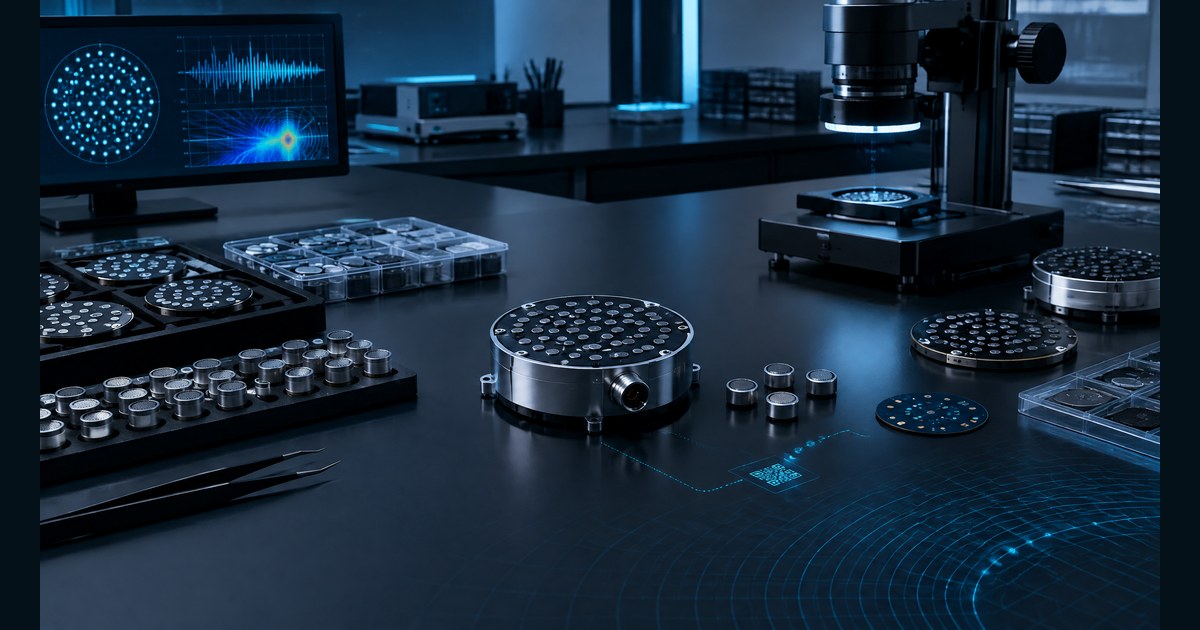
A procurement guide to separating a documented acoustic sensing result from a broad marketing promise, with questions about test conditions, uncertainty, revisions, and intended use.
Start by identifying what the claim actually measures
Acoustic documentation often moves quickly between detection, classification, direction finding, tracking, and identification. These are different outputs. A microphone array may provide an acoustic indication or a rough bearing without proving a unique aircraft identity, exact position, operator identity, flight permission, or any authority to respond. The UK Department for Transport describes acoustic DTI sensors as processing motor noise against stored sound signatures and cautions that directional information from multiple sensors may be rough.
Translate headline language into an observable output
Ask the manufacturer to define the output in operational terms. Is the system reporting that sound consistent with a candidate drone signature was observed? Is it assigning a class? Is it estimating a bearing? Is it producing a track after combining several observations? Each answer requires a different test method and acceptance threshold. A claim such as ‘drone detection’ should not silently be read as confirmed identification. The same discipline applies to terms such as AI classification, real-time alert, or 360-degree awareness.
Separate the sensor layer from the complete counter-UAS system
A passive acoustic receiver is one component in a wider workflow. Network transport, time synchronisation, analytics, display software, storage, operator review, and other sensors can change the final result. A manufacturer should state whether a number applies to the acoustic sensing element, an integrated demonstrator, or a complete site configuration. This prevents a component-level observation from being presented as an end-to-end system capability.
Require test conditions beside every performance number
A number without its test context is difficult to compare. The UK Department for Transport notes that acoustic range depends on microphone sensitivity, how noisy the drone is, and whether its sound can be separated from wind, engines, and other background sources. A responsible datasheet therefore treats environment and configuration as part of the claim, not as footnotes that can be omitted during a sales discussion.
Ask for the variables that can move the result
Request the target type or sound library condition, target motion, altitude or distance definition, weather, wind, temperature, terrain, background-noise level, microphone configuration, mounting arrangement, and software version. Also ask whether the result was obtained in a controlled test, a representative site, or a small illustrative demonstration. These details do not make a claim weak. They make it interpretable and allow the buyer to decide whether it is relevant to the proposed site.
Look for false-alarm and missed-detection reporting
A detection percentage by itself can hide the cost of nuisance alerts or missed events. Ask how non-drone sounds were sampled, how many trials were included, how a positive event was labelled, and whether the test set was separated from the data used to tune the classifier. For a civil facility, the useful question is not simply whether a signal can be heard. It is whether the documented output remains useful in the facility’s actual acoustic environment.
Treat uncertainty and traceability as part of the claim
Measurement language should explain how much confidence a result deserves. NIST Technical Note 1297 provides guidance on evaluating and expressing measurement uncertainty. NIST’s metrological traceability guidance likewise says that a traceability claim should describe the measurement process, calibration chain, result, and associated uncertainty. It also warns that traceability alone does not prove that a result is fit for a particular purpose.
Ask what is measured and what is inferred
For acoustic systems, the measured input may be a sound pressure signal or time difference between channels. A bearing, class label, confidence score, or alert priority may then be inferred by software. The documentation should distinguish these layers. Ask which quantities have calibration or verification evidence, which outputs are model estimates, and how uncertainty or confidence is calculated. A confidence score is not automatically a probability of correct identification.
Do not confuse calibration evidence with site suitability
A calibrated microphone or traceable test instrument can strengthen the evidence for a measurement. It does not prove that an acoustic network will meet a site’s coverage, continuity, or nuisance-alert needs. The buyer still has to compare the uncertainty and test conditions with the intended use. This is why a written site validation plan is more useful than a generic statement that the sensor is calibrated.
Examine documentation control, not just the specification sheet
Technical responsibility continues after a PDF is issued. ISO guidance on documented information under ISO 9001 describes controlled information as part of a quality-management system and allows organisations flexibility in how it is maintained. For a buyer, the practical issue is whether the supplier can show which revision was tested and whether later changes are visible to the project team.
Request a revision trail for hardware, firmware, and models
A useful evidence pack should identify the product or board revision, firmware, model or library release, test date, test procedure, and document revision. Ask what happens when a microphone, enclosure, algorithm, or sound library changes. A result from one software release should not automatically be transferred to another without explaining the change assessment.
Check whether limitations travel with the claim
A responsible manufacturer should preserve the conditions and exclusions when a specification is copied into a proposal, partner document, or translated datasheet. Look for explicit statements about background noise, target variability, weather, installation, and the distinction between observation and identification. If a limitation disappears between the test report and the sales summary, the buyer should ask for the controlled source document before relying on the number.
Build a procurement record that can be reviewed later
The goal is not to reject every performance statement. It is to create a traceable path from a supplier claim to a project decision. NIST’s AI Risk Management Framework offers a useful general reminder that trustworthiness should be considered in the design, development, use, and evaluation of AI products and systems. For acoustic sensing, that means preserving evidence and defining how a human reviewer will interpret an alert.
Use a focused evidence request
Ask for the current datasheet, test report or test summary, test configuration, environmental conditions, target and non-target data description, false-alarm and missed-event definitions, calibration or verification records where relevant, software and library versions, known limitations, and change-notification process. If a document is confidential, the buyer can request a redacted version or an evidence review under suitable commercial controls rather than accepting an unsupported number.
Convert evidence into a written acceptance question
For each important claim, write a plain question: what output will be demonstrated, in what site condition, using which configuration, against which pass or review criterion, and how will exceptions be recorded? This keeps a pilot from becoming an informal promise. It also gives SonicVast or another supplier a clear basis for confirming what can be supported for the specific project, rather than implying universal accuracy, coverage, availability, certification, or deployment.
Ask for the evidence pack before comparing headline range
For a civil low-altitude awareness project, request the controlled technical documents first. Then map each claim to the intended acoustic environment and to a written validation or acceptance activity. Product, PCBA, SDK, interface, lifecycle, and support details should be confirmed in writing for the actual project rather than assumed from a general manufacturer description.
Discuss your projectAcoustic sensing provides sound-based observations and may support classification or directional context. It does not detect literally silent targets or by itself establish unique identity, permission, exact position, or response authority. Environmental conditions, site evidence, and the documented system configuration remain material. No performance, certification, availability, price, partnership, or deployment claim is made here for SonicVast or any other supplier.