
ACOUSTIC SENSING / ENGINEERING AND PROCUREMENT
Acoustic Drone Detection Equipment: What Environmental Specifications Require Site Confirmation?
The right acoustic drone detection equipment specification cannot be completed from a product sheet alone. An outdoor microphone array may be exposed to rain, wind, heat, condensation, dust, vibration and a changing industrial soundscape, while its processing unit may sit in a protected cabinet with different conditions. Before comparing suppliers, record the actual site envelope and ask which values are guaranteed, which are tested, and which remain subject to project validation.
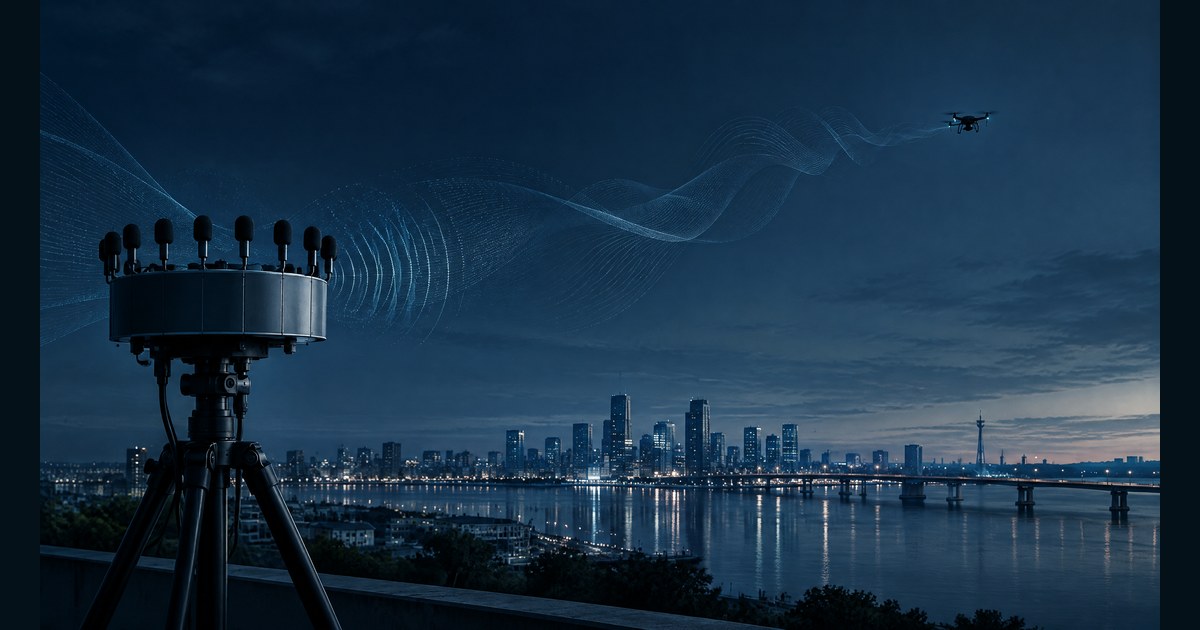
A site-confirmation guide for climate, weather, soundscape, enclosure, mounting, power and network conditions that shape an acoustic drone detection equipment specification.
Confirm the climate envelope, not only the nominal operating temperature
Begin with the conditions the equipment will experience continuously and during extremes. A single temperature number can hide daily cycling, solar heating, humidity, condensation and the difference between a microphone head, an electronics enclosure and a network cabinet.
Record temperature, humidity and condensation exposure
Document the measured or design minimum and maximum air temperature, relative humidity range, expected condensation, and whether the equipment will move between air-conditioned and outdoor spaces. Ask the supplier to separate operating, storage and transport limits. IEC 60068 is a family of environmental test methods that includes cold, dry heat, temperature change, damp heat and combined climatic and dynamic tests, but a listed test method is not by itself proof that a particular configuration meets your site envelope. Request the tested assembly, test severity and pass criteria in writing.
Check solar load, altitude, salt and corrosive agents
A coastal, rooftop, desert or chemical-process site can impose stresses that a mild indoor temperature range does not describe. Confirm direct solar exposure, shade, elevation, salt mist, dust or sand, and nearby corrosive gases. Also identify whether the microphone windscreen, cable glands, brackets and fasteners use materials suitable for the location. These are site and configuration questions, not automatic consequences of choosing an acoustic sensor.
Translate weather into an acoustic and maintenance specification
Weather affects both survival and the sound signal. Outdoor measurement guidance commonly treats wind and rain as conditions that can introduce unwanted microphone noise or reduce the comparability of measurements. For a detection system, the procurement question is therefore not simply whether the unit still powers on, but how the approved configuration behaves and is maintained in the site’s weather.
Specify wind, rain, dew and snow conditions
Record prevailing wind, gust exposure, rain intensity, blowing rain, dew, frost and snow where relevant. Ask what windscreen or rain protection is included, whether it changes frequency response, and what evidence supports performance in the intended configuration. Queensland Government noise guidance recommends calm-to-gentle breeze and no rain for certain measurement work, while Larson Davis notes that outdoor microphones can face rain, dew, wind and heat and that protection choice depends on weather, site access and monitoring duration. Those references do not create a universal drone-detection limit; they show why the project should define weather hold points, data-quality flags and inspection intervals.
Plan inspection access and consumable replacement
A rain screen, windscreen, drain path or protective cover can become part of the sensing chain. Confirm how staff will inspect, clean and replace it without disturbing array geometry or cabling. Include safe access, bird or insect contamination, blocked vents, water pooling and post-storm checks in the maintenance register. A technically suitable sensor can still be a poor site choice if its protection cannot be inspected at the required frequency.
Characterise the local soundscape before setting acoustic expectations
Acoustic suitability depends on what else is audible at the proposed location. The site survey should capture representative operating periods rather than rely on a quiet-day impression. The objective is to understand observability and review confidence, not to promise a universal range or identification result.
Map persistent, intermittent and tonal sources
Log fans, transformers, compressors, pumps, traffic, rail, aircraft, construction, alarms, vegetation and human activity. Note when each source operates and whether it changes with load or weather. ISO 1996-2 describes direct measurement and calculation approaches for environmental sound and highlights the need to evaluate uncertainty. For procurement, use that principle to request a site sound log, representative recordings where permitted, frequency information and a clear method for separating background conditions from candidate observations.
Check reflections, blockage and mechanical vibration
Buildings, tanks, walls and canopies can reflect or shield sound. Roof plant, poles and loose brackets can add structure-borne vibration or wind-induced noise. Record the proposed mounting surface, nearby reflective objects, line-of-sight obstructions and vibration sources. Do not treat a microphone-array layout or a stated bearing output as transferable until the supplier and integrator have reviewed the actual mounting and acoustic context.
Confirm enclosure, mounting and utility conditions as one system
Environmental specifications often fail at the interfaces. The microphone head, preamplifier, cable route, junction box, compute unit and power supply may have different protections and limits. The bid package should describe the complete installed chain, not just the headline sensor enclosure.
Ask what an IP code does and does not establish
The IEC explains that the first digit of an IP code concerns protection against solid objects and the second concerns liquids, with ratings defined by IEC 60529 test conditions. An IP code is therefore useful evidence about enclosure ingress protection, but it does not by itself establish acoustic performance, corrosion resistance, UV life, mounting strength, hazardous-area approval or the protection of every connector and cable entry. Request the rating for each exposed assembly and confirm that the tested configuration matches the supplied one.
Verify structure, grounding, power and communications
Record pole or wall loading, bracket material, allowable vibration, earthing and lightning-protection responsibilities. Confirm supply voltage, protection, backup duration if required, cable length, connector type, network path, bandwidth, time synchronisation and operation during link loss. Keep these as written interface requirements. Passive acoustic reception does not mean the entire system is energy-free, and it does not establish explosion-proof approval; high-hazard sites need a separate safety and compliance review.
Turn the site survey into acceptance evidence
A useful environmental specification links each site observation to a supplier response and a verification method. This keeps the procurement conversation grounded without pretending that a datasheet can predict every field condition.
Build a confirmation register
For each parameter, record the site value or range, source of the evidence, required margin, responsible party and confirmation date. Include temperature and humidity, condensation, wind and precipitation, dust or salt, soundscape periods, mounting and vibration, enclosure and cable protection, power quality, network availability, inspection access and any restricted work windows. Mark each item as measured, designed, supplier-declared, independently tested or still open.
Define a bounded field validation
A field validation should use agreed locations, weather notes, operating sound conditions, approved test aircraft or other lawful test source, data-quality rules and an evidence format. Evaluate whether the system produces the intended review outputs under the documented conditions. Do not convert a short demonstration into a guaranteed detection range, aircraft identity, flight-authorisation decision or automatic response authority. If the site envelope changes, revalidation may be necessary.
Ask for a completed environmental confirmation matrix
Before requesting a final quotation, provide representative climate, weather, soundscape, mounting, utility and maintenance information. Ask the supplier and integrator to return a marked-up matrix showing declared limits, test evidence, exclusions, interface responsibilities and proposed field checks. SonicVast project discussions can then be scoped around the documented site rather than an assumed generic environment.
Discuss your projectEnvironmental limits, enclosure ratings, interfaces, certifications and field performance depend on the exact supplied configuration and project conditions. Confirm them in current technical documentation and written project records. Acoustic sensing cannot detect a literally silent target or, by itself, establish unique aircraft identity, flight permission or response authority.