
TECHNOLOGY INSIGHT / PASSIVE ACOUSTIC SENSING
Acoustic Drone Detection System: A Practical Guide for C-UAS Integrators
A practical acoustic integration starts with the site, the sound environment, and the intended safety workflow. Microphone arrays capture sound patterns associated with aircraft activity; software can analyze time-frequency features and raise an alert for human review. Wind, rain, traffic, construction, vegetation, reflections, and other aircraft can affect interpretation, so results should be assessed alongside lawful operational information and other available sensors.
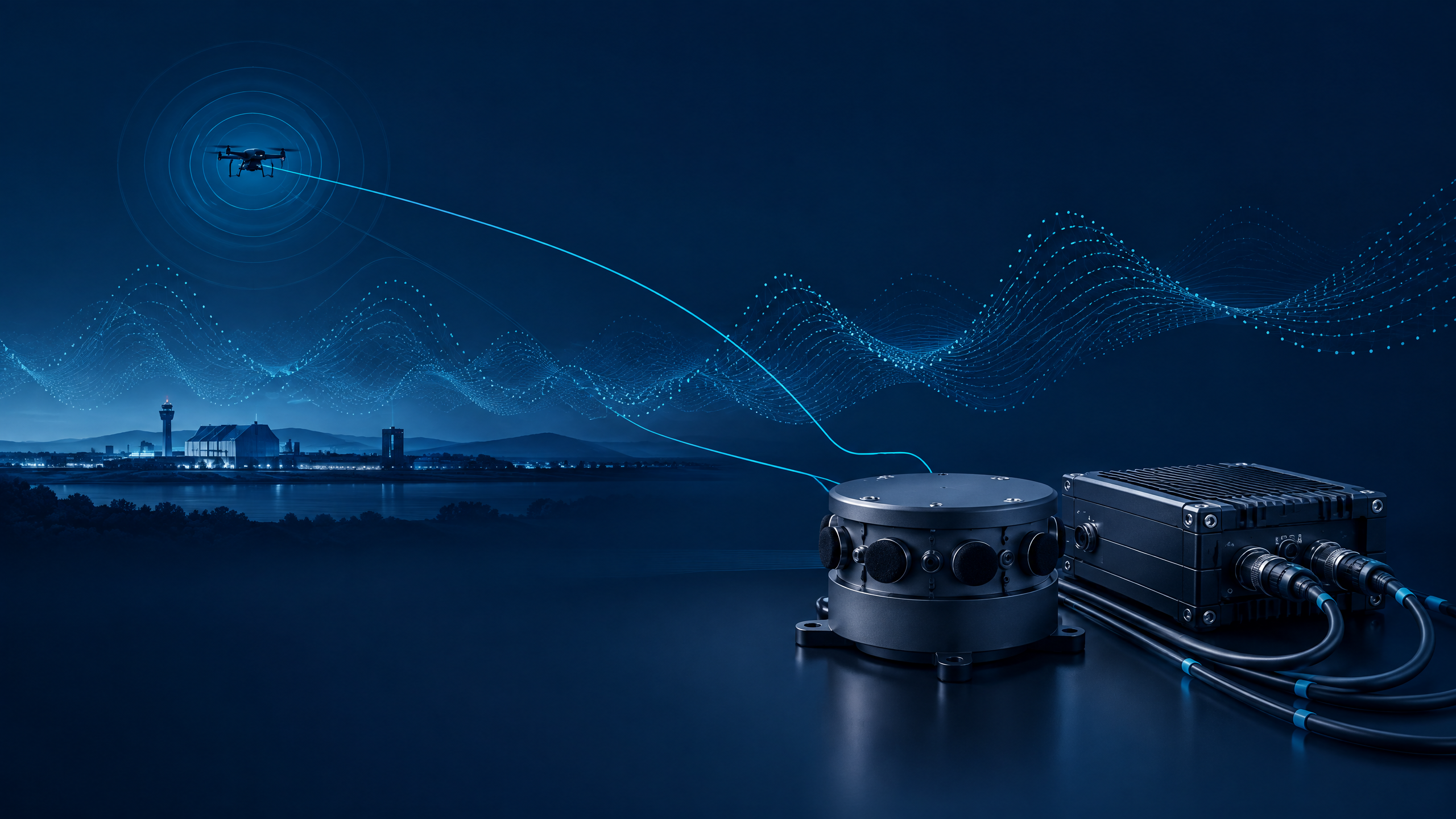
Acoustic sensing can add a passive listening layer to a civil low-altitude safety program. Integrators should treat it as contextual detection input, not a stand-alone decision or response mechanism.
TECHNICAL PRINCIPLE / DEFINE → CONNECT → GOVERN
Acoustic sensing technical principle
Integration begins with the workflow boundary.
The infographic frames acoustic sensing as a contextual input to an existing civil low-altitude safety programme.
Set the permitted role
Document what an acoustic alert means and where it enters the existing event-review process.
Associate event context
Link time, sensor health and approved site records without presenting sound as a final conclusion.
Keep decisions accountable
Human review, access controls and retention rules keep the workflow traceable.
Civil safety infographic / For understanding and review; not operating guidance.
Define the civil safety use case
Begin with a documented purpose such as early awareness around a facility, event, or managed airspace. Describe what an alert means, who reviews it, and what lawful safety action follows. Site conditions and existing security procedures should shape capability requirements; CISA recommends considering the facility, airspace, organizational resources, and integration with a layered security plan. Acoustic detection does not establish intent, authorization, identity, or a regulatory violation by itself.
Understand the sensing chain
A microphone array samples ambient sound and compares changing acoustic patterns with an analysis model. Array geometry and signal processing may support a directional estimate, while classification can indicate that a pattern is consistent with an aircraft sound. Interpretation depends on local acoustics and the quality and relevance of evaluation data. Document environmental assumptions, alert confidence, nuisance sources, maintenance checks, and how uncertainty is shown to operators. Do not present a model label as proof of a specific aircraft or pilot.
Connect alerts to governance
Route alerts into an auditable workflow with time, location context, sensor status, analyst disposition, and retention rules. Use privacy-by-design practices: collect only what the safety purpose requires, restrict access, set retention limits, and review local rules for recording or processing ambient audio. Where applicable, Remote ID or other authorized aviation information can provide context, but acoustic sensing and Remote ID serve different functions. Test the complete workflow under representative conditions, record false-alert causes, and update procedures without introducing interception or countermeasure functions.
A civil technology explainer
Acoustic sensing can add a passive listening layer to a civil low-altitude safety program. Integrators should treat it as contextual detection input, not a stand-alone decision or response mechanism.
Request an Acoustic Integration BriefingThis guide is general educational material for civil, detection-only safety planning. It does not provide legal advice, countermeasure instructions, targeting guidance, deployment specifications, or a guarantee of detection, identification, coverage, or regulatory compliance. Confirm requirements with relevant aviation, privacy, safety, and site authorities. Source names are displayed for editorial transparency; no external links are shown.