
ACOUSTIC SENSING / ENGINEERING AND PROCUREMENT
Acoustic Drone Detection System Integrator: How to Manage Configuration Changes Across a Sensor Integration Project
An acoustic drone detection system integrator is often asked to change one part of a project after design work has already started: a customer revises an interface, a site changes its network boundary, a sensor enclosure must be adapted, or an analytic output needs a different handoff. The difficult question is not whether the change is technically possible. It is whether everyone can identify the approved version, understand the consequences, and prove what was tested. A controlled configuration process keeps a sensor integration project from becoming a collection of undocumented exceptions.
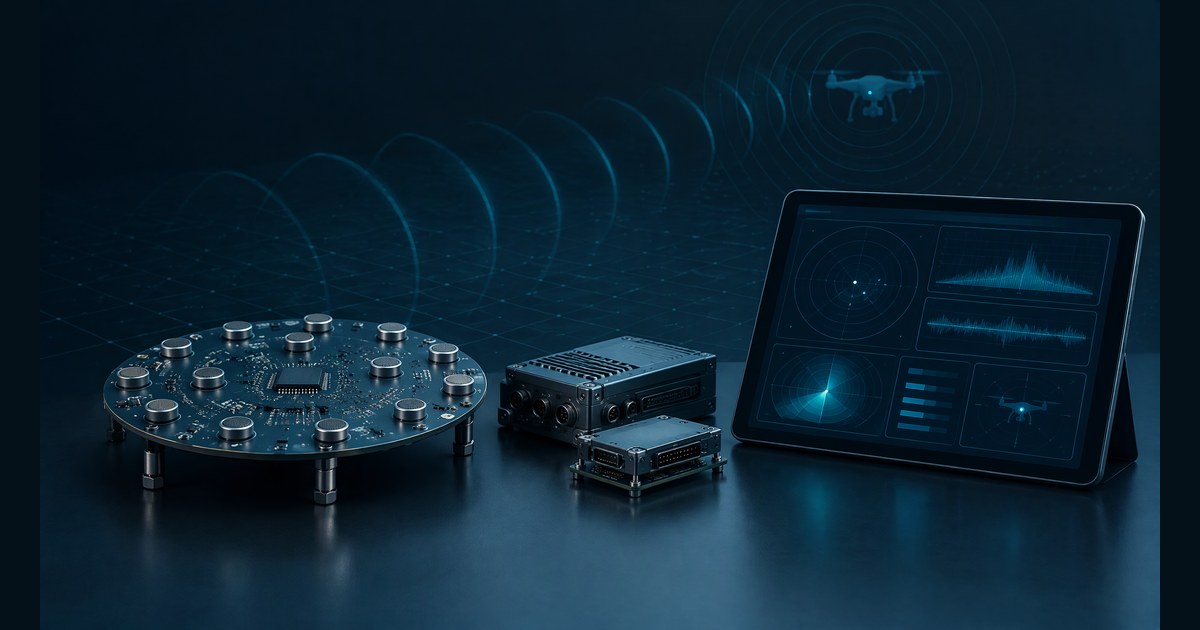
A practical change-control framework for keeping acoustic sensors, interfaces, software, documentation and acceptance evidence aligned as a civil low-altitude awareness project evolves.
Start by defining what is under configuration control
Configuration management is broader than storing the latest drawing. NASA describes it as a lifecycle discipline for controlling changes to a product’s performance, functional and physical characteristics, while NIST describes activities that initialize, change and monitor configurations. For a civil acoustic sensing project, the controlled set should be agreed before the first field integration rather than inferred after a discrepancy appears.
Build a configuration-item register
Create a register with a unique identifier and owner for each item that can affect the delivered system. Typical entries may include the acoustic sensor or processing board, mounting and enclosure definition, power and network interface, firmware and software build, analytic or classification configuration, API or message schema, site drawings, installation instructions, test procedures, and training or handover records. The exact list depends on the statement of work. The important point is that a customer-approved interface document and a supplier-controlled software package should not be treated as informal files with equal status to a released baseline.
Separate requirement, design choice and assumption
A requirement states what the project must achieve or support. A design choice states how the team proposes to achieve it. An assumption records something that must remain true for the design to work, such as an available network service or a defined mounting condition. Put each in a different field or document type. This prevents a convenient design preference from quietly becoming a customer obligation, and it gives the change board a clearer question when an assumption later proves wrong.
Establish a baseline that the whole team can name
A baseline is an agreed description of a configuration at a point in time. NASA’s systems-engineering guidance links a baseline to a known configuration against which proposed changes can be evaluated. In practice, a useful baseline is not merely a date in a file name. It is a release identifier that connects requirements, interfaces, hardware and software versions, drawings, procedures and evidence.
Use a release manifest, not a folder called final
For each controlled release, create a manifest that records the item identifier, revision, status, approving authority, effective date and dependencies. For example, an integration release might identify the sensor hardware revision, firmware build, host software version, configuration profile, message schema and test-procedure revision. If a field team reports an observation or a test result, the project should be able to state which manifest was active. Avoid labels such as final2 or latest because they hide whether a file was reviewed, superseded or merely uploaded.
Make interface ownership explicit
An interface is a shared boundary, so one party cannot change it safely in isolation. Record who owns the sensor-side definition, who owns the receiving platform, who approves a message or timing change, and who verifies the connection after release. NASA notes that changes affecting an external interface need coordination and approval by affected stakeholders. That principle applies even when the change appears small, such as a field name, timestamp convention, connector pinout, power tolerance or diagnostic code.
Assess every proposed change before implementation
A change request should explain the requested outcome, the reason, the affected configuration items and the evidence needed to close it. Do not accept a technical suggestion in a chat message as an approved change. The request can be lightweight for a minor documentation correction, but the decision record must still show what was considered and who authorized it.
Use an impact checklist suited to acoustic integration
Ask the responsible reviewers to examine requirements, acoustic data handling, time synchronization, interfaces, power and environmental assumptions, cybersecurity and access boundaries, privacy governance where microphones are involved, installation work, operator workflow, maintenance, safety and acceptance testing. The review should also ask whether a change alters the meaning of an output. Bearing, position, track, classification and model confidence are different outputs and should not be treated as interchangeable simply because a software field has been renamed.
Classify the change by consequence, not by effort
A one-line schema change can have a larger integration effect than a lengthy drawing correction. Classify proposed changes according to their impact on performance, interfaces, safety, compatibility, cost, schedule, training and delivered items. NASA distinguishes major changes that may affect such matters from minor changes that do not affect interchangeability or the system structure. A project may define its own thresholds, but it should publish them and apply them consistently.
Trace the change in both directions
NASA defines traceability as a discernible association among requirements, system elements, verifications or tasks, and recommends bidirectional traceability. For a change request, link the request to the originating requirement or stakeholder need, the affected design and interface items, the revised test or inspection, and the final disposition. The reverse check matters too: if a test, defect or field constraint exposes a gap, the team should be able to find which requirement and configuration it touches.
Approve, implement and verify in a controlled sequence
A practical change workflow has four distinct decisions: assess the proposal, authorize or reject it, implement the approved revision, and verify that the implementation matches the decision. Combining all four into an informal email thread makes it difficult to tell whether a test was performed on an approved build or on an experimental one.
Give the change authority a defined mandate
The customer, system integrator, sensor supplier and platform owner should agree who can approve which classes of change. A small project may use a named change authority rather than a large board, but the authority still needs the right technical and operational representatives. Changes to an external interface should not be approved solely by the party proposing them. Record the decision, rationale, conditions and required follow-up documents.
Update the baseline and test assets together
An approved change is incomplete until affected specifications, drawings, software packages, configuration files, procedures and training material are updated or explicitly marked unaffected. The verification method should be selected during impact assessment. It may be a document inspection, interface test, regression test, site check or a combination. Do not imply that a generic factory test proves a site-specific integration change; the evidence must match the changed requirement and operating context.
Close with configuration verification
Before a release is accepted, compare the delivered items with the approved manifest and confirm that required tests and discrepancies have a recorded disposition. NASA describes configuration verification as inspecting documents, products and records and checking that the design is documented. For the buyer, this creates a useful handover question: can the integrator show the exact as-delivered configuration and the evidence that supports each changed element?
Make change control part of procurement and handover
Configuration control is most valuable when it is written into the project’s delivery model, not added only after a failed integration. ISO 10007 provides guidance on configuration management from product concept through disposal. A buyer does not need to prescribe one software tool, but should require a usable record that remains available to the authorized project team.
Put the minimum records in the statement of work
Ask for a configuration-management approach, controlled-item list, baseline and release rules, change-request form, approval roles, interface register, requirements-to-test trace, discrepancy log and as-delivered manifest. Also define what happens when a supplier component is revised: notice period, compatibility assessment, customer approval, regression evidence and replacement-document delivery. These are procurement requirements for visibility, not assumptions about a particular vendor’s internal process.
Ask for an operable handover, not only a data dump
At handover, the receiving team should be able to identify the active configuration, restore or reproduce the approved setup where contractually required, interpret the interfaces, run the agreed checks and report a discrepancy. Request a short change history that explains why significant revisions were made. If a supplier retains all release knowledge in an inaccessible tool or undocumented workflow, the project may technically receive files while still inheriting a black box.
Keep future changes governed after acceptance
Acceptance is a baseline transition, not the end of configuration management. Establish who can request a post-acceptance change, how urgent fixes are distinguished from permanent releases, and how field observations feed back into requirements and tests. Any future capability, interface or analytic change should be evaluated against the accepted configuration rather than treated as an unrelated upgrade.
Ask the integrator to walk one change from request to evidence
For a proposal or design review, select one realistic change, such as a network endpoint or message-schema revision, and ask the acoustic drone detection system integrator to show its request, impact assessment, approval, updated manifest and verification record. The exercise reveals whether the project has a functioning control loop or only a collection of versioned files.
Discuss your projectAcoustic sensing listens for observable sound and is affected by site conditions, background noise and the evidence available at the time. Configuration control improves project traceability; it does not guarantee detection, classification, coverage, identity or an automatic response. Interface contents, SDK/API support, release terms, warranty and handover obligations require written project confirmation.