
TECHNICAL BLOG / ACOUSTIC MANUFACTURER SERIES
Working With an Acoustic Drone Detection System Manufacturer: OEM, PCBA and SDK Integration
Working with an Acoustic Drone Detection System Manufacturer means agreeing what the supplier delivers and what your product team must own. For original equipment manufacturer (OEM) programmes, that agreement should cover hardware, software, event interpretation and support before a prototype becomes an operational civil-awareness product.
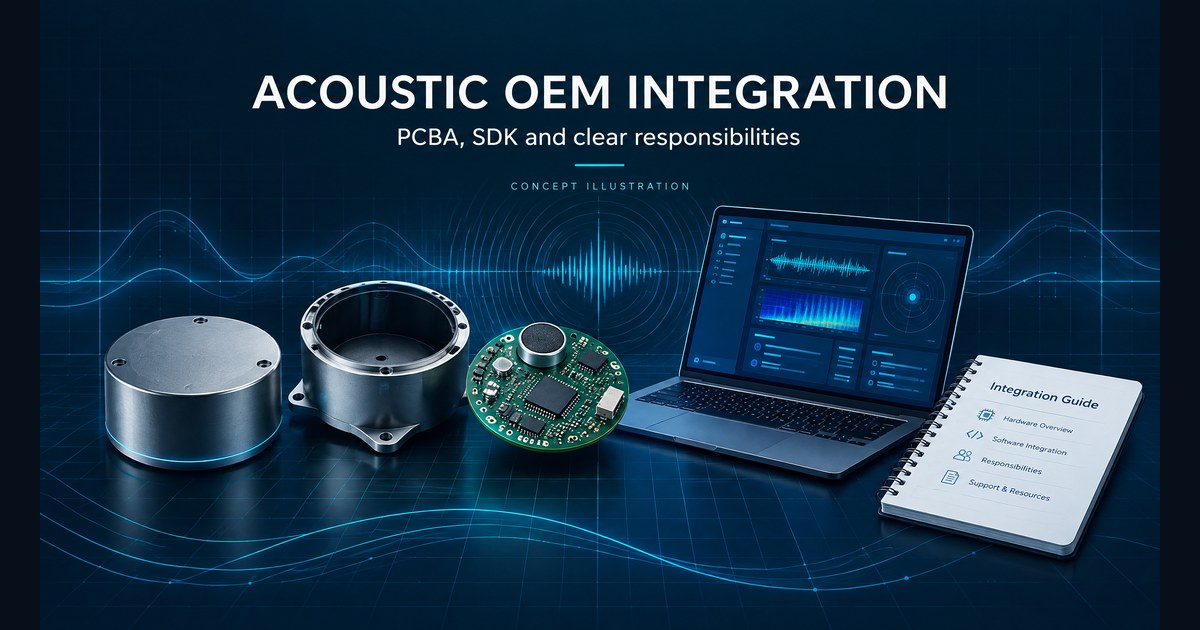
A civil-integration guide to delivery contracts, module ownership, SDK evidence and maintenance, with clear boundaries between acoustic suppliers and final-product assemblers.
Define the delivery package before assigning responsibilities
SonicVast supports complete-system discussions and qualified printed circuit board assembly (PCBA) and software development kit (SDK) discussions. These are integration paths, not interchangeable promises. The contract should identify deliverables, exclusions, documentation access and the party authorised to approve changes.
Separate system delivery from embedded-module delivery
A complete-system agreement should name the included sensing, processing and application elements. An embedded agreement should distinguish the supplied board or software from the partner's enclosure, host platform and application. Neither label alone establishes installation ownership, compliance responsibility or acceptance criteria. Record these separately.
Make technical disclosure a defined milestone
SonicVast's public page reserves detailed engineering materials for appropriate technical, safety and compliance review. Agree when qualified teams receive the necessary integration information, who may access it and how revisions are controlled. Do not design around an assumed SDK language, connector or public protocol.
Keep acoustic-module responsibility distinct from product responsibility
Assign ownership of acquisition, processing, host resources and system supervision. Passive acoustic observation does not require an observable drone radio-control signal or active RF emission from the acoustic sensing layer. That independence does not guarantee detection: audible signatures and environmental interference still matter.
Define the module's operating assumptions
Request qualified documentation for the supplied module's power, timing, compute and environmental assumptions. Agree who validates microphone integration and processing configuration. Define how invalid inputs or degraded sensing become visible to the host, so missing events are not mistaken for evidence that no aircraft is present.
Assign enclosure and host-system verification
The final-product team should identify who verifies packaging effects, power quality, thermal behaviour and host availability. Changes to openings, mounting or nearby equipment can affect the sound reaching sensors. A board-level test therefore cannot substitute for verification of the assembled product under agreed operating conditions.
Specify what an SDK event means across software versions
An SDK contract needs more than a successful connection. Define event meanings, units, timestamp semantics and failure behaviour. CloudEvents provides a useful reference for event identity and schema evolution; it is not evidence that SonicVast implements that specification or any particular transport.
Separate release versions from evidence versions
CloudEvents requires an event ID, source, type and specification version; incompatible data-schema changes should use a different schema URI. For your integration, agree how records identify the SDK release, event schema, firmware and relevant model or configuration revision. One version number cannot describe every change affecting interpretation.
Test duplicates, missing values and compatibility
Agree how the host handles repeated events, delayed delivery, unknown fields and missing optional information. Define direction coordinates or confidence semantics only where those outputs are actually supplied. Test consumer compatibility before upgrading, and document whether a change affects formatting, interpretation or both.
Preserve evidence without converting an acoustic cue into identification
An acoustic event can support a civil review workflow, including association with approved optical, radar or RF context. It should remain distinguishable from confirmed identification and from an operator's decision. Evidence handling belongs in the integration agreement, not in an undocumented application shortcut.
Record provenance and uncertainty
Define which supplied event attributes are retained, alongside source identity, occurrence and receipt times, configuration revisions and health context. Record later review conclusions separately. If another sensor contributes evidence, preserve its origin rather than presenting a combined alert as though every modality independently confirmed the same aircraft.
Agree access, retention and acceptance evidence
Set permissions, retention periods and approved export procedures. Raw audio availability is not established by SonicVast's public page; discuss access only within the qualified review. Acceptance should include agreed event examples, degraded-input cases and host-side handling tests, with documented limitations rather than universal detection claims.
Allocate maintenance and assembly obligations before release
NIST's published Secure Software Development Framework offers a common vocabulary for software purchasers and suppliers. Use lifecycle discussions to turn general support expectations into named responsibilities, including vulnerability reporting, compatibility assessment and controlled updates. These are contract topics, not claims of SonicVast certification.
Agree update, rollback and end-of-support terms
Document supported combinations of board revision, firmware, SDK and host software. Agree notification periods, regression evidence and responsibility for restoring a supported configuration. Separate defect correction from feature development, and define how the product team handles dependencies when a supplied component reaches end of support.
Do not infer manufacturing rights from module supply
Supplying a PCBA does not automatically license board reproduction, third-party assembly or local production. If partner assembly is proposed, agree authorised materials, substitutions, traceability, testing and warranty boundaries. The final product's compliance responsibilities also need explicit allocation; component delivery alone does not establish finished-system approval.
Start a qualified integration discussion with an ownership brief
Describe the civil application, host product, proposed delivery package and engineering owners. Include validation objectives and evidence requirements so the discussion can address the right technical and support boundaries.
Discuss an acoustic projectMANUFACTURER GUIDE / QUESTIONS AND ANSWERS
Frequently asked questions
Can an OEM keep its own enclosure and product identity?
SonicVast describes qualified integration discussions for partners with their own packaging and product programmes. Scope, branding rights and engineering responsibilities still need agreement.
Does SDK access include source code or raw audio?
Do not assume either. SonicVast's public page does not establish those entitlements. Confirm permitted materials, data access and licensing during qualified review.
Why retain the SDK version with event evidence?
Software and configuration changes can affect interpretation. Version provenance helps teams reproduce test conditions and understand records created before an update.
Who owns verification after the enclosure changes?
The contract should name the responsible team and any supplier support. Reassess changes that affect acoustic inputs, power, temperature or host-system behaviour.
Does radio-independent sensing detect every radio-silent drone?
No. Passive acoustic sensing can provide a cue without an observable control link, but sound, noise and processing conditions constrain observations.
This guide covers civil integration only. It specifies no public interface, certification, production location or universal detection outcome. Detailed commitments require qualified review and written agreement.