
ACOUSTIC SENSING / ENGINEERING AND PROCUREMENT
Acoustic Drone Localization System: Coordinate Accuracy Is Not Track Association Quality
An acoustic drone localization system can report a plausible coordinate while still assigning that observation to the wrong track. The reverse can also happen: a system may preserve track continuity but carry a biased or unstable position estimate. Civil operators should therefore score coordinate accuracy and track association quality as two related but separate questions, rather than treating one headline tracking result as proof of both.
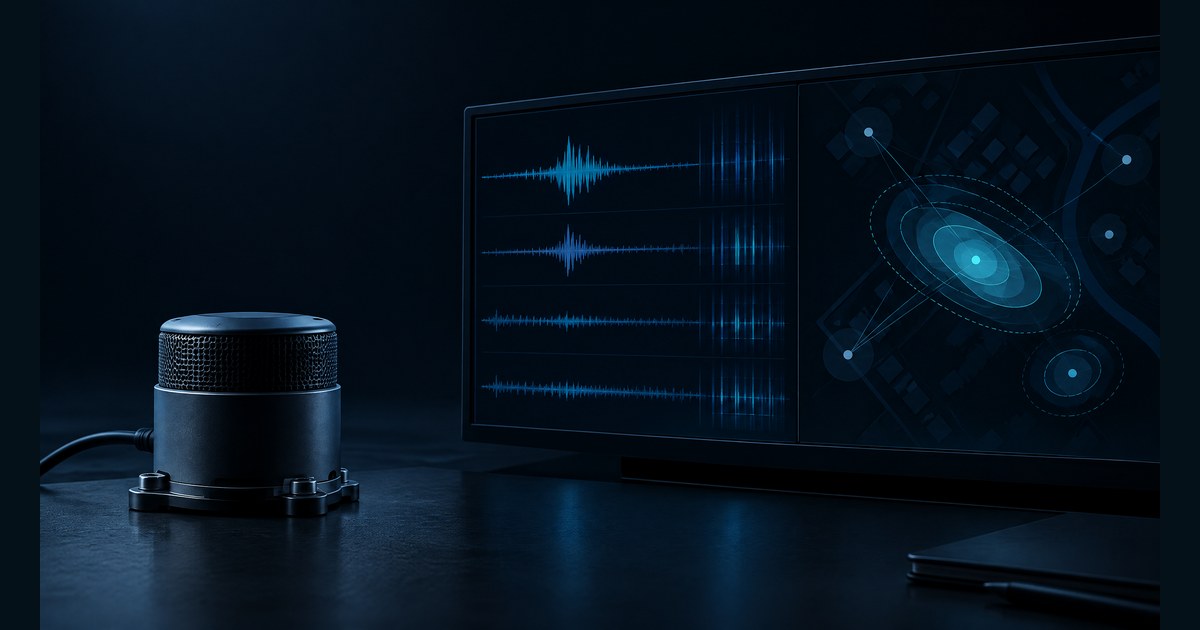
A procurement guide for testing whether an acoustic system places a sound source correctly and whether it keeps that source attached to the correct track over time.
What the two quality questions actually measure
Localization asks where the system places an observation. Association asks which continuing track the observation belongs to. The distinction matters whenever more than one aircraft, sound source, or candidate observation is present, and it also matters when a single track temporarily becomes weak or ambiguous.
Coordinate accuracy is a spatial comparison
A coordinate result can be compared with an independently established reference position at a defined time. Buyers can then examine horizontal or three-dimensional error, bias, spread, missing updates, and the conditions under which the estimate was produced. A bearing, a projected point, and a full position are not interchangeable outputs, so the test record should state exactly which output is being scored. Microphone-array methods commonly derive directional or positional information from differences in arrival time between microphones; Valin and colleagues’ work illustrates why signal quality and changing acoustic conditions are part of the engineering problem.
Track association is a continuity and identity comparison
Association asks whether successive observations remain attached to the same real-world source. Typical failure modes include an identity switch, a track split into two labels, two sources being merged, or a new observation being attached to an old track after a gap. The track may look smooth on a screen while its identity is wrong. The HOTA research paper treats detection, localization, and association as distinct components of multi-object tracking, which is a useful discipline for civil acceptance testing.
Why a good coordinate can still belong to the wrong track
Two sources can pass near one another, produce overlapping sound, or alternate in audibility. In those moments, each individual coordinate may be close to a reference while the system labels the observations incorrectly. A single-target test can conceal this problem because there is no competing identity to confuse.
The screen picture is not the evidence record
A civil review should retain timestamped observations, track identifiers, confidence or quality fields when available, and the reference labels used for comparison. Reviewers should be able to see when a track was created, continued, dropped, reacquired, or reassigned. This is more informative than judging a line on a live map after the event. NIST’s tracking-metrics work emphasizes known ground truth and common evaluation procedures for comparing detection and tracking systems.
Association errors can hide inside a low-error average
An average coordinate error can remain small even when a short identity switch occurs. Conversely, one track can remain correctly associated while its position has a consistent offset. Acceptance results should therefore report at least two views: spatial error against the independent reference, and association events against the reference track identity. Do not combine them into one unqualified percentage unless the formula, matching rule, time tolerance, and exclusions are documented.
A civil test design that keeps the measures separate
The most useful evaluation is a labelled set of scenarios, not a single demonstration. The reference system and the acoustic system should share a time basis, while the reference method remains independent enough to test the acoustic result rather than merely repeating it.
Define the reference before running the trial
Specify the reference coordinate frame, time synchronization method, allowable matching interval, and how the reference identifies each source. State whether the comparison is against a surveyed location, an approved tracking source, or another documented reference method. NIST’s ground-truth work supports treating reference construction as a distinct part of recognition and tracking evaluation. If no defensible independent reference exists, report an operational observation rather than claiming measured accuracy.
Use scenarios that expose association weaknesses
Include separated single-source runs for baseline localization, then controlled multi-source or crossing scenarios for association. Also record interruptions, background machinery, wind, reverberant surfaces, and periods when one source is acoustically masked. These are test conditions, not universal performance assumptions. The purpose is to show where the system’s output changes and whether it recovers with the same track identity after an interruption.
Report a matrix instead of one headline number
A useful report can show coordinate error statistics by scenario, the proportion of reference observations matched to the correct track, identity-switch count, track fragmentation, missed updates, and reacquisition behaviour. Include sample count and exclusions. If the system supplies only bearing or a confidence region, evaluate that output on its own terms rather than converting it into an unsupported exact coordinate.
Procurement questions for an acoustic localization project
The buyer’s objective is not to demand a universal accuracy promise. It is to make the proposed output, evidence, and limitations testable at the intended civil site.
Questions about the coordinate output
Ask whether the output is a bearing, a local position, a georeferenced coordinate, or a track estimate derived from several updates. Ask how timing, array geometry, installation alignment, sound propagation, and environmental noise affect the estimate. Request the uncertainty representation and the conditions used in any supplied test result. Acoustic source mapping literature, including work catalogued by NASA, shows why uncertainty belongs beside an acoustic localization result rather than being hidden behind a point on a map.
Questions about the track record
Ask how a track is created, maintained, ended, and reacquired. Ask how simultaneous sources are labelled in test data, how identity switches are counted, and whether the interface exposes events for later review. Also ask whether association is performed inside the acoustic layer or after integration with other approved sensors. Compatibility and interface behaviour should be confirmed in writing for the specific project.
Questions about operational interpretation
A coordinate is an observation, not proof of aircraft identity, flight permission, intent, or response authority. A track label is an analytic association, not a unique aircraft identity. Civil procedures should define who reviews an alert, what independent evidence is required, and how approved activity is distinguished from an unverified observation.
Make two acceptance lines in the project test plan
Write one acceptance line for spatial comparison against an independent reference and a second for correct track association over time. Define scenarios, time tolerance, identity rules, missing data, and reporting fields before the demonstration. Ask SonicVast to confirm the applicable output and integration evidence for the actual site rather than assuming a generic specification applies.
Discuss your projectAcoustic sensing depends on observable sound and site conditions. It does not detect literally silent targets or establish a unique aircraft identity. Coordinate and association results require a defined reference, test scenario, and written project assumptions; no universal accuracy or coverage claim is made here.