
ACOUSTIC SENSING / ENGINEERING AND PROCUREMENT
Acoustic Drone Surveillance System: How to Minimize Data Without Losing Evidence
An acoustic drone surveillance system does not have to treat every captured sound as a permanent record. A civil project normally has two competing needs: limit unnecessary collection of conversations and other ambient sound, yet preserve enough technical context to explain what the system observed when an event is questioned. The right answer is not simply “record everything” or “retain nothing.” It is a documented evidence policy that connects each data element and retention period to a defined review purpose.
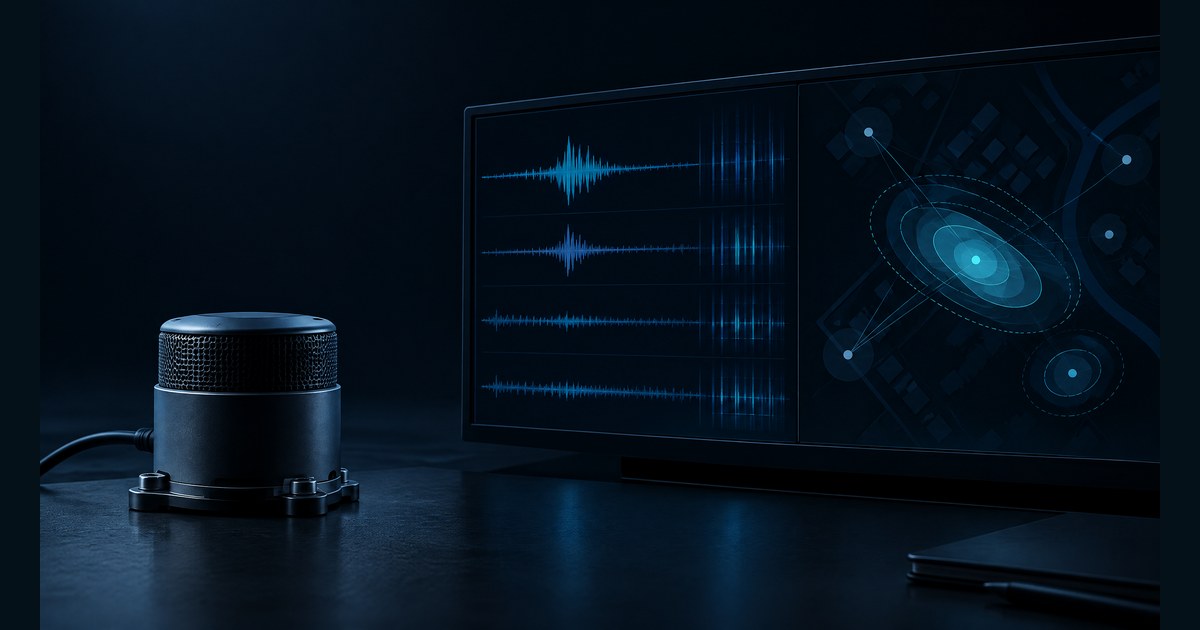
A procurement and governance guide for deciding what an acoustic drone surveillance system should observe, retain, protect, and delete when a civil project needs both privacy restraint and defensible event records.
Start with the question the record must answer
Data minimization becomes practical when the project defines its evidence question before selecting storage settings. The question might be whether an acoustic indication occurred in a protected area, whether several sensors observed the same time window, or whether an operator’s review decision can be reconstructed. These questions require different records. A system intended only for live situational awareness may need a short-lived feature stream and event metadata. A system intended to support an incident review may need a preserved audio excerpt, calibration information, and an operator note.
Separate detection from identification
Acoustic sensing can provide sound observations, candidate classifications, timing, and directional context. It does not by itself establish a unique aircraft identity, the pilot’s identity, flight permission, or an automatic response authority. That distinction matters for retention: the project may need to preserve why an indication was raised and how it was assessed without retaining a continuous archive that implies more certainty than the sensor can provide. The record should label an observation, an analytical output, and a human conclusion as different things.
Write an evidence question for every retained field
For each proposed field, ask what decision it supports. A timestamp can help align acoustic data with an approved camera or radar record. A sensor identifier can show which node produced an observation. A model version can help explain why an analytic result changed after a software update. Raw audio may be necessary for a limited review, but it may not be necessary for every routine event. If the project cannot explain the purpose of a field, it should not become a default retention requirement.
Use a tiered evidence model instead of one archive
A useful design divides data into tiers with different lifecycles. This avoids the false choice between losing all context and keeping every microphone channel indefinitely. The exact periods must be set by the project’s purpose, risk assessment, applicable law, and records policy; they should not be copied from a vendor default or invented as a universal standard.
Tier one: transient sensing and feature data
The sensing layer may process environmental sound locally or at an edge gateway to produce short-lived features, timestamps, and event candidates. If no event meets the project’s review threshold, those inputs can be deleted or overwritten according to the approved policy. This approach reduces the amount of ambient sound held in the system, but it must not discard information that the project has defined as necessary to validate system health or investigate a known event. A buyer should ask whether deletion is technically enforced and whether the system distinguishes routine buffers from preserved records.
Tier two: event packages for accountable review
When a defined trigger or operator review threshold is met, the system can create a narrower event package. It may contain the event time, sensor and site reference, directional or classification output, confidence or uncertainty notation, relevant system status, and a short audio segment if the project has justified retaining it. The package should preserve provenance, including when it was created and whether it was edited or exported. It should not silently turn an analytical label into a confirmed aircraft identity.
Tier three: a controlled preservation copy
Some events may require a longer-lived copy because an authorized investigation, safety review, insurance process, or formal dispute is active. That exception should be tied to a case reference, an owner, an access record, and an end condition. The ICO states that surveillance retention should be the shortest period needed for the purpose, while allowing preservation for a specific active investigation. This is different from keeping all routine audio indefinitely in case it becomes useful later.
Design the retained record for interpretation, not just playback
Evidence quality is more than a sound file. A short clip without timing, sensor identity, configuration context, and handling history may be impossible to interpret later. Conversely, a large archive can create privacy exposure without improving the decision. The procurement specification should therefore define the minimum context needed to understand an event and the limits of the conclusion that context can support.
Preserve provenance and uncertainty
A defensible event record should indicate the source sensor, synchronized time reference, software or model version where relevant, processing stage, and the person or process that reviewed it. It should also preserve uncertainty. Bearing is not position, a candidate class is not a model identification, and an acoustic indication is not proof that a drone was present. Recording those distinctions helps later reviewers avoid reading more into the evidence than the system produced.
Do not confuse completeness with usefulness
Continuous multi-channel audio may appear comprehensive, but it can include unrelated speech, nearby industrial activity, and other sound that the surveillance purpose does not require. A smaller event window with a documented pre-event and post-event context may be more useful if it is enough to test the observation. Whether that is adequate must be established through site evaluation and acceptance criteria, not assumed from a generic product setting.
Make access, export, and deletion part of the system specification
Minimization is not achieved if the interface collects little but exports unrestricted files. Governance must cover who can view live data, who can open an event package, who can export it, and who can authorize a preservation exception. The ICO guidance emphasizes restricted access, secure storage, retrievability, and audit trails where surveillance information may be used as evidence. NIST similarly describes minimizing collection and retention of personally identifiable information and applying safeguards based on the potential impact of misuse.
Require role-based handling and an audit trail
A civil project should be able to distinguish routine monitoring from evidence review and administration. Access records should show the user or service, time, action, and record involved. Export should create a controlled copy with its own identifier rather than leaving the original status unclear. These are procurement questions about functions and workflow, not assumptions that a particular sensor or software package already provides them.
Specify deletion and preservation exceptions
The policy should state how routine buffers are overwritten, how event packages reach their disposal date, and how a valid preservation hold pauses deletion. It should also state who reviews expired holds and who confirms secure deletion. A retention period based only on disk capacity or a manufacturer default is not an evidence policy. The project should document the reason for each period and revisit it when the purpose, site, or legal environment changes.
Turn the trade-off into procurement and acceptance tests
A buyer can test data minimization and evidence sufficiency together. The aim is not to reward the system that stores the most data. It is to verify that the system can produce an adequate, interpretable record for the project’s defined cases while limiting unrelated collection and access.
Questions for the supplier and integrator
Ask which outputs are generated before any audio is retained, whether edge processing is available, what starts an event package, and whether thresholds are configurable. Ask how the system records time synchronization, sensor health, model version, and operator review. Ask whether raw audio and derived metadata have separate permissions and retention rules. Finally, ask for written confirmation of export format, audit records, deletion behavior, backup handling, and any SDK or API functions required to enforce the project policy.
Acceptance evidence for a civil site
Acceptance should include documented scenarios such as a routine period with no qualifying event, a genuine candidate event requiring review, and a preservation request with a defined case owner. The project can then check that non-qualifying data follows the deletion policy, that the qualifying record contains the promised context, and that access and export actions are traceable. Site noise, weather, building reflections, and approved nearby activity should be considered because evidence sufficiency is an engineering and operational question, not a universal acoustic constant.
Specify the evidence lifecycle before specifying storage capacity
Before comparing acoustic drone surveillance system proposals, write a data map from sound input to deletion or preservation. Identify the event questions, minimum context, access roles, export format, retention rationale, and acceptance tests. Then ask SonicVast or another qualified integrator to confirm which functions are available for the actual project and which require written customization or integration work.
Discuss your projectPrivacy, records, employment, and surveillance requirements vary by jurisdiction and site context. This article is a civil procurement framework, not legal advice. Acoustic observations do not by themselves establish aircraft identity, authorization, or response authority.