
ACOUSTIC SENSING / ENGINEERING AND PROCUREMENT
Acoustic Perimeter Detection System: Separate Fence Vibration from Airborne Sound
The phrase acoustic perimeter detection system can hide two different engineering questions. A fence-mounted vibration or strain sensor observes mechanical energy transmitted through the fence. An airborne acoustic system observes sound arriving through the air, often with microphones and signal processing. They may both generate an alert near a boundary, but they do not sense the same event, produce the same evidence, or require the same acceptance test.
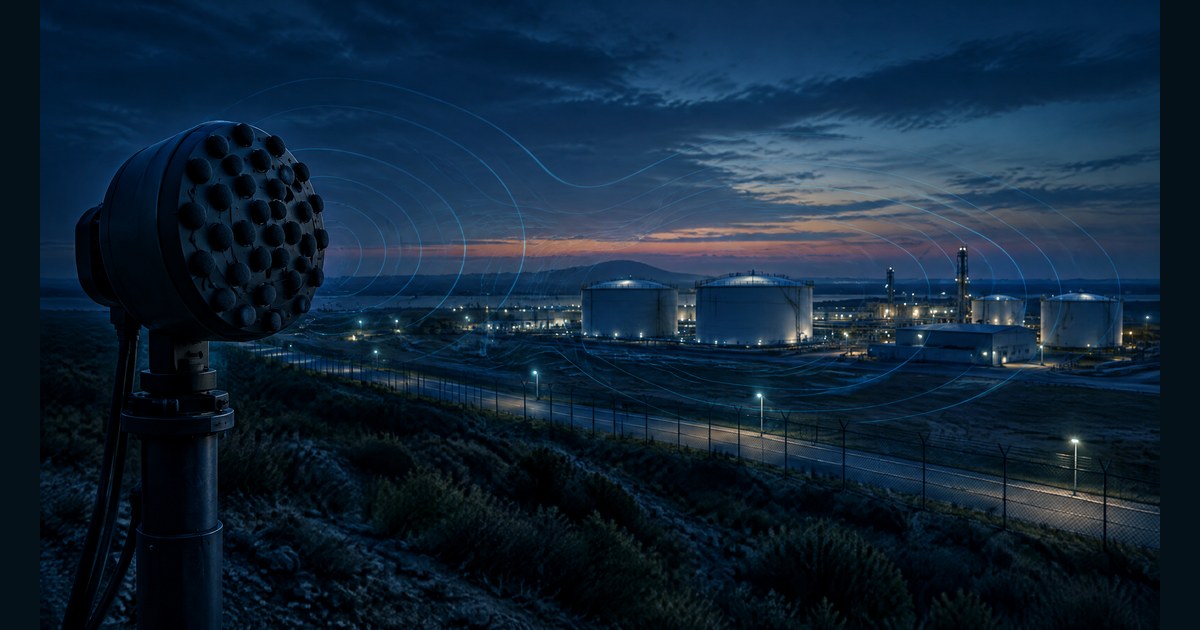
A practical civil-security guide to deciding whether a perimeter requirement concerns mechanical activity on a fence, sound from an airborne source, or a governed combination of both.
Start with the physical event you need to observe
Before comparing products, write the event in physical terms. Is the concern a person climbing, cutting, or lifting the barrier? Is it an aircraft or other sound source approaching above the site? Or does the site need a review workflow that can compare a fence event with an airborne acoustic observation? This wording prevents a broad label from becoming an unsupported coverage promise.
Fence vibration is a barrier event
U.S. Nuclear Regulatory Commission guidance describes fence vibration or strain systems as devices that detect vibration or strain of the fence, such as that produced by climbing or cutting. The sensing element is attached firmly to the post or fence fabric so that stress in the barrier can generate an alarm. In this arrangement, the measured object is the fence and its mechanical response, not the sound field above the property. The NRC also notes that wind, hail, and blown debris can create nuisance alarms, so mounting, signal processing, and local conditions matter.
Airborne acoustics is an air-path observation
An airborne acoustic sensor receives pressure variations through the air. A microphone array can compare arrival times or other signal features to estimate a direction or organize a candidate sound source. A 2026 Acta Acustica study describes a distributed MEMS-microphone approach using time-difference-of-arrival processing and machine learning to distinguish drone acoustics from environmental noise. That research is evidence of a sensing method, not a universal range, accuracy, identification, or deployment guarantee for every site.
Why the two signals should not be treated as interchangeable
A fence sensor may alarm when the barrier is disturbed even if the disturbance produces little useful airborne sound. An airborne microphone may observe a sound source without any contact with the fence. A nearby vehicle, gate impact, construction activity, or wind event can also affect one layer and not the other. The right question is therefore not which technology is always better, but which physical pathway matches the event and how the resulting evidence will be reviewed.
Different location meanings
A fence system generally associates an event with a zone or segment of the barrier. An airborne array may provide a bearing, an estimated direction, or a position estimate derived from synchronized microphones and a model. Bearing, position, classification, and model confidence are separate outputs. A directional acoustic observation should not be described as proof that an aircraft crossed a particular fence segment unless another approved evidence source supports that conclusion.
Different environmental exposures
Fence sensing is coupled to the condition, tension, rigidity, attachments, and maintenance of the physical barrier. Airborne sensing is affected by background noise, wind, reflections, multipath propagation, source direction, and the acoustic characteristics of the site. The Acta Acustica study explicitly identifies environmental noise, multipath propagation, and limited range as continuing challenges for acoustic detection. These are not interchangeable installation risks, so a single generic sensitivity claim is not meaningful procurement evidence.
Turn the distinction into a procurement specification
A civil buyer can make the requirement clearer by asking the supplier to name the sensed phenomenon, the expected output, and the test method. The specification should avoid treating the word acoustic as proof of airborne listening or as a synonym for a vibration cable.
Questions for a fence-vibration requirement
Ask which fence constructions and sensor attachment methods are supported, what event types are included in the test plan, how zones are defined, and how tamper or sensor-fault states are reported. Ask for evidence that distinguishes deliberate test stimuli from wind, rain, hail, vegetation, loose hardware, gate movement, and maintenance activity. The NRC guidance is a useful reminder that tests and results should be documented and that dead spots, line supervision, and corrective actions belong in the record. Its nuclear-facility criteria should not be copied as a universal civil specification without an appropriate engineering review.
Questions for an airborne acoustic requirement
Ask what the system reports: raw sound features, a detection score, a bearing, an estimated position, a track, or a classification. Request the test environment, microphone synchronization method, background-noise conditions, weather assumptions, false-alarm handling, and the evidence retained for later review. Ask how an observation is marked uncertain and how it is correlated with approved visual, radar, RF, access-control, or operator evidence. Do not accept a model label alone as proof of identity, authorization, or intent.
Design a review workflow instead of a blanket coverage claim
The U.S. Department of Homeland Security describes perimeter intrusion detection sensors as usable alone or with other sensors, barriers, and access-control technologies. That supports a layered design conversation, but it does not establish that every sensor covers every boundary or that fusion removes uncertainty. A useful workflow preserves the identity of each observation and records why an operator accepted, rejected, or escalated it.
Keep the event records separate
Store a fence alert with its fence segment, sensor state, test status, and maintenance context. Store an airborne acoustic observation with its time window, microphone or array identity, estimated direction or position if available, classification result, and environmental notes. A later correlation can link the records without rewriting one sensor's output as the other sensor's measurement.
Use correlation to ask better questions
If a fence event and an airborne sound observation occur near the same time, the combined record may help an authorized team decide what to verify next. It still does not prove that the two events share one cause. Conversely, the absence of an airborne acoustic observation does not prove that a fence event was false, and the absence of a fence event does not prove that no aircraft sound was present.
Make maintenance and acceptance evidence part of the system
Perimeter sensing is an operational record, not only an equipment list. The DHS overview frames these sensors as part of a broader security arrangement, while NRC guidance illustrates the value of documented testing, inspection, and corrective action. Civil projects should adapt that evidence discipline to their own risk, authority, and maintenance procedures.
Document physical changes at the fence
For a vibration layer, record fence repairs, tension or rigidity changes, new gates, cable routing, vegetation contact, construction nearby, sensor replacements, and alarm-zone changes. Retest affected segments after work. A clean dashboard cannot compensate for a changed mechanical structure whose sensing assumptions were never rechecked.
Document acoustic scene changes
For an airborne layer, record new machinery, road or rail activity, building surfaces, seasonal weather patterns, construction, microphone relocation, firmware or model revisions, and changes in approved flight activity. Revalidation should use representative local sound conditions rather than a laboratory result presented as universal performance.
Write two sensing statements before requesting a quotation
Describe the barrier event and the airborne observation as separate lines in the project brief. For each, specify the zone or area of interest, expected output, nuisance sources, acceptance stimulus, maintenance record, and escalation owner. Then ask an integrator how the records can be displayed together without turning a directional or classified observation into an automatic conclusion.
Discuss your projectFence-vibration and airborne-acoustic behaviour depends on construction, environment, configuration, and validation. The cited public guidance and research do not establish SonicVast performance, certification, coverage, availability, or a universal acceptance threshold. Confirm hardware, interfaces, software outputs, testing, service terms, and site suitability in writing for the actual project.