
ACOUSTIC SENSING / ENGINEERING AND PROCUREMENT
Acoustic Security System for Drones: How to Guide Operators Through Uncertain Acoustic Events
An acoustic security system for drones should not force an operator to choose between ignoring a sound and declaring a confirmed aircraft. Its practical value is to make an uncertain acoustic event easier to describe, preserve, compare and escalate under a site-approved procedure. The right guidance separates what the sensor observed from what the team thinks it may mean.
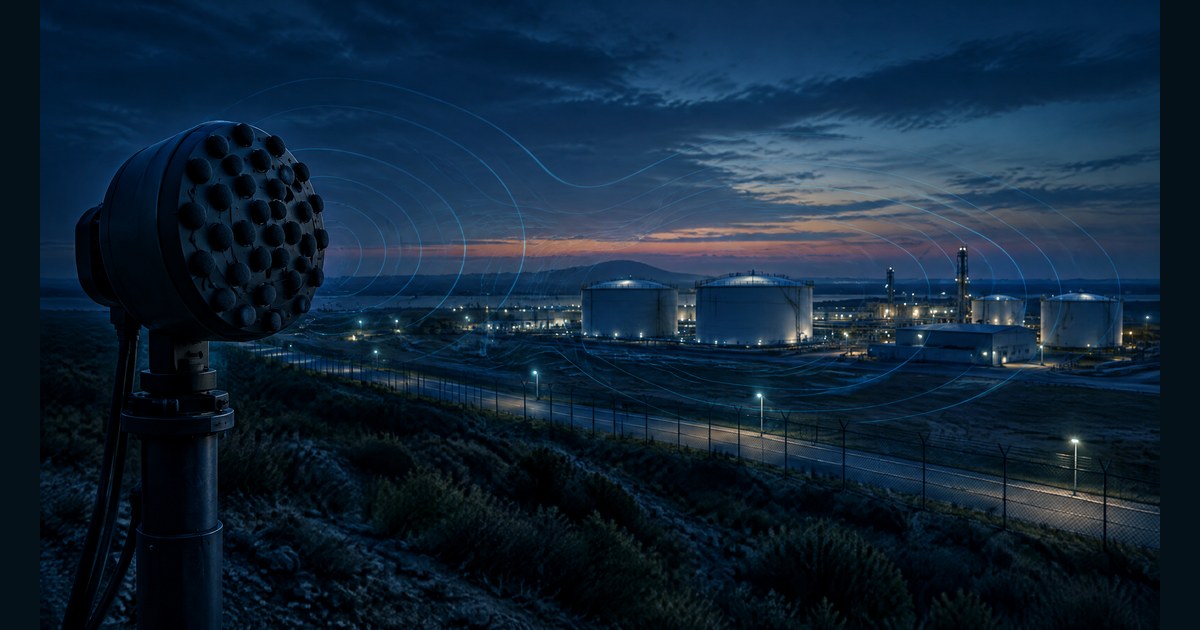
A governance-first guide for civil operators who need to decide what to do when an acoustic sensor reports a possible drone-related sound but the evidence is incomplete.
Start with an observation, not a conclusion
The first operator instruction should define the event in neutral terms. A sensor may report a sound pattern, a directional estimate, a confidence value or a change from the local acoustic baseline. Those outputs are useful evidence, but they are not automatically an aircraft identity, an operator identity, an authorization status or a threat assessment. The Federal Aviation Administration explains that detection systems can generate alerts for further investigation, while detection does not determine intent or the level of threat posed by a UAS.
Use a controlled event vocabulary
A short vocabulary reduces interpretation drift. For example, an operator record can distinguish sound detected, candidate aircraft-related sound, corroborated observation and unresolved event. These labels describe the state of the evidence. They should not quietly become labels such as hostile, illegal or confirmed drone unless an authorized process has established those findings. The vocabulary should be agreed during system design and shown in the user interface, event log and operating procedure.
Separate outputs that are often confused
Bearing is not position. A directional cue is not a track. A classification suggestion is not a model identification. A high confidence score is not proof that the target is present. Operators should be trained to read each field as a different piece of evidence and to record missing fields rather than filling them with assumptions.
Preserve the context that makes an alert reviewable
An uncertain event is easier to assess when its surrounding context is retained. The event record should capture the time reference, sensor or node identifier, status of the sensor, available direction or area estimate, confidence or quality indicators, and any relevant environmental note. The purpose is not to create a perfect reconstruction from one alert. It is to give a later reviewer enough information to understand what was actually observed.
Record environmental and system conditions
Wind, rain, construction, road traffic, rotating equipment, birds and temporary site activity can change the acoustic scene. The log should also show maintenance state, connectivity interruptions, calibration status where applicable and software or configuration changes. This does not prove the cause of an event. It makes a comparison possible between a candidate event and the conditions in which it occurred.
Keep raw evidence distinct from operator notes
A waveform, feature record or system-generated event should remain distinguishable from a human comment such as possible rotor noise. Preserve the original timestamp and record later edits as additions or revisions. This simple separation protects the review process from hindsight: a later interpretation should not overwrite the evidence that prompted the first review.
Build a verification ladder for uncertain acoustic events
Operator guidance should provide a graduated path rather than a binary alarm response. The first step is acknowledge and classify the event as unresolved. The next step is check whether the event persists, repeats or changes in a way that is consistent with a moving source. The team can then compare approved sources such as visual observation, radar, RF context, Remote ID information where lawfully available, access-control records or an authorized flight schedule. The goal is corroboration, not automatic escalation.
Define what counts as corroboration
Corroboration should be written in operationally clear terms. A second source may confirm that an object or activity was present, or it may simply provide a different explanation for the same time window. A camera view that shows a bird can help resolve a sound event, while the absence of a camera view does not prove that no aircraft was present. The procedure should tell operators which sources are available, how their timestamps are aligned and when a supervisor or external authority must be consulted.
Use time windows without pretending to create certainty
A defined review window helps operators compare evidence without searching indefinitely. Within that window, they can inspect sensor health, local activity, other approved detections and any relevant flight authorization record. If the evidence remains incomplete, the correct disposition can be unresolved or monitor, not confirmed. A well-designed process makes uncertainty an explicit outcome rather than a reason to improvise.
Design the human-machine interface around accountable decisions
A useful interface shows the event state, evidence quality and next permitted review action together. It should avoid alarm colors or wording that imply intent before the evidence supports it. The Federal Aviation Administration notes that detection systems may be stand-alone or combined for primary and secondary validation, and that airport deployment can have operational and safety effects that require risk-based procedures. For civil sites, the interface should therefore support a controlled decision path rather than present detection as an instruction to take enforcement action.
Make acknowledgement meaningful
Acknowledgement should mean that a responsible person has seen the event and started the defined review. It should not mean that the event is true, false or closed. The interface can ask for a disposition such as corroborated, explained by known activity, sensor-quality issue, unresolved or escalated for authorized review. Each disposition should require only the evidence needed for that decision and should leave an audit trail.
Plan handoffs and degraded operation
An operator may change shifts, lose access to a camera feed or face a temporary sensor outage. Guidance should specify what information transfers to the next person and how an event is marked when one evidence source is unavailable. If the system is used at an airport or another regulated site, the local response plan and responsible authorities take precedence over a generic vendor workflow.
Turn the guidance into a procurement and training requirement
Before selecting an acoustic security system for drones, buyers should request a demonstration of the uncertain-event workflow, not only a detection screen. Ask the supplier to show how the system labels candidate observations, exposes data quality, stores event history, records operator dispositions and integrates approved secondary evidence. Ask which functions are configurable and which require written engineering confirmation. This keeps the evaluation focused on usable evidence rather than an unsupported accuracy or coverage promise.
Questions for a pilot or acceptance plan
A project team can ask: What exactly triggers an event? Which fields are retained? Can operators distinguish sensor status from acoustic confidence? How are environmental conditions documented? Can a reviewer reconstruct the sequence without changing the original record? What happens when the event cannot be corroborated? How are approved flights represented? What permissions control escalation, export and deletion? These questions test whether the system supports accountable operations in the actual site environment.
Train for uncertainty with realistic examples
Training should include a real or clearly labeled illustrative example involving background machinery, a bird, a vehicle or an authorized aircraft-related activity. The exercise should ask the operator to document the observation, check approved evidence and select a disposition. It should not reward a fast declaration of drone presence. The EASA guidance on drone incident management emphasizes preparation and taking the right steps when an incident occurs; that principle is more useful than a script that assumes every alert has the same cause.
Specify the unresolved-event workflow before specifying the dashboard
For a project discussion, begin with the event states, evidence fields, verification sources, escalation authority and audit requirements. Then ask how the proposed acoustic core, software interface and integration layer will implement that workflow at the site. SonicVast can discuss sensing and integration options, while final interface behavior, compatibility, data retention and operating responsibilities should be confirmed in writing for the actual project.
Discuss your projectAcoustic observation does not detect literally silent targets or establish a unique aircraft identity, flight permission or automatic response authority. Environmental conditions, array design, sensor health and site evidence affect interpretation. The cited technical study reports results under stated research conditions and does not establish universal field accuracy. Any airport, infrastructure or public-safety response must follow the responsible authority's approved procedures.