
ACOUSTIC SENSING / ENGINEERING AND PROCUREMENT
Acoustic UAV Localization System: Read Localization Uncertainty Without Treating It as a Guarantee
An acoustic UAV localization system may show a bearing, a position estimate, or a moving track. None of those labels turns an observation into a guaranteed coordinate. For a civil infrastructure buyer, the important question is not simply whether the screen displays a small error value. It is whether the stated uncertainty matches the measurement conditions, whether the output being discussed is bearing or position, and whether repeated observations remain consistent enough to support a documented review.
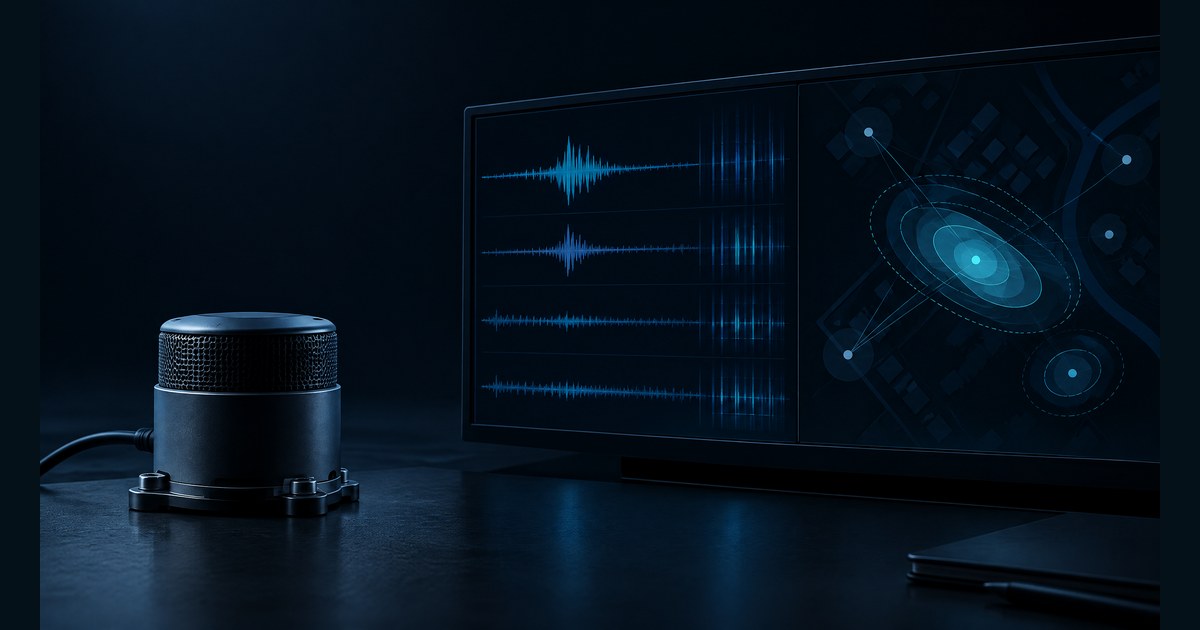
A practical guide to reading acoustic localization outputs as estimates with stated uncertainty, not as guaranteed coordinates or automatic identification.
What a localization estimate actually says
Localization is an inference from measured sound and system metadata. The result should be read as an estimate of a defined quantity under defined assumptions. NIST Technical Note 1297 describes uncertainty as part of expressing a measurement result, rather than as an optional warning label. That principle is useful here: a coordinate without its reference frame, time, conditions and uncertainty is incomplete evidence.
Bearing, position and identity are different outputs
A bearing estimate describes a direction from a sensor or array. A position estimate combines one or more observations with sensor locations, timing, geometry and a model to infer where a source may be. A track adds a time sequence and a motion model. Identification is a further claim about what the source is. An acoustic observation may support one output without proving the next one. In particular, a directional line is not automatically a unique map coordinate, and a position estimate is not proof of aircraft identity, operator, authorisation or intent.
Uncertainty is not a success probability
A confidence interval, standard uncertainty, covariance ellipse or similar display has a specific statistical and modelling meaning. It does not mean that every actual source must fall inside the displayed shape, and it does not describe every risk relevant to a site decision. Buyers should ask what coverage level or confidence convention is used, what data were used to estimate it, and whether the representation is calibrated for the deployment environment. If the interface only shows a single radius with no definition, the number is difficult to interpret or compare.
Why acoustic position uncertainty changes with conditions
Acoustic localization quality is not a fixed property of a sensor label. It depends on the signal, propagation path, array geometry, timing, background sound and the reference data used by the processing chain. A published review by Chen, Yao and Hudson explains that source-localization performance varies with frequency and that range estimation can be especially sensitive when source characteristics are unknown. This is a reason to demand conditions and error definitions alongside any headline result.
Geometry can make one direction look better than another
A microphone array has a geometry and an orientation. The same source distance can produce different uncertainty along different axes. With multiple arrays, the intersection of bearings may be well conditioned in one part of a site and poorly conditioned in another. A narrow angular estimate can still produce a wide area on the ground when the range is weakly constrained. Reviewers should therefore inspect the shape and orientation of the uncertainty region, not only its smallest dimension.
Environment and metadata belong in the result
Wind, reflections, structures, vegetation, machinery and other aircraft can alter the received sound or the timing relationship between sensors. Array coordinates, clock status, mounting orientation and event timestamps also affect interpretation. A useful record preserves the conditions under which the estimate was produced. If the system cannot show which sensor data, time window, coordinate system and quality indicators contributed to a result, a small displayed uncertainty should not be treated as independently verified precision.
How to read a moving track without over-trusting it
A track is a sequence of estimates, not a direct view of an aircraft. Track processing can smooth noisy observations and predict between updates. That can make a path appear visually persuasive even when the underlying observations are sparse or affected by a changing sound scene. The central review question is whether the track uncertainty remains realistic as new measurements arrive.
Consistency matters as much as a single low error value
Drummond, Perrella and Waugh describe track covariance consistency as the property that a computed covariance realistically represents actual estimation errors. If uncertainty is understated, downstream association and review functions may treat unrelated observations as a match or reject a relevant one. For an acoustic project, this does not require a buyer to reproduce a research filter. It does require asking how the supplier checks that reported uncertainty remains credible across repeated observations, changing noise and different parts of the site.
Look for residuals, update history and track breaks
A responsible review record can show when a new bearing or position measurement disagreed with the predicted track, how the uncertainty changed, and whether the system started a new track or continued the old one. A large residual is not automatically a failure; it may be evidence that the motion model, timing, source association or environment changed. What matters is that the event is visible and not silently converted into a confident-looking path.
An illustrative review example
The following is an illustrative example only. It is not a SonicVast specification, customer result or deployment claim. It shows how a buyer can reason about an output without turning it into a guarantee.
A bearing line is not yet a confirmed location
Suppose an array reports a candidate sound from a north-eastern bearing. The display shows a narrow angular band, but the source range is not directly measured. A reviewer should record the bearing, timestamp, array position, coordinate reference, signal-quality indicators and relevant site conditions. The correct conclusion may be that the observation is directionally informative while the possible source area remains broad. It would be premature to state that an aircraft was at one exact coordinate.
Repeated agreement still needs independent interpretation
Suppose later observations produce a smooth path near the first bearing. That persistence can strengthen confidence that the observations are related, but it does not by itself prove aircraft identity or eliminate common-mode error. The team should check whether the observations came from independent sensors or the same contaminated sound environment, whether the timing and coordinates were stable, and whether the reported uncertainty was evaluated against known reference events.
Procurement questions that make uncertainty usable
Uncertainty becomes useful when it is defined, recorded and tested against the decisions the site actually needs to make. The aim is not to demand one universal accuracy number. It is to understand what the system can support under the project's own acoustic and operational conditions.
Ask what the displayed quantity and interval mean
Request a definition for every location field: bearing, range, latitude and longitude, altitude, track state and any confidence or covariance field. Ask for the coordinate reference system, update time, latency, confidence convention and whether the interval is empirical, model-based or both. Ask what happens when the data do not justify a position estimate. A system that can return an explicit low-confidence or bearing-only state may be more interpretable than one that always fills the map with a precise-looking point.
Ask how the claim will be accepted on site
Agree in writing on test conditions, reference truth, event timing, environmental notes, missing-data handling and the metrics that will be reported. Separate bearing error from position error and track continuity. Confirm how false associations, track swaps and uncertainty under-coverage will be documented. Any SDK, API, logging, calibration, integration, warranty or service details should also be confirmed for the specific project rather than assumed from a general product description.
Turn localization confidence into a reviewable project requirement
For an acoustic UAV localization system project, specify the output states, uncertainty definitions, metadata, track-consistency checks and acceptance evidence before comparing vendors. SonicVast can discuss the relevant acoustic sensing, integration and documentation scope for a particular civil site; capabilities and interface details should be confirmed in writing for that project.
Discuss your projectAcoustic sensing can provide sound observations and estimates, but it does not detect literally silent targets or by itself establish unique aircraft identity, flight permission or response authority. Environmental conditions, site evidence and lawful operating procedures remain material.