
TECHNOLOGY INSIGHT / INTEGRATION
Choosing the Right Drone Detection Sensors for C-UAS Integration
For civil operators, sensor selection is a systems and governance decision rather than a shopping list. RF observation, radar, acoustic sensing and EO/IR can contribute different observations, while site context and human review help explain what those observations may mean. The useful question is not which sensor is universally best, but which combination is technically suitable, legally authorized and practical to validate at the specific site.
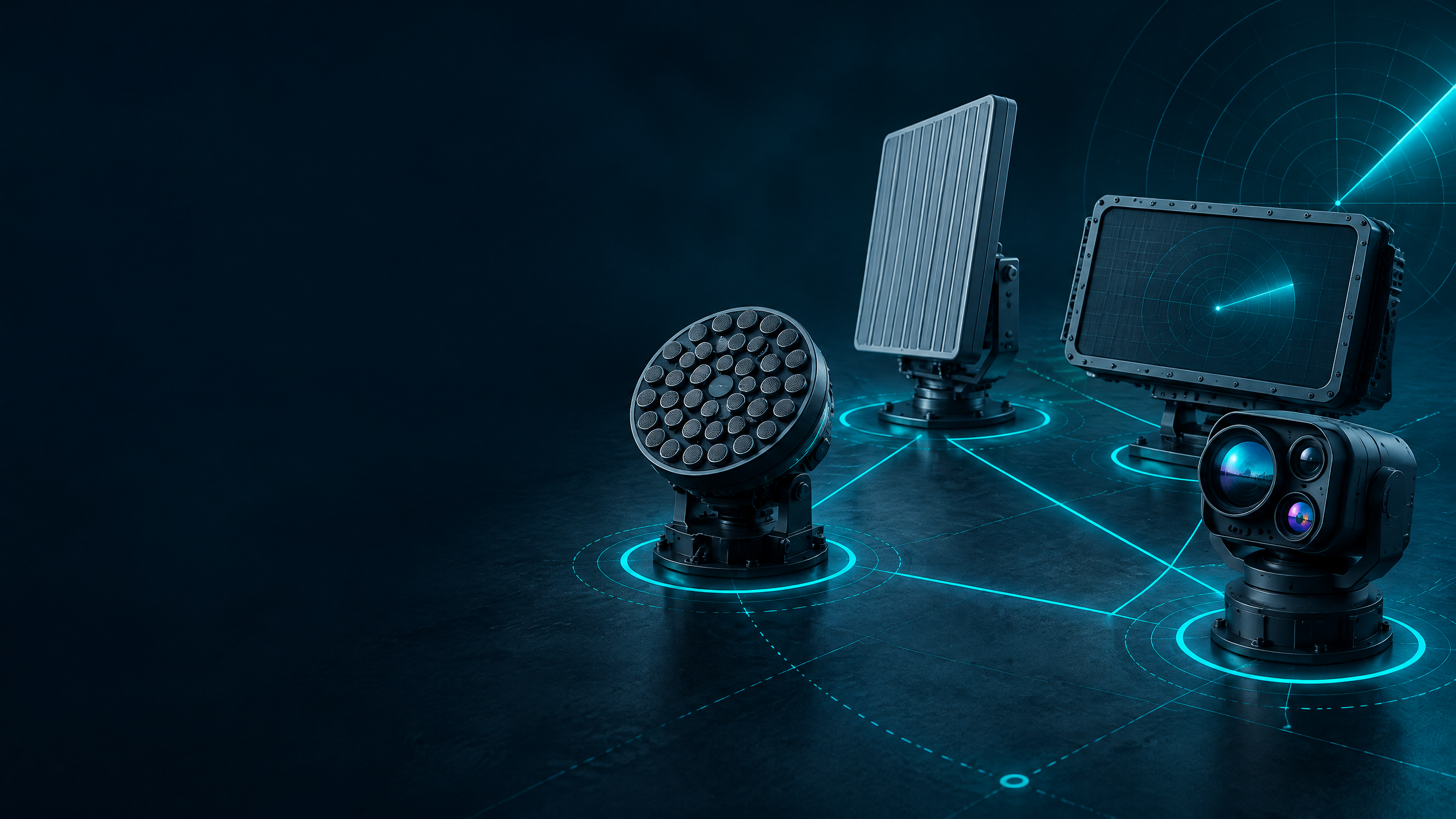
Civil C-UAS integration is strongest when no single sensor is treated as a verdict. Selection should begin with site conditions, lawful purpose, safety obligations and a documented validation plan.
Start with the site and the safety case
Begin by mapping the site before comparing sensor specifications. Airports, energy facilities, oil and gas sites, and other critical infrastructure have different sightlines, clutter, noise, reflective surfaces, access constraints and aviation interfaces. Record the assets and areas that need protection, normal activity patterns, permitted flights, nearby communities and emergency procedures. The selection brief should also identify aviation, spectrum, privacy and safety requirements. This site-led baseline prevents a technical feature from becoming an unsupported performance promise and gives integrators a defensible basis for deciding what evidence is useful.
Treat sensor types as complementary evidence
RF observation can reveal some emissions, while radar can provide motion-related observations and acoustic sensing can add a local sound signature. EO/IR may support visual review when lighting, weather, line of sight and privacy controls permit. Each layer has blind spots and environmental dependencies. An RF-silent aircraft, or one using a fibre-optic control link, can reduce observable RF cues; that does not make another signal conclusive. Site context, sensor health, timing and human review should be combined carefully. No detection signal alone proves identity, intent, authorization or threat.
Design integration around review and governance
A partner should explain how alerts are logged, correlated, presented and escalated without implying that automation makes the final judgment. Define who may review an event, what information is retained, how false or uncertain observations are handled, and when an incident is closed. Privacy-by-design matters when cameras or microphones can capture people or neighbouring property. Lawful authorization should be documented before collection, sharing or response. For regulated sites, involve aviation, spectrum, privacy, security, safety and emergency-policy owners early so integration decisions match the operating environment.
Validate the whole chain at the actual location
Require a documented validation plan that tests the integrated workflow rather than a sensor in isolation. It should state scenarios, environmental conditions, calibration and maintenance assumptions, data handling, review steps and acceptance criteria agreed by the site owner. Include ordinary aircraft activity, benign sources, ambiguous observations and periods when RF cues may be limited. Record limitations and unresolved questions instead of smoothing them into a headline metric. Technical suitability is site-specific, so a responsible partner should support controlled evaluation, transparent reporting and periodic reassessment as the site, rules or threat picture changes.
Integration principles for civil low-altitude safety
Before selecting or connecting any sensor, integrators should define the safety objective, accountability boundaries, data governance, validation criteria, and escalation path. Technical value comes from reviewable contextual evidence, not absolute conclusions drawn from a single signal.
Discuss a Civil Integration BriefingEditorial note: this article provides civil, compliance-first technology education only. It is not operational instruction, legal advice, or a performance promise. All sensing, data handling, system integration, and follow-on action must remain within applicable authorization, aviation, electromagnetic-compatibility, privacy, and site-governance requirements, with qualified human review.