
ACOUSTIC SENSING / ENGINEERING AND PROCUREMENT
Counter Drone Acoustic Sensor System: Review Sensor Evidence Alongside Optical Confirmation
A counter drone acoustic sensor system can provide an early sound-based indication, but an indication is not the same as an identified aircraft. The useful review question is whether the acoustic record and an optical record describe the same event, at the same time and place, with limitations that an operator can see. This approach helps civil infrastructure teams decide what to retain, what to verify, and what still requires human judgement.
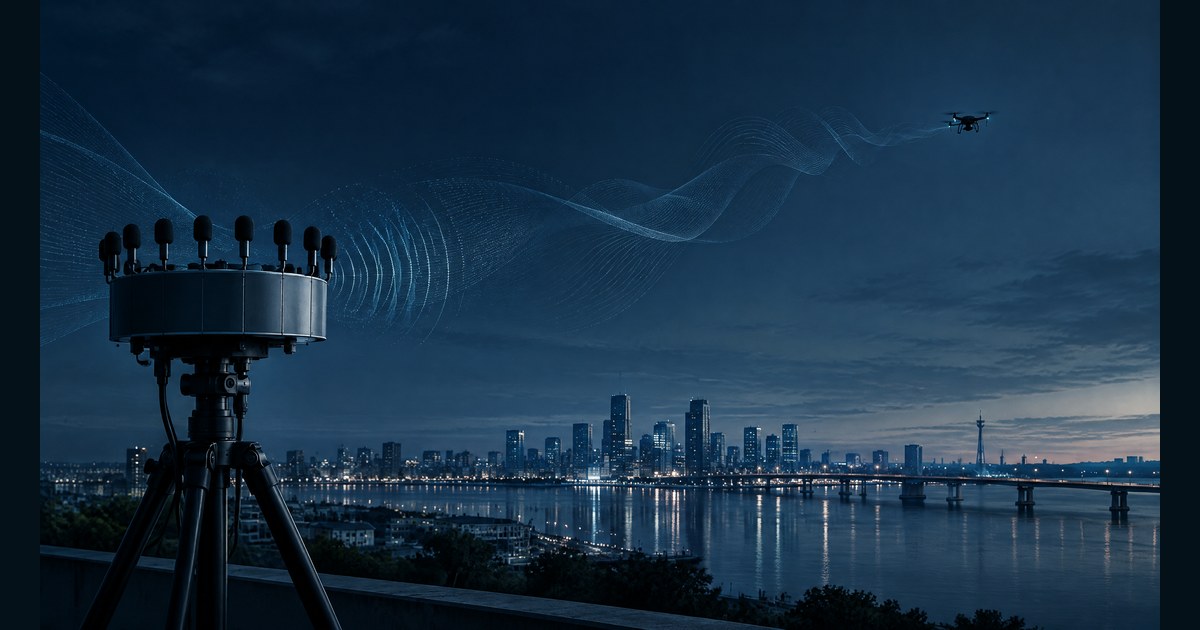
A practical evidence-review framework for comparing acoustic indications with visible or infrared confirmation without overstating what either sensor proves.
Start by separating indication, confirmation and identification
The first mistake in a sensor review is to treat every output as an identity claim. CISA describes acoustic systems as using tuned microphone groups to detect sound signatures from UAS propellers. It also describes EO/IR systems as cameras that collect visible or infrared light. These are different observations. A sound indication can justify looking for a visual or thermal record, while an image can add shape, motion or thermal context. Neither record alone automatically establishes the operator, flight permission or intent.
What the acoustic record can contribute
Ask the acoustic subsystem to show the observation behind its alert: the timestamp, node or array identity, bearing or location estimate, signal-quality indicators, classification label if used, and the relevant audio segment or derived features. CISA notes that acoustic systems may produce location, distance, altitude, speed and direction outputs, but it also notes shorter range, environmental sensitivity and dependence on comparison libraries for make or model identification. Those outputs should therefore be presented as estimates with conditions, not as universal facts.
What optical confirmation can add
A visible-light or infrared camera can test whether an object is present in the expected sector and time window. It may add a visual outline, movement pattern, lighting condition or thermal contrast that sound cannot provide. CISA cautions that EO/IR performance depends on clear line of sight and field of view, that low-light observation may require infrared, and that weather can degrade image quality. An optical non-confirmation can therefore mean no object was present, but it can also mean the camera was not able to observe the relevant area clearly.
Build a shared event record before comparing sensors
Acoustic and optical evidence cannot be compared reliably if each system uses a different clock, location reference or event definition. The review record should preserve the original observation and the processing steps that turned it into an alert. NIST’s cyber-physical-systems framework describes how distinct sensing applications can validate or challenge one another, while also warning that trustworthy data fusion depends on integrity, identification of relevant devices and justified trust.
Minimum fields for an evidence packet
For each candidate event, retain a common event identifier, UTC or site-defined timestamp with time-zone handling, sensor and firmware identity, node location, bearing or camera sector, raw or retained source material, processing version, confidence or quality indicators, and any operator annotation. Record whether the optical frame is live, replayed or unavailable. If a system has filtered or compressed the audio or video, preserve that fact so a later reviewer does not mistake a derived product for the original observation.
Compare time windows, not just alert labels
Use a defined comparison window around the acoustic indication, then ask whether the optical sensor was pointed toward the relevant sector and operating normally during that window. A camera frame captured several minutes later should not be described as confirmation of the earlier sound. Conversely, a camera view without a matching acoustic record may reflect a quiet target, an acoustic masking condition, a different bearing estimate or a sensor-state issue. The result should be recorded as corroborated, unresolved or contradictory, with the reason visible.
Review the conditions that can break apparent agreement
Agreement between two labels is not enough. A sound environment, line-of-sight obstruction or weather change can make the apparent relationship misleading. CISA identifies persistent loud noise, extreme weather, structures and terrain as factors that can reduce acoustic performance or location accuracy. It identifies line of sight, field of view and weather as material EO/IR considerations. UK government counter-drone documents similarly describe weather, terrain, buildings, clutter and crowded environments as conditions that can reduce the effectiveness and range of multiple sensor types.
A sound indication with no optical match
Do not immediately label this a false alarm. Check whether the camera had the right sector, focus and exposure, whether the target was outside the camera field of view, and whether rain, fog, darkness, glare or obstructions affected the image. Then inspect the acoustic context: machinery, traffic, birds, construction and other persistent sounds may create a plausible but non-aircraft signature. If the source cannot be resolved, preserve the event as an unconfirmed acoustic indication rather than forcing a positive or negative identity.
An optical observation with no acoustic match
The reverse mismatch also needs a disciplined explanation. The object may have been too quiet at the sensor, too distant, acoustically masked, outside the array’s effective conditions or not an aircraft. A camera alert may also be affected by birds, insects, reflections or image-processing limits. The record should state which checks were completed and whether the acoustic sensor was healthy. Absence of an acoustic alert is not proof that no aircraft was visible.
Turn correlation into a review decision, not an automatic conclusion
The practical value of sensor comparison is a clearer, traceable review path. UK government C-UAS guidance distinguishes detection, positive identification and accurate tracking, and states that no single sensor can provide all three across every environment. For a civil site, that distinction can be translated into accountable review states rather than a single confidence number.
Use explicit review states
A simple scheme can include acoustic indication, optical observation, cross-sensor corroboration, unresolved event and sensor-degraded event. Each state should define which evidence is present and what it does not establish. For example, cross-sensor corroboration can mean that the records overlap in time and plausible location; it does not by itself establish authorization, operator identity or the need for a response. The site’s approved procedures should determine who may classify an event and what follow-up is lawful.
Keep the human decision visible
A system may automate event matching or camera cueing, but the audit trail should show the source records, automated result, operator review and any later correction. NIST emphasizes trustworthiness and integrity in cyber-physical systems, while UK guidance highlights the importance of human accountability for final decisions. This is especially important when a sensor record could affect airport continuity, an industrial process or a public safety notification.
Questions to put into a procurement or pilot review
A meaningful demonstration should test the information contract between acoustic and optical components, not only whether an alert appears on a screen. The buyer should request representative records and the conditions under which the system produced, withheld or downgraded an alert.
Ask how evidence is exchanged
Request the event schema, timestamp precision, coordinate reference, bearing convention, health-state fields, confidence semantics, retained audio or image format, and revision history for analytics. Confirm whether the optical system receives a bearing, a search sector or a location estimate, and how it reports that it could not observe the requested area. Compatibility should be confirmed in writing for the selected hardware, software release and integration interface.
Ask how the site will be tested
Define test conditions for day and low light, ordinary background noise, weather changes, obstructions, moving cameras and planned authorized flights. Require separate accounting for detection, localization, optical observation, cross-sensor association and identification. Do not accept a combined accuracy claim that hides which stage succeeded. A pilot should also show how a reviewer retrieves the original evidence and explains an unresolved event.
Define the acoustic-to-optical review contract before selecting hardware
For a civil infrastructure project, begin with the event fields, timing rules, camera-control behaviour, degraded-state messages and evidence-retention requirements. Then ask suppliers or integrators to demonstrate those items under site-relevant conditions. SonicVast project discussions can be used to confirm suitable acoustic sensing, customization and integration options, but interface contents, analytics, support terms and performance must be confirmed for the actual project in writing.
Discuss your projectAcoustic sensing listens for observable sound and may not detect a literally silent target. Optical confirmation depends on line of sight, field of view, light and weather. Sensor correlation does not establish aircraft identity, flight authorization, operator identity or automatic response authority. Legal, privacy, aviation and site-safety requirements must be reviewed locally.