
TECHNICAL BRIEF / ACOUSTIC NETWORKS
Distributed Acoustic Sensor Networks for Low-Altitude Drone Detection
A microphone array and a distributed acoustic network solve related but different problems. An array compares sound across microphones within a node; a network compares observations across separate nodes. Neither turns every audible pattern into a confirmed drone. For civil low-altitude awareness, the engineering goal is to preserve meaningful differences between observations: what each node heard, how it estimated direction, when the evidence was acquired, and whether the equipment and environment supported a trustworthy comparison.
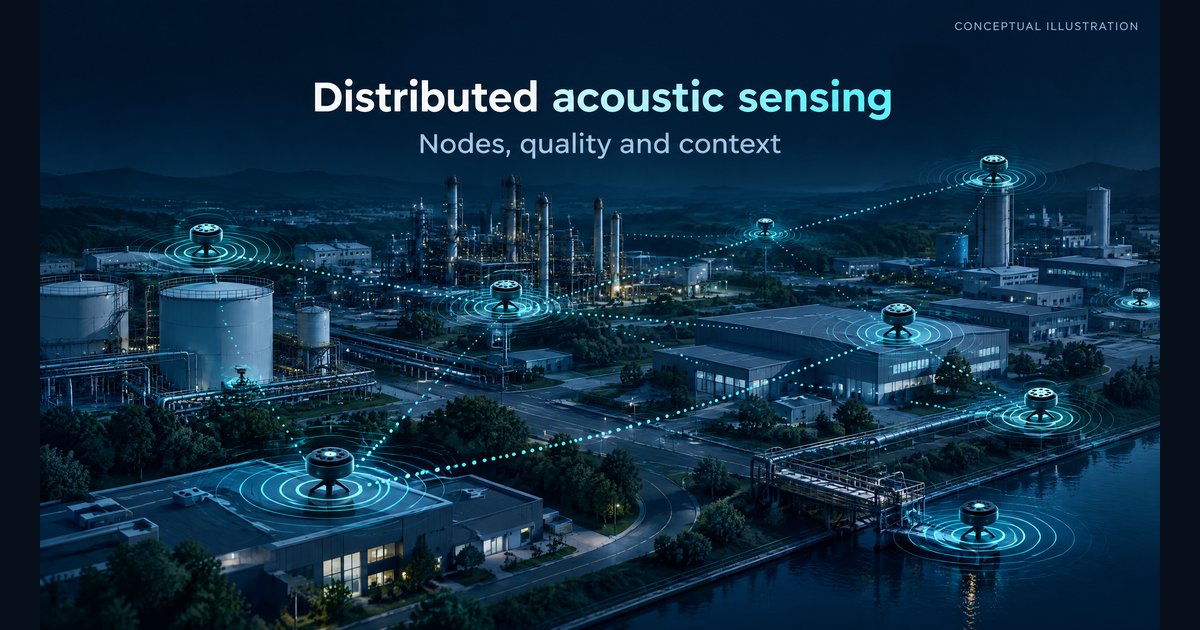
Distributed acoustic sensing connects local sound observations into a reviewable evidence network. Understanding arrays, timing, propagation, uncertainty and integration contracts helps civil low-altitude projects distinguish useful corroboration from apparent agreement.
Separate microphone geometry from network architecture
Within an acoustic node, microphones receive a sound at slightly different times. When channel timing and microphone geometry are known, signal processing can use those differences to estimate a direction of arrival. This is an array function, not evidence that the sound source has been located across a wider area. A distributed network links separate nodes, each contributing its own observation and quality information. Some architectures share derived events; others exchange selected signal features or audio under defined controls. Network connectivity alone does not create coherent sensing. Integrators should specify which operations occur locally, which occur centrally, and what information must survive transmission. Keeping these levels distinct makes it easier to diagnose whether a questionable result arose from microphone calibration, local processing or network comparison.
Treat sound signatures and bearings as qualified observations
Rotating propulsion can produce repeating acoustic components, harmonics and changes in energy over time. These features can support comparison with learned or reference patterns, but they are not a unique identity: machinery and other moving sources can share similar characteristics. A direction estimate answers a different question from a sound classification. It describes a plausible arrival direction relative to the node, with uncertainty influenced by signal quality, array calibration and the sound field. Reflections may make the strongest arriving component differ from the direct path. A review interface should therefore keep the detected pattern, estimated bearing, confidence meaning and observation interval separate. Confidence scores from different algorithms are not automatically comparable, and a bearing alone does not establish distance, aircraft identity or authorisation.
Make time and acoustic conditions part of the evidence
Sound takes time to travel, so an acquisition timestamp and a server receipt timestamp describe different moments. Comparing nodes requires a documented clock reference, synchronization condition and timing uncertainty; communication delay must not silently become observation time. If processing compares arrival times across nodes, its assumptions about sound propagation also need explicit treatment. Temperature gradients, wind and reflections can alter propagation, while background noise can mask a useful signal. Terrain, structures and absorption further limit what reaches a microphone. An observation missing at one node may therefore reflect an acoustic limitation rather than an absent aircraft. Store relevant quality indicators with each event, including clipping, channel faults and signal quality measures. Evaluate changing environmental conditions instead of assigning the network a universal detection range.
Compare evidence without manufacturing certainty
Multi-node review asks whether observations could describe the same sound source, considering their time windows, features, directional uncertainty and environmental context. Agreement can strengthen a hypothesis, but correlated errors can also create apparent agreement: nodes may hear the same machinery or share an unsuitable classifier. Disagreement should remain visible rather than being averaged away. A triangle in a conceptual illustration can help explain how different viewpoints contribute evidence; it is not a validated deployment layout, a mandatory node count or a spacing prescription. Actual network design requires project-specific evaluation. Where authorised RF, radar or optical inputs are available, preserve their provenance alongside acoustic evidence. A common event identifier can link related observations while retaining competing explanations and an unresolved state for human review.
Scale through explicit contracts and visible node health
Scalability depends on consistent event semantics, not simply adding sensors. An open integration contract should describe node identifiers, time references, coordinate conventions, uncertainty fields, schema versions and the meaning of quality flags. SDK and API integration is a project scope to define and verify; it does not guarantee support for every external interface, protocol or data model. Agree on authentication, access roles, retention and delivery behaviour before connecting operational systems. Node health deserves a separate channel: microphone faults, clock drift, processing status, software versions and connectivity interruptions help explain changing evidence quality. Consumers must distinguish an explicit quiet observation from a missing report or offline node. Test version compatibility and data gaps so that growth does not conceal degraded sensing behind a healthy-looking dashboard.
Define the evidence contract before integration
Ask what a node can report, what its quality fields mean, how timestamps are interpreted, and how downstream systems represent uncertainty and loss. Acceptance work should examine representative sound conditions and failure states, not only successful data exchange. Preserve traceability from displayed events to source observations.
Discuss Acoustic Network IntegrationThis educational civil-safety guide describes sensing principles and integration considerations, not placement instructions, operating parameters, guaranteed performance or automated response authority. Project validation remains necessary.