
ACOUSTIC SENSING / ENGINEERING AND PROCUREMENT
Drone Acoustic Sensor Manufacturer: What Microphone Matching and Environmental Records Should Show
When a project evaluates a drone acoustic sensor manufacturer, the important question is not simply whether each microphone produces a signal. It is whether every channel has an identifiable measurement history. Microphone type, preamplifier, sensitivity, frequency response, calibration conditions, storage, transport, and field verification can all affect how a distributed acoustic system should interpret its data. A clear record makes those dependencies visible before a buyer compares detection results.
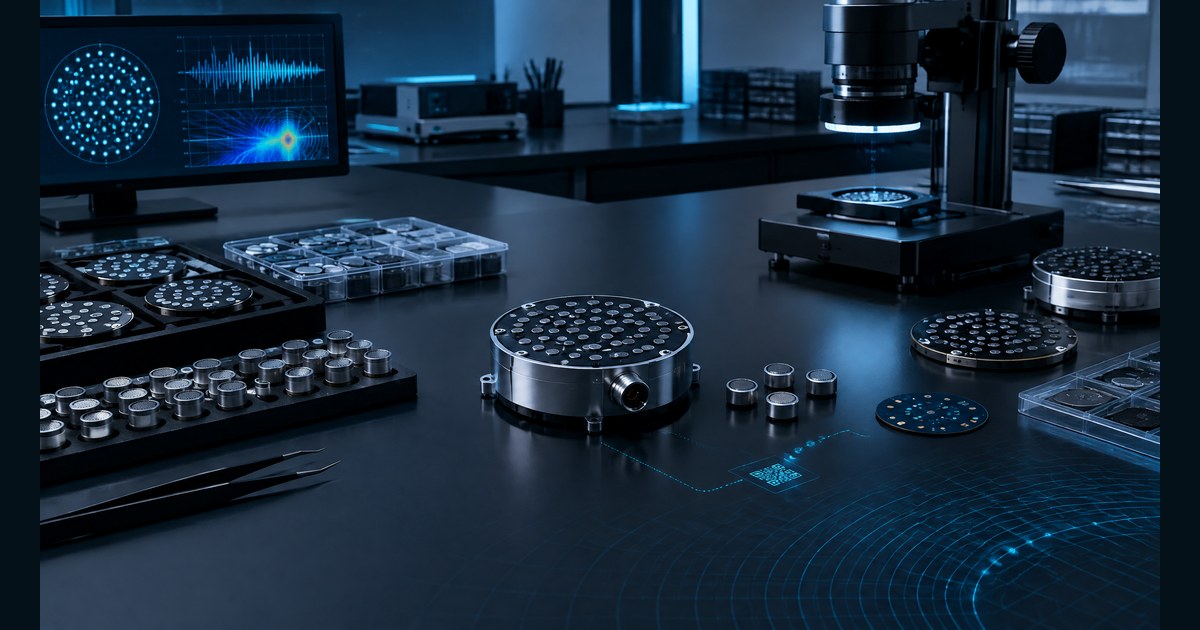
A procurement-focused guide to checking whether microphone channels are matched, calibrated, and handled with enough environmental evidence for a defensible acoustic-sensing project.
Matching means more than buying identical microphone models
A matched acoustic channel is a documented measurement chain, not a box of visually identical parts. NIST explains that calibration establishes the quantitative relation between a microphone's electrical output and the specified acoustic signal. In practice, the record should connect the microphone capsule to its preamplifier, cable or interface, acquisition channel, and calibration result.
Confirm the sound-field assumption
Free-field, pressure, and random-incidence microphones are designed around different sound-field assumptions. National Instruments' G.R.A.S. guide explains that their differences become especially important at higher frequencies, where microphone dimensions influence the measured field. A supplier record should therefore identify the microphone category and intended incidence condition. A channel cannot be called matched merely because its model number matches another channel if the installation, orientation, correction data, or signal chain differs.
Match the complete channel, not only the capsule
Ask for an asset ID, capsule type, preamplifier type, interface or connector, nominal sensitivity, calibration date, and the calibration file or chart associated with that exact combination. National Instruments describes microphone sets delivered as a unit with calibration charts for sensitivity and frequency response. That is more useful than a generic family datasheet because it gives the integrator a channel-level reference for configuration and later troubleshooting.
What a useful calibration record should contain
The purpose of a calibration record is to preserve the conditions under which a sensitivity or response was established. It should let a reviewer identify what was measured, by which method, against which reference, and with what uncertainty or acceptance rule. The exact laboratory method depends on the microphone, frequency range, application, and required uncertainty; NIST cautions that calibration methods differ in complexity and accuracy.
Separate nominal specifications from measured evidence
A datasheet may state a typical sensitivity or frequency range. A calibration record should identify the individual unit or complete set and show the measured sensitivity, response information, reference conditions, date, and instrument identity where applicable. Keep nominal limits, production test results, laboratory calibration, and a field check as separate evidence types. They answer different questions and should not be presented as interchangeable.
Define matching tolerance in writing
The buyer and supplier should agree what matching means for the project: sensitivity difference at a stated frequency, frequency-response deviation over a stated band, phase or timing consistency for array processing, or a combination. The tolerance should include the test condition and calculation method. Without those details, a phrase such as close match cannot be audited or used consistently during incoming inspection.
Environmental handling is part of measurement integrity
Microphones do not operate in an abstract laboratory. NIST identifies static pressure, temperature, relative humidity, vibration, and other influences as factors that can affect microphone performance. GRAS explains that environmental coefficients describe sensitivity changes relative to the conditions used during calibration. The practical procurement issue is therefore not to promise one universal correction, but to preserve the conditions and handling history needed to judge whether a result remains fit for purpose.
Record storage, transport, and installation events
A useful handling log can record the unit ID, packing and unpacking dates, storage location, temperature and humidity observations where relevant, shock or visible-damage inspection, connector or cable condition, protective accessories, and the time allowed for the unit to stabilize before verification. These are project controls rather than universal legal requirements. Their value is that a later sensitivity change can be investigated against an actual history instead of an assumption that the sensor remained unchanged.
Treat condensation and contamination as decision points
The record should state what happens if a sensor arrives cold, wet, contaminated, or with a damaged windscreen or enclosure. Do not silently install it and interpret a failed check as a software problem. Quarantine, visual inspection, drying or acclimatization under an approved procedure, and repeat verification may be appropriate, but the responsible party and release criteria should be agreed in advance. A supplier should not claim environmental robustness beyond the documented design or test evidence.
Use field verification to protect the baseline
A field check does not replace a laboratory calibration certificate. It answers a narrower question: whether the channel behaves consistently with its recent baseline under the current setup. GRAS notes that environmental changes can affect sensitivity and that a calibrator itself may require environmental consideration. A project should define the check source, coupling arrangement, frequency or level, acceptable deviation, and response when the result falls outside the limit.
Build a before-and-after evidence path
For a deployment or maintenance event, retain the pre-installation check, installation date, environmental observations, post-installation check, and any configuration change. The same channel identifier should appear in the acoustic data, calibration record, and maintenance log. This allows an integrator to distinguish a genuine change in the observed sound environment from a changed microphone sensitivity or an altered acquisition setting.
Connect records to acceptance without overclaiming
Acceptance can verify that supplied channels meet the written matching and documentation criteria. It cannot by itself prove a universal drone-detection range, aircraft identity, or classification accuracy. Acoustic sensing observes sound that is present at the microphone; it does not establish a unique aircraft identity or authority to take action. Keep channel acceptance, site validation, and operational decisions as separate review stages.
Questions to put to a drone acoustic sensor manufacturer
A focused request for records is often more revealing than a long list of headline specifications. Ask the manufacturer to show how each acoustic channel can be identified, compared, protected, and reverified throughout the project lifecycle.
A practical document request
Request a channel map; individual serial or asset identifiers; microphone and preamplifier details; matching definition and tolerance; calibration charts or files; calibration method and reference conditions; environmental operating and storage limits; handling and acclimatization instructions; field-check procedure; nonconformance workflow; and revision history for firmware, correction files, or mechanical changes. Ask which records are supplied with the shipment and which require project confirmation.
What to confirm before integration
Confirm the sound-field model, sampling and interface assumptions, connector and cable configuration, time synchronization needs, enclosure and wind-protection arrangement, serviceable components, and ownership of calibration records. SonicVast project discussions can address acoustic sensing, customization, and integration support, but the actual microphone set, documentation package, environmental limits, SDK or interface contents, and service terms should be confirmed in writing for the specific project.
Turn matching language into an evidence schedule
Before requesting a quotation or pilot, define the channel identifiers, matching metric, calibration conditions, environmental log fields, field-check method, and release criteria. Then ask each supplier to mark which evidence is standard, which is project-specific, and which must be generated during acceptance.
Discuss your projectCalibration intervals, environmental limits, matching tolerances, and acceptance methods depend on the microphone design and project uncertainty requirements. Acoustic sensing does not by itself identify a unique aircraft or authorize an operational response. Confirm product configuration, records, interfaces, and service terms in writing.