
PIPELINE DETECTION / PRACTICE NOTE
Drone Detection for Pipelines: Acoustic, RF and Multi-Sensor Approaches
Pipeline environments are long, uneven and operationally sensitive. A responsible detection program therefore begins not with a promised sensor result, but with a defined decision: what must be noticed, who may review it, what evidence can be retained, and how a site will validate the answer without disrupting safe operations.
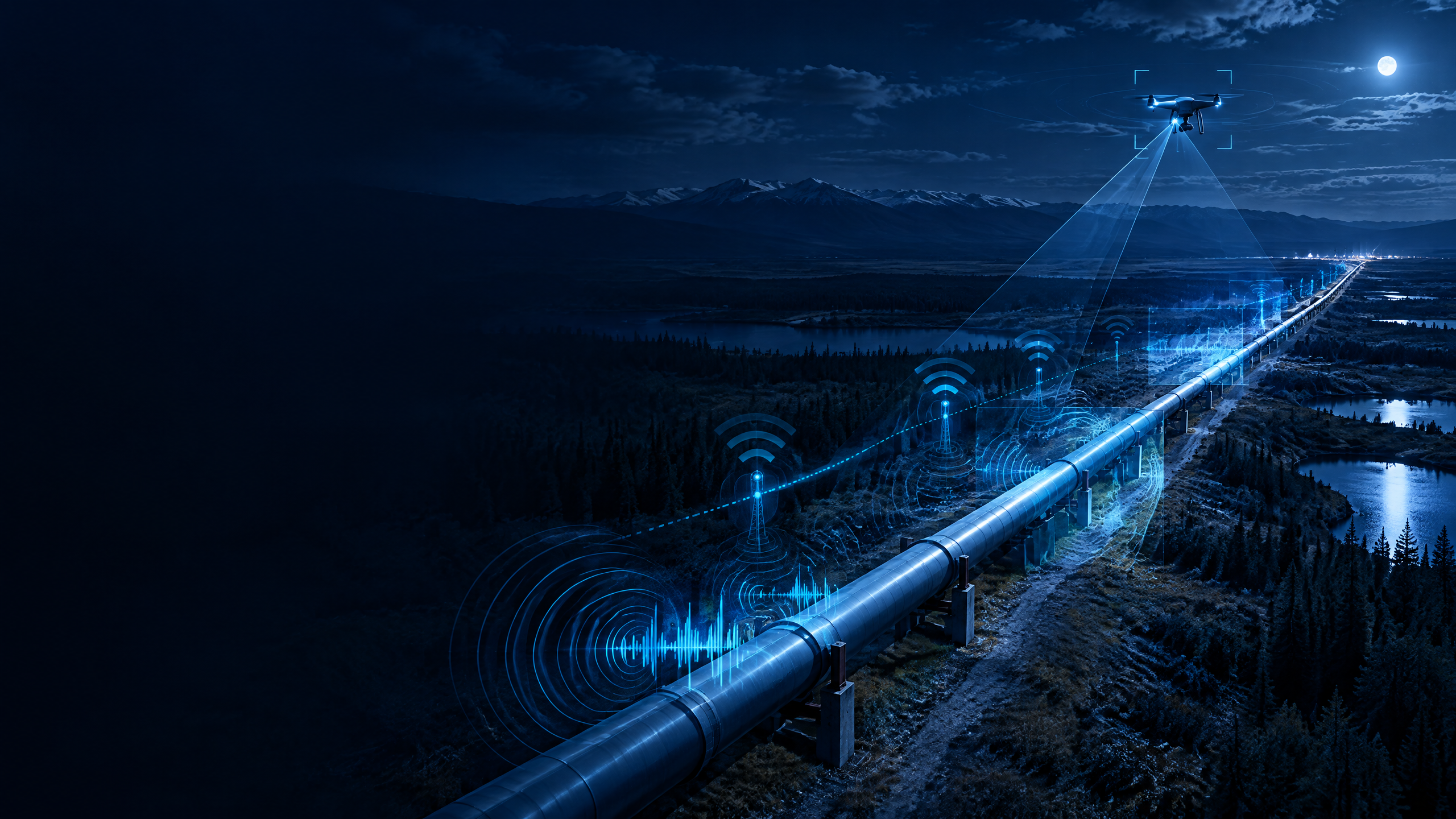
A compliance-first guide to evaluating acoustic, RF and multi-sensor drone-detection layers around pipeline corridors, with uncertainty, human review, authorization and data governance treated as design requirements.
Use sound as a contextual signal
Acoustic sensing can add context where line of sight is inconsistent, but the signal is shaped by terrain, weather, machinery, vehicles, wildlife and local activity. Treat an acoustic event as an observation requiring classification, not as proof of a drone. Document the listening environment, known nuisance sources, privacy boundaries and the review path before tuning alerts. Site-specific validation should test representative conditions over time and record both missed events and false positives without turning raw audio into an unrestricted archive.
Frame RF observations as uncertain evidence
RF sensing may identify activity associated with a control, navigation or communications signal, yet the observation can be incomplete, ambiguous or affected by lawful nearby users. Integrators should define what the system is authorized to observe, how identifiers are minimized, and when an analyst must withhold a conclusion. Do not infer operator intent, aircraft identity or unlawful conduct from an RF observation alone. Preserve only the fields necessary for the approved use case, apply access controls, and establish retention and deletion rules with the asset owner and counsel.
Let EO/IR support human verification
Optical or EO/IR imagery can help a reviewer understand scene context, but visibility, lighting, occlusion and camera movement all limit confidence. A video frame is evidence for review, not an automatic finding. Define lawful viewing zones, masking expectations, role-based access and escalation criteria. If imagery is linked to an alert, keep the association auditable and explainable; separate confirmed observations from hypotheses, and provide a clear way to correct a record when later review changes the assessment.
Fuse signals without hiding uncertainty
A multi-sensor design can help reviewers compare independent observations across a corridor, but fusion does not automatically create certainty. Define the event model, confidence vocabulary, time synchronization assumptions, sensor health checks and human approval points. Connect alerts to the approved C2 or incident workflow through governed interfaces and least-privilege API access. Validate the complete chain with site owners: sensing, correlation, notification, review, logging, correction and closure. If the data cannot explain why an alert was raised, it is not ready to carry operational weight.
Where this approach applies
The framework is useful for pipeline operators, control-room teams, integrators, auditors and public-sector partners comparing detection concepts for lawful low-altitude awareness. It is most appropriate during requirements definition, pilot design, governance review and change management. It is not a substitute for local aviation, privacy, radio, occupational-safety, procurement or critical-infrastructure requirements, and it should not be read as an instruction for tactical deployment or response.
Start with a governed site assessment: map the corridor, name the decision owners, inventory lawful data sources, define human-review gates and agree on how uncertainty will be recorded before selecting sensors or integrations.SonicVast provides civil low-altitude security education. This record contains no performance guarantee, detection-range claim, superiority claim or operational countermeasure guidance. Organizations remain responsible for authorization, legal compliance, safety, security and site-specific validation.