
TECHNOLOGY INSIGHT / INTEGRATION
Drone Detection System Integration: A Guide for C-UAS Solution Providers
For civil low-altitude security, a detection system should be treated as an evidence and decision-support service, not as a standalone claim about an aircraft or operator. Integrators must connect complementary observations with site procedures, aviation and spectrum requirements, privacy safeguards, and accountable human review. The right architecture depends on the location, environment, protected activity, available infrastructure, and authorized response policy. This guide outlines a disciplined way to select partners, define interfaces, validate performance for the intended use, and communicate uncertainty without turning a sensor output into a conclusion about identity, intent, authorization, or threat.
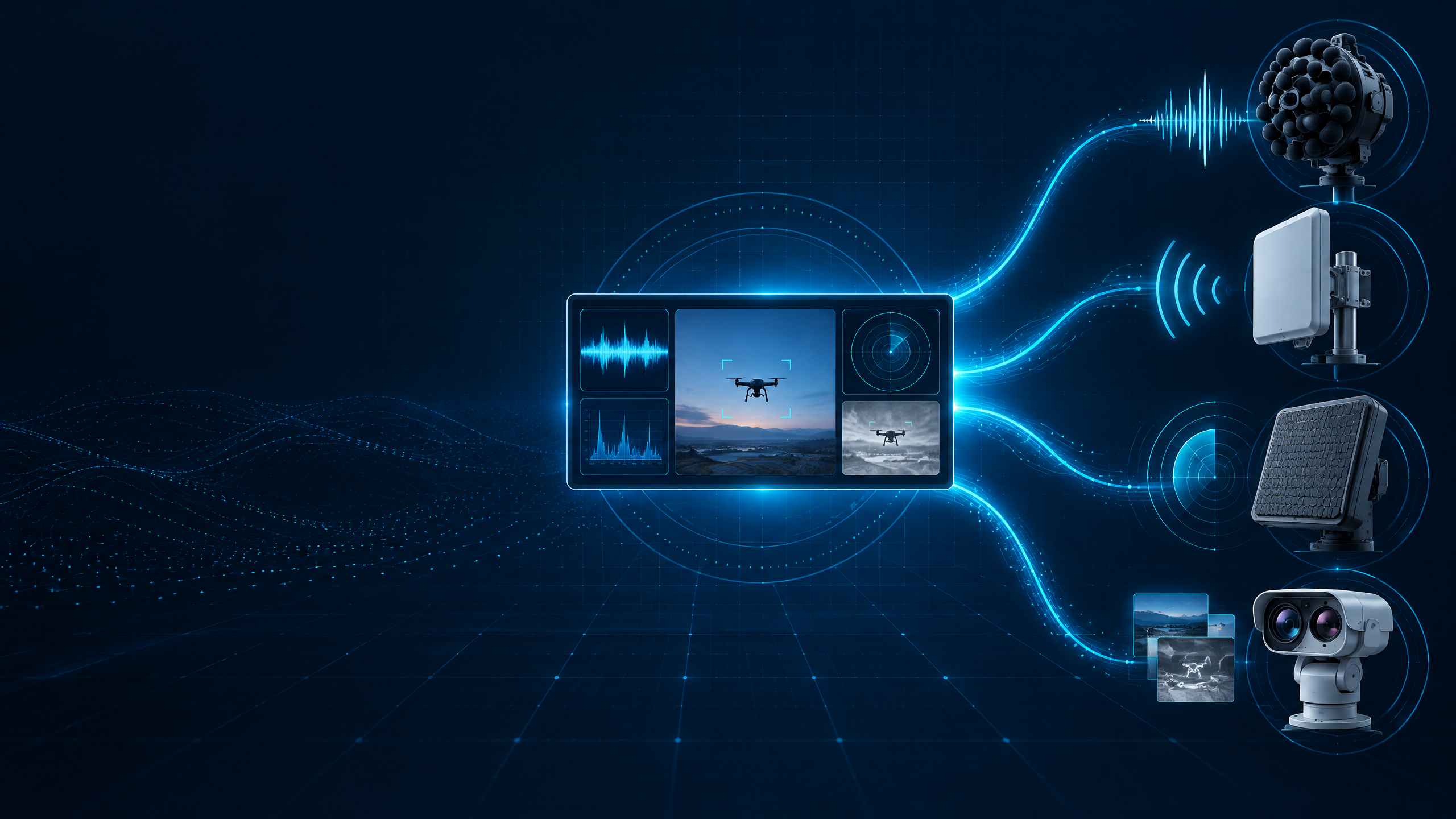
Civil C-UAS integration is less about selecting a single sensor than creating a documented, reviewable system that fits a particular site, its risks, and its lawful operating context.
Start with the site and the decision
Begin with a site-led use case rather than a catalogue of sensors. Map airspace interfaces, people and property at risk, normal activity, obstructions, weather exposure, electromagnetic conditions, acoustics, lighting, network paths, and available power. Define which decisions the system may support, who reviews an alert, what evidence must be retained, and what the system must never infer. Airports, energy facilities, oil and gas sites, and other critical infrastructure require coordinated safety, aviation, spectrum, privacy, and emergency-policy review. Technical suitability is therefore site-specific: a design that is useful in one setting may be unsuitable, unlawful, or unsafe in another.
Combine evidence layers without overclaiming
RF observation, radar, EO/IR, acoustic sensing, and site context can contribute different kinds of evidence, but none should be treated as a complete answer by itself. RF-silent operation or fibre-optic control can reduce observable RF cues, while weather, structures, traffic, reflections, ambient sound, lighting, and network conditions can affect every layer. Fusion should preserve source, time, confidence, coverage assumptions, and known gaps rather than manufacture certainty. A detection signal does not by itself prove identity, intent, authorization, or threat. Human reviewers should be able to inspect the underlying observations and record why an alert was accepted, downgraded, escalated, or closed.
Select partners through interfaces and governance
Assess providers on integration discipline as much as on sensing technology. Request clear data schemas, timestamping, health status, audit logs, access controls, retention settings, cybersecurity responsibilities, software-update practices, and failure-mode documentation. Clarify whether outputs are raw observations, classifications, tracks, or workflow events, and require terminology that distinguishes correlation from confirmation. Establish ownership for calibration, maintenance, incident review, and privacy requests. Contracts should define lawful-authority boundaries and prohibit undocumented countermeasure, interception, or jamming assumptions. A modular design can reduce lock-in, but only when interoperability is tested under the actual site constraints and operators receive training for uncertainty and degraded modes.
Validate, document, and improve responsibly
Validation should mirror the intended civil environment and be agreed before deployment. Document scenarios, environmental conditions, test objects or observations, exclusions, sampling limits, alert-handling steps, and acceptance criteria without promising universal results. Include nuisance and missed-observation review, latency and data-quality checks, sensor-health events, manual overrides, and safe failure procedures. Re-test after layout, software, lighting, construction, spectrum, or policy changes. Keep an evidence register linking observations to reviewer decisions, while applying proportionate privacy controls and retention limits. A mature integrator reports uncertainty and site boundaries plainly, then uses post-incident reviews and scheduled governance checks to improve the service within lawful authorization.
Integration principles for civil low-altitude safety
Before selecting or connecting any sensor, integrators should define the safety objective, accountability boundaries, data governance, validation criteria, and escalation path. Technical value comes from reviewable contextual evidence, not absolute conclusions drawn from a single signal.
Discuss a Civil Integration BriefingEditorial note: this article provides civil, compliance-first technology education only. It is not operational instruction, legal advice, or a performance promise. All sensing, data handling, system integration, and follow-on action must remain within applicable authorization, aviation, electromagnetic-compatibility, privacy, and site-governance requirements, with qualified human review.