
TECHNOLOGY INSIGHT / ANALYTIC RF
Drone RF Signal Analysis: Understanding Modern RF-Based Detection
Analytic RF can help authorized civil-safety teams build awareness of radio activity associated with low-altitude operations and add contextual evidence to a broader detection process. It is not a standalone verdict: responsible use depends on local radio rules, electromagnetic…
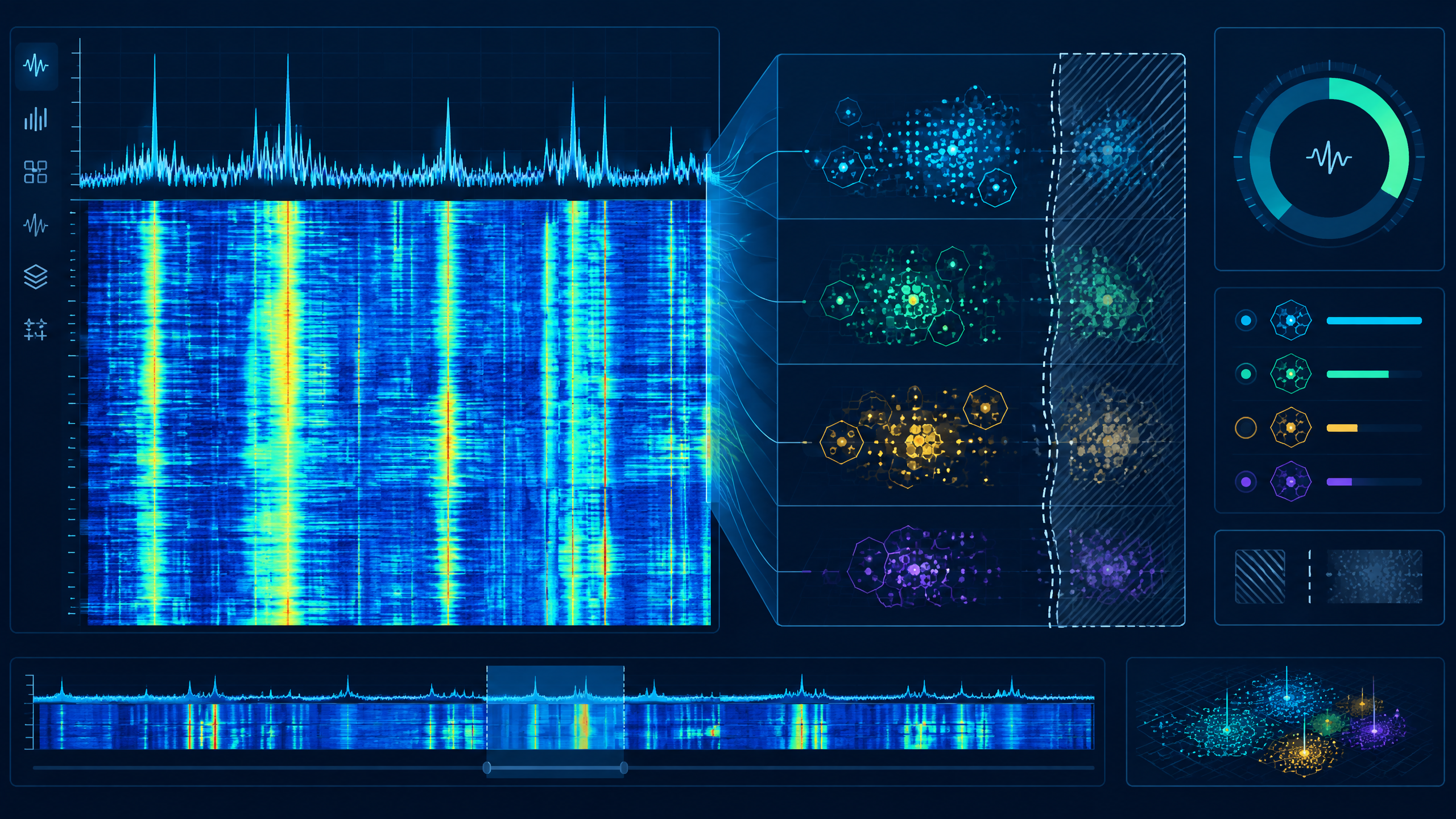
Analytic RF can help authorized civil-safety teams build awareness of radio activity associated with low-altitude operations and add contextual evidence to…
TECHNICAL PRINCIPLE / SAMPLE → ANALYSE → EXPLAIN
Analytic RF technical principle
Analysis makes signal context reviewable.
A governed analysis path turns a permitted RF observation into a documented, explainable item for qualified civil-safety review.
Receive bounded observations
The sensing boundary is defined by authorisation, data minimisation and the site’s legitimate safety objective.
Compare changing context
Pattern, timing and environmental context are assessed with the limitations of the available information kept visible.
Document the interpretation
Review outputs record confidence, limitations, ownership and next-step governance rather than presenting an automatic conclusion.
Civil safety infographic / For understanding and review; not a spectrum-action or response guide.
Public-safe summary
Analytic RF can help authorized civil-safety teams build awareness of radio activity associated with low-altitude operations and add contextual evidence to a broader detection process. It is not a standalone verdict: responsible use depends on local radio rules, electromagnetic compatibility, privacy safeguards, system integration, and human review.
What Analytic RF means in a civil-safety context
Analytic RF is a non-contact sensing approach that examines radio-frequency activity in the surrounding environment. At a high level, an analytic system looks for observable signal characteristics and changes over time, then presents those observations as awareness for trained and authorized personnel. The purpose is context, not certainty. A signal observation may help a team understand that a radio-enabled device could be active nearby, or that the local RF environment has changed. The observation alone does not establish who is operating a device, why it is present, whether it is compliant, or whether it creates a safety concern. Those questions require other evidence and an accountable decision process. For civil low-altitude safety, this distinction matters. RF awareness can support an operator who is already considering site conditions, authorized activity, visual information, airspace notices, and reports from other systems. It should not replace those sources or turn an automated output into an accusation.
How RF awareness complements other sensors
RF analysis is most useful when treated as one layer in a multi-sensor fusion model. A camera, acoustic sensor, airspace-management service, or human report may answer a different part of the same question. Combining signals can help teams compare timing and context, identify uncertainty, and decide whether additional human verification is appropriate. System integration should preserve the meaning and limitations of each source. A dashboard can show that several observations are consistent in time, but consistency is not proof of identity or intent. Clear confidence labels, event history, access controls, and an audit trail help reviewers understand what the system observed and what it did not observe. This approach is relevant to airports, energy and port facilities, and industrial sites because each location has different operating patterns and different consequences for disruption. A vendor-neutral program therefore starts with the site’s safety objectives and governance requirements rather than assuming that one sensor or one alert policy fits every location.
Governance principles for civil low-altitude safety
Airports, energy and port facilities, and industrial sites should define the safety objective, accountability boundaries, records, and escalation path before deciding how Analytic RF can contribute one authorized input to multi-source awareness.
Discuss an RF Governance ReviewEditorial note: this article is civil, compliance-first technology education only, not operational instruction or legal advice. Any RF observation, data handling, or follow-on action must remain within local authorization, electromagnetic-compatibility, privacy, aviation, and site-governance requirements, with qualified human review.