
ACOUSTIC SENSING / ENGINEERING AND PROCUREMENT
Why a Drone Sound Detection System Needs an Unknown or Uncertain Outcome
A drone sound detection system does not listen to a world divided neatly into drone and not-drone. It listens to overlapping sound sources, changing weather and site conditions, and aircraft whose acoustic patterns may not appear in the training data. For that reason, an operational design should include an unknown, uncertain, or needs-review outcome alongside a positive and negative label. The exact name depends on the implementation, but the purpose is the same: preserve uncertainty when the evidence is not strong enough for a more specific conclusion.
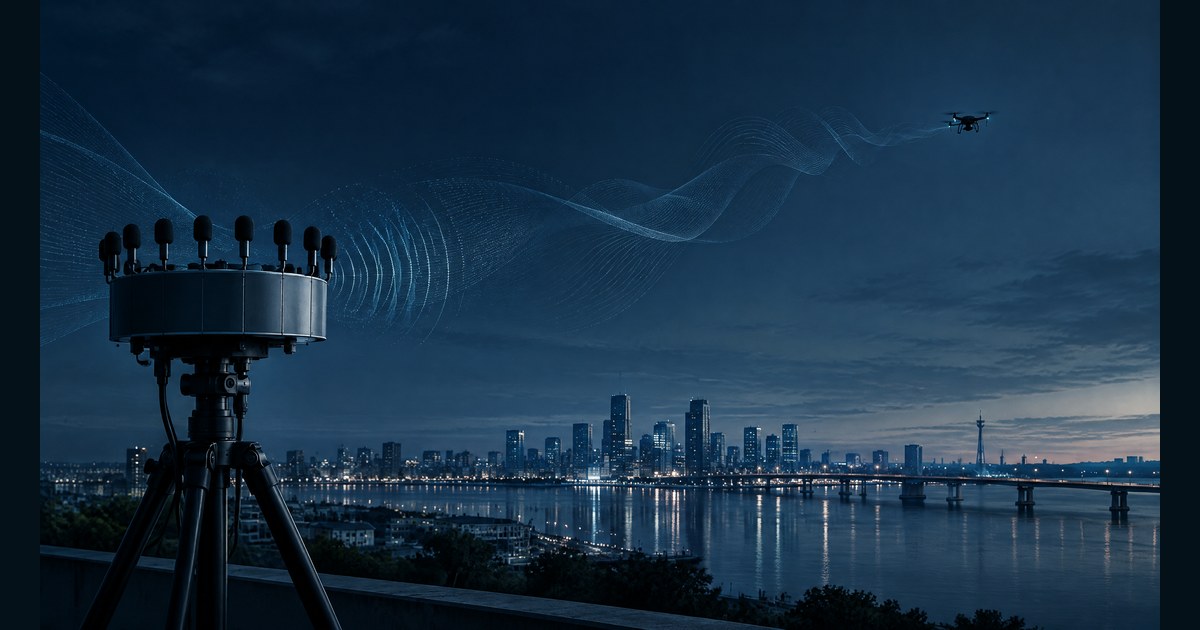
A responsible drone sound detector should be able to say that an observation does not fit its known classes. That single design choice protects operators from turning unfamiliar industrial sound into an overconfident drone identification.
A binary label hides the real decision problem
A simple classifier may be presented with two classes: drone and no drone. That can be useful for a controlled experiment, but a civil site has more possibilities than those labels suggest. A bird, road vehicle, ventilation plant, construction tool, aircraft, loudspeaker, or an unfamiliar aircraft can produce an observation that is neither a validated drone example nor a clean background example. DSIAC identifies surrounding environmental sound as a central challenge for acoustic drone detection, while the Sensors review separates presence detection from identification and localization.
Detection, identification, and location are different outputs
A detector may indicate that a sound is compatible with a drone-like event. That does not establish the aircraft model, operator, authorization, intent, or exact position. A microphone array may add directional or localization information, but a bearing is not the same as a confirmed identity. The FAA states that UAS detection systems do not determine intent or the level of threat posed by a UAS. A procurement specification should therefore name each output separately instead of treating one confidence score as an all-purpose answer.
The unknown is not the same as a failed sensor
An unknown result can be a valid observation. It may mean that the audio is too weak, masked, distorted, incomplete, outside the model's known classes, or inconsistent with the patterns used for a positive decision. A failed sensor is different: it concerns availability, health, calibration, communications, or data integrity. The system should make those states distinguishable so an operator does not mistake missing data for a quiet scene or an unfamiliar sound for a confirmed drone.
Why closed-set classification is risky at a real site
Traditional classification assumes that the test examples belong to the same label set used during training. In practice, a perimeter receives new combinations of sources and conditions. The Scientific Reports study “Open set classification of sound event” describes this as an open-set recognition problem: unexpected sound events can appear even when the model was trained on known classes. Its discussion also notes that selecting an appropriate threshold for unknown detection is difficult and that industrial deployment has additional complexity.
Unknown sounds can be forced into a familiar class
If a system must choose drone or no drone for every audio window, it may assign the less-wrong label even when neither is well supported. A high confidence value does not automatically prove that the input resembles a validated drone case; it can also reflect how the model partitions unfamiliar feature space. An explicit unknown state gives the system somewhere to place an observation that deserves investigation without claiming more than the audio supports.
The threshold changes the meaning of an alert
A threshold is not a universal quality setting. Lowering it may make the system more willing to surface weak candidate events, but it can increase review workload. Raising it may reduce routine alerts while allowing more marginal events to remain unreported. The threshold should be evaluated with site recordings, known confounders, time windows, and a defined review process. A vendor's single laboratory score cannot establish the right operating threshold for every airport, port, utility, or industrial perimeter.
What an uncertainty-aware result should contain
The useful question is not simply whether the interface displays the word unknown. Buyers should ask what evidence accompanies that state and how it behaves in the rest of the workflow. An uncertainty-aware result can help an operator decide whether to collect more audio, compare another approved sensor, check a site activity record, or close the event as an environmental sound.
Record the reason for uncertainty
A review record should distinguish at least between low signal quality, conflicting features, an out-of-distribution pattern, an incomplete time window, and a sensor or communications problem. The wording can be product-specific, but the distinction matters. “Unknown sound” and “sensor unavailable” lead to different engineering and operational follow-up. If the system cannot provide a detailed reason, it should still preserve the raw result metadata needed for later review, subject to the site's privacy and retention policy.
Keep confidence attached to the claim it qualifies
A confidence or score should be labelled by what it measures. It might describe similarity to a learned class, an event probability under a defined test condition, or a localization estimate. It should not be presented as confidence in aircraft intent, legal status, or threat level. The FAA's distinction between detection and threat determination is a useful governance boundary for interface design and operator training.
Preserve an accountable review path
NIST's AI Risk Management Framework emphasizes trustworthiness considerations across design, development, use, and evaluation. Applied to acoustic sensing, that means defining who reviews an unknown event, what additional evidence may be consulted, how the decision is recorded, and when the model or threshold is re-evaluated. The purpose is not to replace professional judgement with a score. It is to make the score, its limitations, and the resulting decision traceable.
How to test the unknown state before procurement
An acceptance plan should test more than successful examples. It should ask whether the system remains honest when the input is unfamiliar or the environment changes. The test can be designed as a civil sensing evaluation without prescribing any response or mitigation action.
Build a site-specific confounder set
Collect or document representative background conditions such as road traffic, fans, pumps, generators, construction, birds, weather, aircraft, and approved site activity. Include quiet periods and changing conditions. The Sensors review reports confusion from birds and building sounds in reviewed acoustic drone work, so a buyer should not accept a dataset containing only clean drone recordings and silent backgrounds as sufficient evidence.
Measure unknown handling separately from positive detection
Ask the supplier to report how often known drone examples are detected, how often known background examples are rejected, and how often unfamiliar or deliberately held-out sounds are sent to unknown or review. The test should state the recording conditions, distance or geometry where relevant, class balance, time window, and treatment of repeated clips. “Accuracy” without these definitions cannot tell a project team whether the system will create an honest review queue.
Test operational handoff, not only model output
A technically correct unknown label has little value if the interface hides it, collapses it into a drone alert, or gives no way to annotate the outcome. Confirm that events include timestamps, sensor identity, health state, relevant audio features or permitted excerpts, and an audit trail for operator disposition. Confirm separately how audio is retained and accessed under the site's privacy and governance rules.
A practical buyer specification for uncertainty
The requirement can be written in plain language. Ask for a defined set of outputs that includes positive candidate, negative or background, unknown or needs review, and sensor unavailable where applicable. Require the supplier to explain the decision thresholds, the training and evaluation classes, the environmental conditions represented, and the evidence available for post-event review. Treat any claimed accuracy, coverage, or identification capability as a project-specific statement that must be supported by agreed test records.
Questions for a supplier or integrator
Ask: What causes an event to enter the unknown state? Can thresholds be configured by site policy? Are unknown events included in validation, or only drone and background classes? How are new recurring sounds added without silently changing historical results? Can the system distinguish a model uncertainty from a sensor-health alarm? What metadata is exported to the site platform? Which outputs are observations, and which—if any—are derived estimates? These questions expose whether uncertainty is a real system function or only a disclaimer in documentation.
When SonicVast enters the discussion
SonicVast can be approached for a project conversation about acoustic sensing, system architecture, and integration scope. The appropriate microphone configuration, processing workflow, interfaces, evaluation method, data handling, and service terms depend on the site and must be confirmed in writing. This article does not establish a universal accuracy level, deployment result, certification, availability statement, or guaranteed classification outcome.
Put the unknown state into the acceptance plan
Before selecting a drone sound detector, define the labels, thresholds, confounder recordings, review roles, metadata, retention rules, and pass/fail evidence for uncertain events. Then ask each supplier to demonstrate those behaviours on representative site conditions rather than presenting only a headline accuracy figure.
Discuss your projectAcoustic sensing observes sound and does not detect a literally silent target or establish aircraft identity, flight permission, intent, or response authority. Environmental conditions and site evidence matter. Product interfaces, thresholds, integration compatibility, data retention, accuracy, availability, certification, and service terms require written project confirmation.