
TECHNOLOGY INSIGHT / PASSIVE ACOUSTIC SENSING
Drone Sound Localization vs. RF Detection: What Is the Difference?
For civil low-altitude safety, the practical distinction is not which sensor is universally “better.” It is what each sensor can observe, what local conditions can obscure that observation, and how alerts are reviewed within a lawful, documented process.
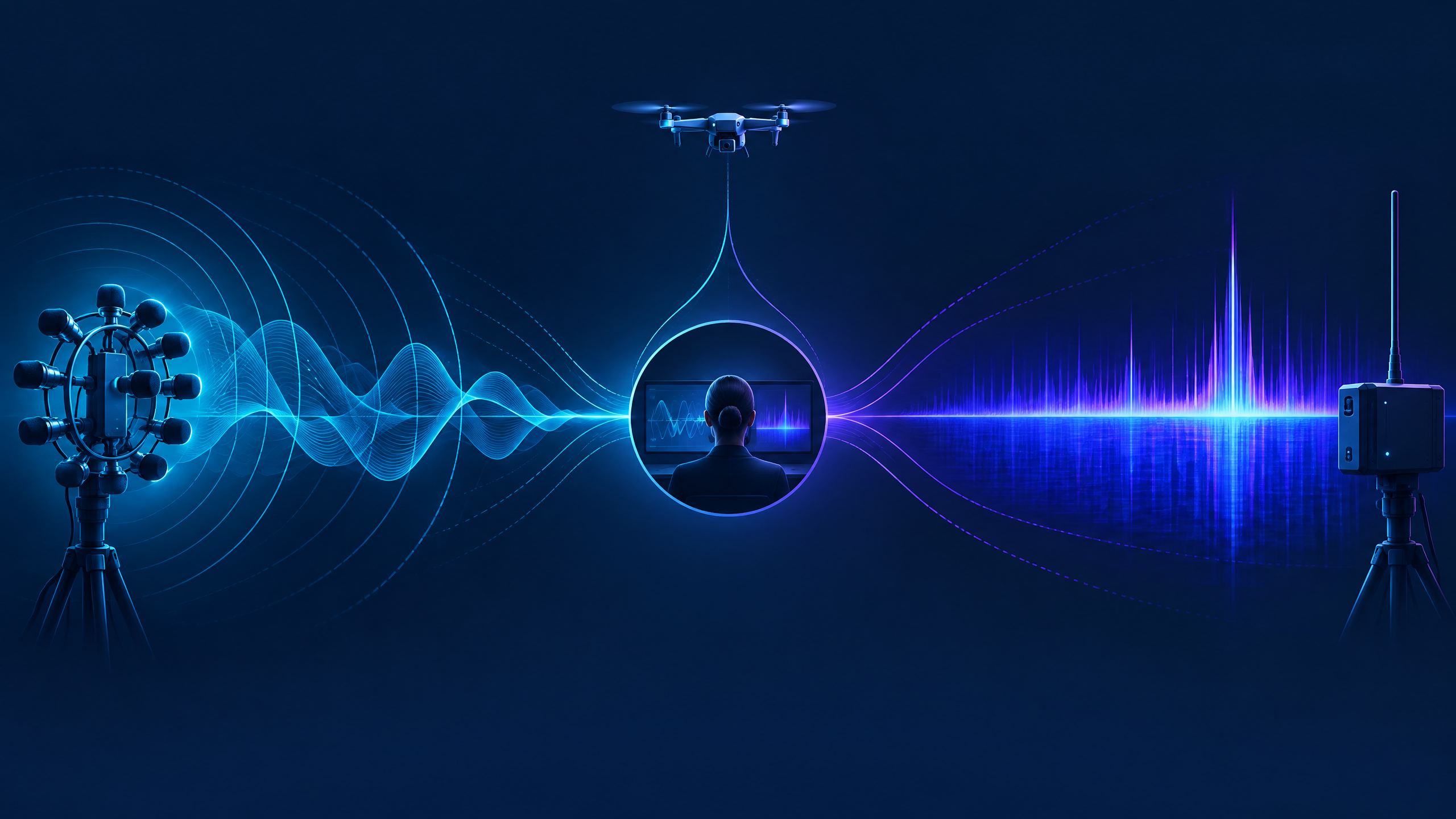
Acoustic localization and radio-frequency (RF) detection observe different signals. Acoustic sensing listens for sound associated with a drone’s propulsion system, while RF detection monitors radio emissions associated with communications or other wireless activity. Neither signal, by itself, establishes intent or a safety finding.
TECHNICAL PRINCIPLE / SOUND + SIGNAL → CONTEXT → REVIEW
Acoustic sensing technical principle
Different sources, complementary questions.
Sound and authorised RF awareness observe different forms of context; neither should be treated as a complete conclusion.
Observe physical activity
Acoustic sensing listens for environmental sound patterns associated with aircraft activity.
Observe authorised RF context
RF awareness can provide a different information source when relevant radio activity is observable.
Keep evidence distinct
Correlate available context responsibly without inferring identity, intent or authority from one source.
Civil safety infographic / For understanding and review; not operating guidance.
Different physical signals
Acoustic sensing uses microphones and signal processing to identify and, where supported, estimate the direction of sound reaching the sensor. The relevant signal is airborne sound from sources such as rotors and motors. RF detection instead observes electromagnetic energy in the radio spectrum and may indicate wireless transmissions associated with a UAS or controller. These are different evidence types: one is an audible environmental signal, and the other is a radio signal.
Different conditions and limitations
Sound is affected by background noise, wind, structures, distance, and other local acoustic conditions. RF observations depend on the presence and characteristics of detectable emissions, as well as the local radio environment. A quiet or noisy setting can change acoustic evidence; a busy or changing spectrum can complicate RF interpretation. Results therefore require context, validation, and clear uncertainty rather than a guaranteed identification.
Civil safety use: combine evidence responsibly
A civil program can treat acoustic and RF outputs as complementary inputs to situational awareness. CISA recommends selecting technology according to the site, the activity of concern, organizational resources, and existing security plans. Operators should record alerts, verify them through authorized procedures, protect sensitive information, and coordinate any aviation or emergency response with the relevant authorities. Detection is not interception, disruption, or enforcement.
A civil technology explainer
Acoustic localization and radio-frequency (RF) detection observe different signals. Acoustic sensing listens for sound associated with a drone’s propulsion system, while RF detection monitors radio emissions associated with communications or other wireless activity. Neither signal, by itself, establishes intent or a safety finding.
Request an Acoustic Integration BriefingThis article is educational and limited to passive, civil detection concepts. It does not provide countermeasure, jamming, interception, targeting, deployment, or operational-performance guidance. Applicable aviation, privacy, spectrum, safety, and data-governance rules must be reviewed before any system is evaluated or used. Source names are displayed for editorial transparency; no external links are shown.