
INDUSTRY WATCH / RESEARCH CONTEXT
FIU-linked research explores passive magnetic cues for short-range drone observation
Recent coverage describes research by Florida International University-linked collaborators into observing weak magnetic-field signatures associated with drone motor activity. The reported work is useful as a signal that passive physical cues remain an active research area. Its controlled, short-range findings should not be compared directly with airport or perimeter programmes, and they do not establish general detection, classification or deployment performance.
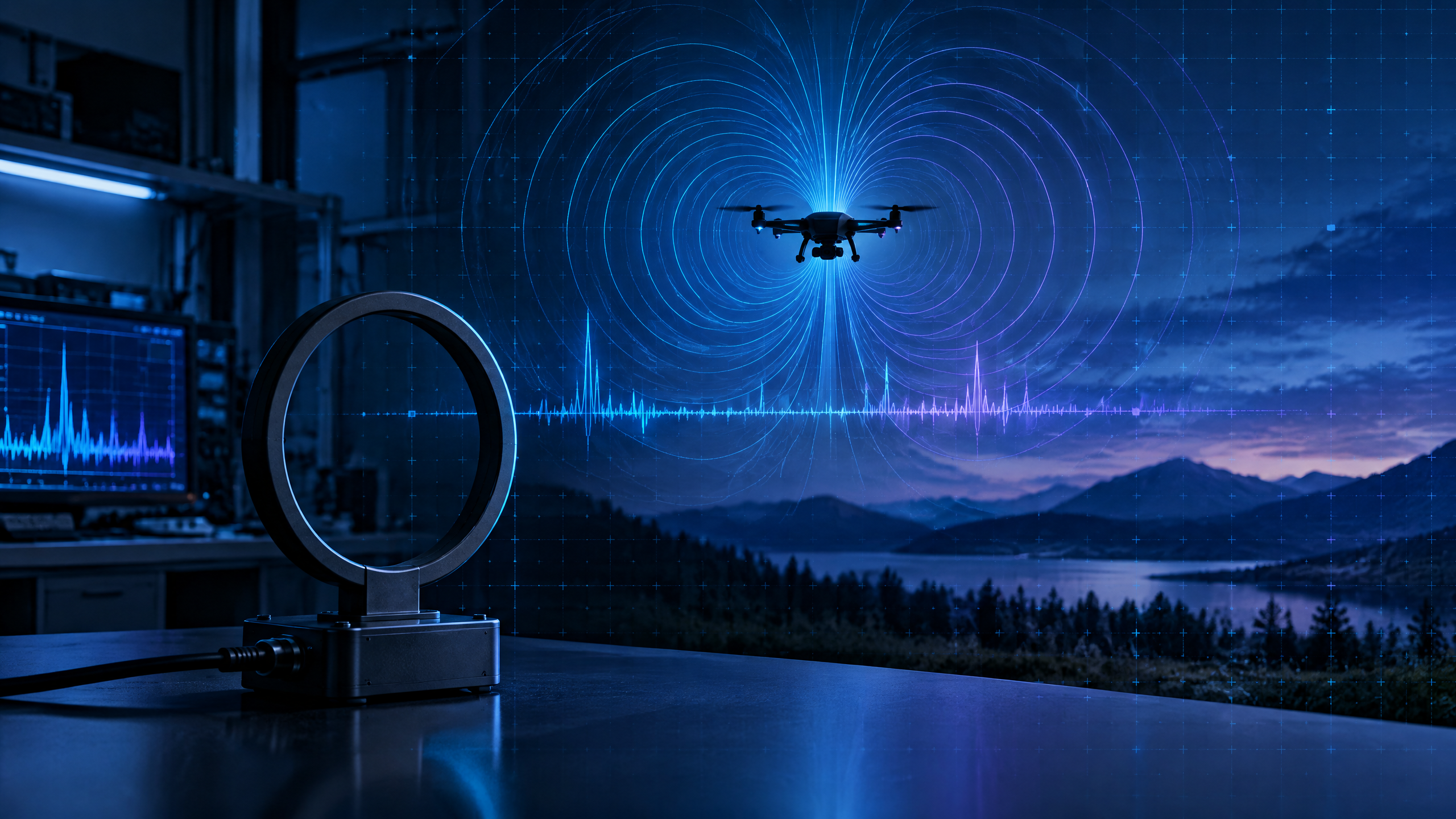
Reported research associated with Florida International University examines weak magnetic signatures associated with drone motors. Its public results are short-range and research-stage, not an airport-scale or operational deployment claim.
The reported method observes a physical motor-related cue rather than a control link or radar return.
The research coverage describes a passive approach intended to observe weak magnetic signatures produced during motor operation. That makes it relevant to a wider discussion of heterogeneous observation layers: different sensors may examine sound, radio context, reflected energy, visual context, or other physical cues. The presence of a cue does not prove a particular aircraft, operator, activity or authorisation status.
Reported controlled-test figures should stay inside the experiment that produced them.
Coverage of the research reports short-range experiments and classification findings under defined test conditions. Those results do not establish an airport-scale observation distance, all-weather performance, a false-alert rate, a deployment architecture or a commercial readiness conclusion. Environmental noise, electromagnetic context, vehicle type, placement and data quality can materially affect any physical-sensing result.
Passive magnetic research is neither a substitute for other layers nor a SonicVast product claim.
This record does not compare research results with SonicVast technology, claim compatibility or performance, or present magnetic sensing as a replacement for acoustic, radio, optical or radar observations. Mature civil programmes must evaluate lawful purpose, site conditions, privacy, data governance and accountable human review before relying on any observation layer.
A responsible interpretation for system integrators
The practical question is how an emerging sensor could contribute context while retaining its own uncertainty and provenance. Integrators should preserve the source of each observation, disclose what remains untested and route material decisions to qualified human reviewers. They should not convert a research paper or media coverage into a performance promise.
Discuss Complementary Sensing ResearchSource note: FIU-, Brookhaven National Laboratory- and University of Ruhuna-linked research context, plus DroneXL coverage. Source names are shown for transparency; no external links are displayed. The referenced work is described as short-range, research-stage and experiment-specific. This record does not claim an airport-scale result, commercial readiness, product equivalence, or SonicVast involvement.