
MULTI-SENSOR / EVIDENCE ARCHITECTURE
How AI Vision Complements Acoustic and RF Drone Detection
This technical brief examines reviewable visual context, privacy safeguards, and non-automatic conclusions. It is written for civil security and integration teams that need transparent assumptions, accountable review, and evidence governance—not a standalone claim or automated decision path.
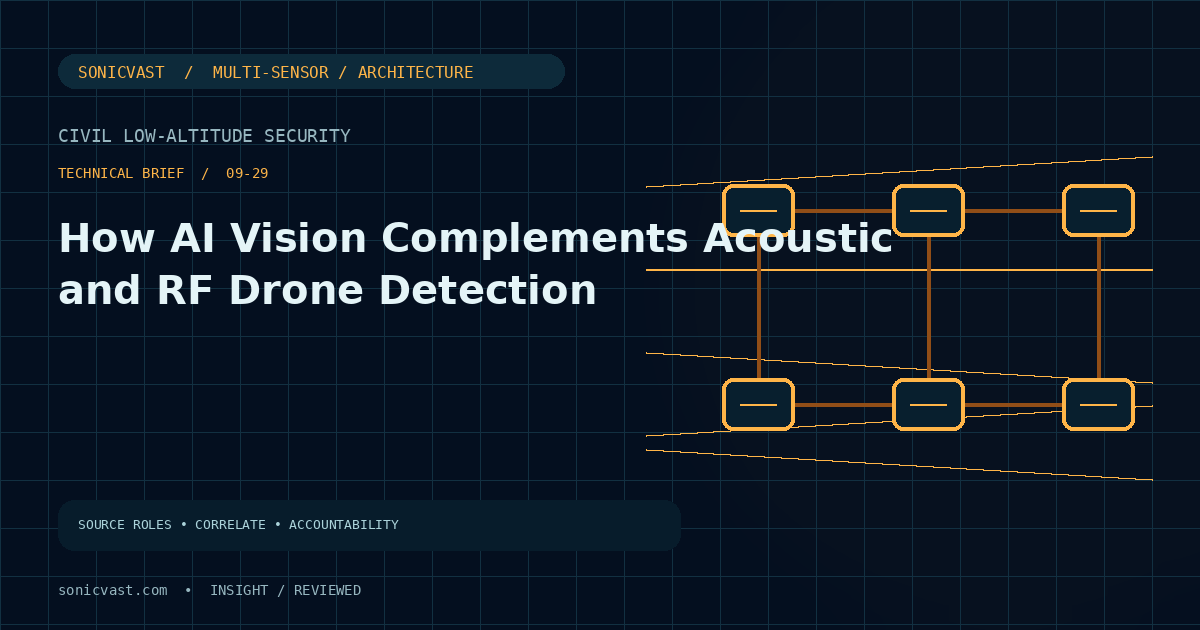
How AI Vision Complements Acoustic and RF Drone Detection is a civil, compliance-first technical brief on reviewable visual context, privacy safeguards, and…
Define what each source contributes to reviewable visual context, privacy safeguards, and non-automatic conclusions—and what it cannot establish.
How AI Vision Complements Acoustic and RF Drone Detection should begin by assigning a limited, understandable evidence role to every source. Acoustic, RF, optical, radar, and other authorised observations can provide different context with different timing, environmental dependencies, and confidence limits. Combining them does not remove those differences or turn an indication into a fact. Civil teams document purpose and provenance, and retain qualified human review for reviewable visual context, privacy safeguards, and non-automatic conclusions.
Preserve timing, uncertainty, and disagreement in the shared picture.
A responsible correlation process keeps source records distinct, labels known quality limits, and records how an authorised reviewer considered alignment or contradiction. The goal is a more informative assessment, not a frictionless automated verdict. When evidence is incomplete, late, or inconsistent, that condition belongs in the record alongside privacy, access, retention, and lawful-purpose controls.
Maintain interfaces through accountable data and lifecycle governance.
A multi-sensor architecture depends on named data owners, compatible interfaces, change records, cybersecurity controls, periodic quality review, and clear decision authority. Those controls make the architecture more serviceable for reviewable visual context, privacy safeguards, and non-automatic conclusions while retaining civil, privacy, and safety boundaries.
Treat correlation as a reviewed question, not a shortcut
Civil integration makes provenance, privacy, interoperability, uncertainty, and decision authority explicit at each hand-off.
Discuss multi-sensor interoperabilityEditorial boundary: this civil technical brief discusses complementary observation and evidence governance only. It does not provide tracking, targeting, tactical deployment, response, interception, jamming, or unsupported performance instructions. Any project requires qualified legal, privacy, aviation, safety, and engineering review.