
TECHNICAL BRIEF / PRIVACY & GOVERNANCE
Microphone Arrays and Privacy: The Compliance Boundary of Acoustic Drone Detection
A microphone array captures sound. That does not mean every array continuously saves recordings, but it does mean privacy review should begin with the actual data flow. For civil industrial facilities, airports and energy sites, the important questions are what enters the system, what is processed, what leaves it and what remains accessible.
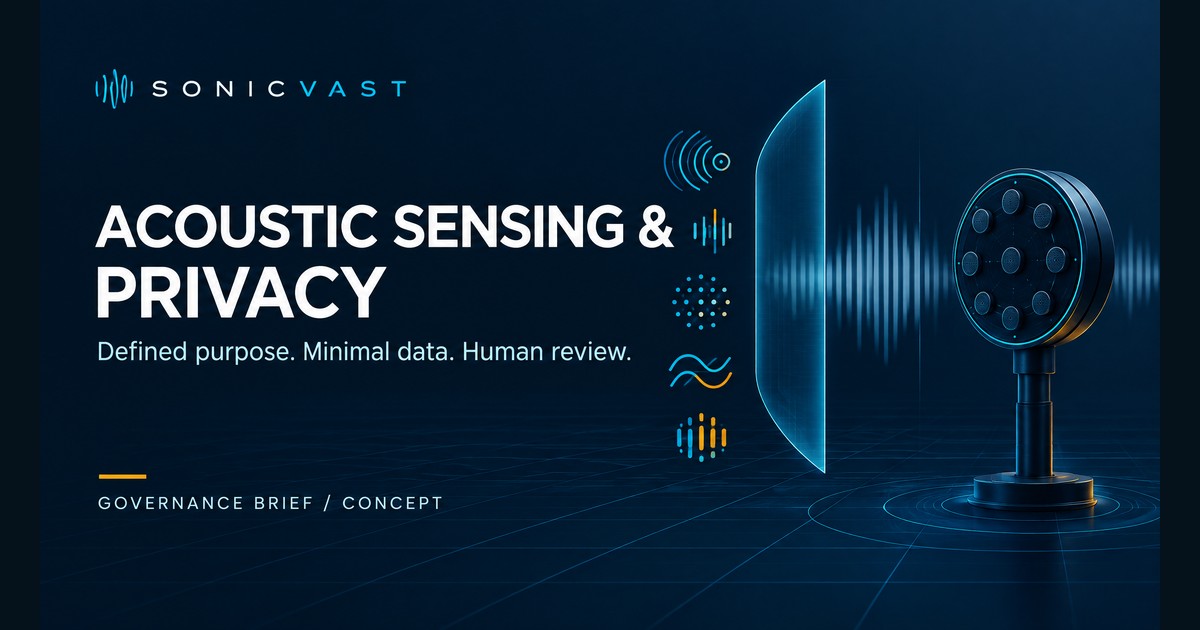
A practical privacy framework for acoustic drone detection: distinguish sound capture from retention, assess incidental speech, and verify deployment controls.
A microphone is a capture device, not proof of permanent recording
An array converts incoming sound into signals that a detection system can analyse. A transient buffer may hold samples briefly while processing takes place. Retention is a separate question: samples might be overwritten, saved as incident clips or copied into diagnostic files. These arrangements have different privacy implications and must be verified rather than inferred from the hardware.
The GDPR text published by EUR-Lex defines processing broadly, including collection and use as well as storage. Consequently, not saving an audio file does not automatically remove data-protection obligations when personal data is processed. Procurement reviewers should ask for a data-flow description covering memory buffers, local storage, network transmission, support tools and backups. “No recordings” is too ambiguous unless it explains every relevant stage.
Incidental speech can matter even when nobody listens
An industrial perimeter can include staff conversations, contractor activity and sound from neighbouring public areas. Whether intelligible speech enters a particular system depends on siting, acoustic conditions and processing. Directional response can reduce unwanted pickup, but it should not be treated as a guarantee that speech is excluded.
Under GDPR Article 4, information relating to an identified or identifiable person is personal data. Speech can meet that test through its content, a recognisable speaker or contextual details; not every environmental sound does. Automated handling does not create an exemption merely because no person listens. Review derived features and event records too: a reduced output is not necessarily anonymous if it can still be linked to a person using reasonably available information.
Rotor signatures are not human voiceprints
Features used to analyse rotor or propulsion noise concern machinery, not a person's voiceprint. That distinction matters, but it is not a general exemption for the complete processing chain. Incidental speech or data linked through another sensor may still require a personal-data assessment.
The GDPR's biometric definition requires specific technical processing of human characteristics that allows or confirms unique identification. Its Article 9 biometric provision concerns processing for the purpose of uniquely identifying a person. The European Data Protection Board explains these distinctions in its video-device guidelines. An ordinary voice recording is therefore not automatically biometric or special-category data merely because it contains a voice. However, speech content may reveal health information or another protected category, independently of biometric identification. Actual processing and purpose need separate examination.
Video-surveillance audio guidance is not a Europe-wide sensor ban
The UK Information Commissioner's Office says that directly recording conversations between members of the public is highly intrusive and usually difficult to justify. In its video-surveillance guidance, it recommends switching audio-recording capability off by default unless its use can be clearly justified and evidenced.
The European Data Protection Board's Guidelines 3/2019 similarly say unnecessary functions, including audio recording, must be deactivated in video systems. These are important warnings about avoidable collection, not a blanket legal prohibition covering every acoustic sensor across Europe. Camera-specific Dutch guidance should not be expanded into such a rule either. For acoustic drone detection, assess the necessity and proportionality of the sensing purpose and each additional function under applicable law. If cameras are integrated, review their audio facilities separately rather than assuming the acoustic layer justifies them.
Minimisation supports compliance; it does not establish it
GDPR Article 5 requires purpose limitation, minimisation, storage limitation and security. Article 6 separately requires an applicable lawful basis. Consent is one possibility, not a universal requirement or a universal solution. A legitimate-interest argument needs the relevant necessity and balancing assessment; public-task or legal-obligation grounds depend on an appropriate legal foundation. A general security objective is not enough by itself.
Choosing feature outputs instead of retained audio may reduce exposure, but it does not prove that a deployment is lawful. The controller must also address transparency, individual rights and accountability. GDPR Article 35 requires a data protection impact assessment where processing is likely to create high risk, including systematic monitoring of publicly accessible areas on a large scale. Check the relevant regulator's criteria before deployment.
PIPL review begins with personal information, not a sensor label
China's Personal Information Protection Law, published by the Cyberspace Administration of China, defines personal information by its relationship to an identified or identifiable person. Article 6 requires a clear, reasonable purpose and minimum necessary collection. Articles 17 and 19 address notice and the shortest necessary retention, subject to applicable exceptions. Article 13 provides several permitted grounds; GDPR legitimate interests should not simply be imported into that framework.
Article 26 expressly addresses image-collection and personal identity-recognition equipment in public places. It does not expressly name acoustic-only environmental sensors, but that is not an exemption from PIPL's general rules. Articles 28–29 add requirements for sensitive personal information, including biometrics, with the applicable Article 13 exceptions requiring careful review. Article 51 requires protective measures, while Article 55 identifies circumstances requiring a prior impact assessment.
Ask for evidence of encryption, access and deletion
Privacy claims should describe the hardware, firmware, software and configuration actually proposed. Verify whether raw audio is transmitted or retained, whether diagnostic modes change that behaviour, and whether downstream services add transcription or speaker analysis. Do not claim that unwanted functions are absent by design without evidence. Document who can change settings and how those changes are approved.
GDPR Article 32 requires security appropriate to risk, including encryption where appropriate; PIPL Article 51 also addresses security measures and permissions. Verify transport encryption, stored-data protection, credential handling, access controls and auditability for every relevant connection. A protocol name alone proves neither encryption nor its absence. Define deletion for audio, events, logs and backups separately. Network segmentation can help reduce exposure, but does not by itself establish adequate security or compliance.
Make privacy review part of site acceptance
For an airport boundary, energy installation or industrial campus, start with the protected area and the actual detection need. Assess nearby workplaces, residential areas and public access routes. Test unwanted pickup using a controlled, lawful method. Establish appropriate notices and a clear contact for privacy questions; signage is not consent and does not replace a lawful basis.
Assign responsibility for processing decisions, supplier support and any hosted services. Review disclosures and cross-border transfers under the applicable rules, including remote access arrangements. Verify retention settings during acceptance and revisit the assessment after configuration changes, software updates or new sensor integrations. Acoustic, camera and RF outputs can create different risks when combined. The defensible boundary is a documented, necessary deployment with tested controls—not an assurance that acoustic technology is inherently private.
Keep the use case civil and specific
This guide concerns transparent drone-detection deployments at industrial facilities, airports and energy infrastructure. It is not a framework for covert listening or monitoring private conversations. Any integrated camera or RF layer needs its own assessment within the complete deployment.
Discuss Acoustic Privacy RequirementsThis article is educational information, not legal advice or a compliance certification. Requirements depend on the jurisdiction, deployment facts and applicable sector rules. Obtain review from qualified legal and privacy professionals before relying on it or deploying a system.