
SENSOR FUSION / FIELD PRACTICE
How Multi-Sensor Detection Supports Reliable UAV Tracking
Reliable UAV tracking in a civil setting is less about asking one sensor to identify an aircraft and more about assembling a defensible account of what was observed, when, and under which site conditions. Acoustic, RF and optical systems each describe a different part of an event. A microphone array may register a sound pattern; an RF sensor may indicate an emission; an optical device may provide visual context. None of those observations, alone, proves identity, intent or authorization. Their value increases when they are time-aligned, associated with a defined site, and presented with enough context for an authorized person to assess the evidence under established procedures. A useful fusion design therefore treats a track as a working record, not a verdict. It should preserve source observations, confidence qualifiers, gaps and operator annotations rather than hiding uncertainty behind a single label. This approach supports proportionate escalation, clearer handover between teams and better after-action review. It also keeps procurement focused on integration, governance and maintainability instead of unverified performance claims.
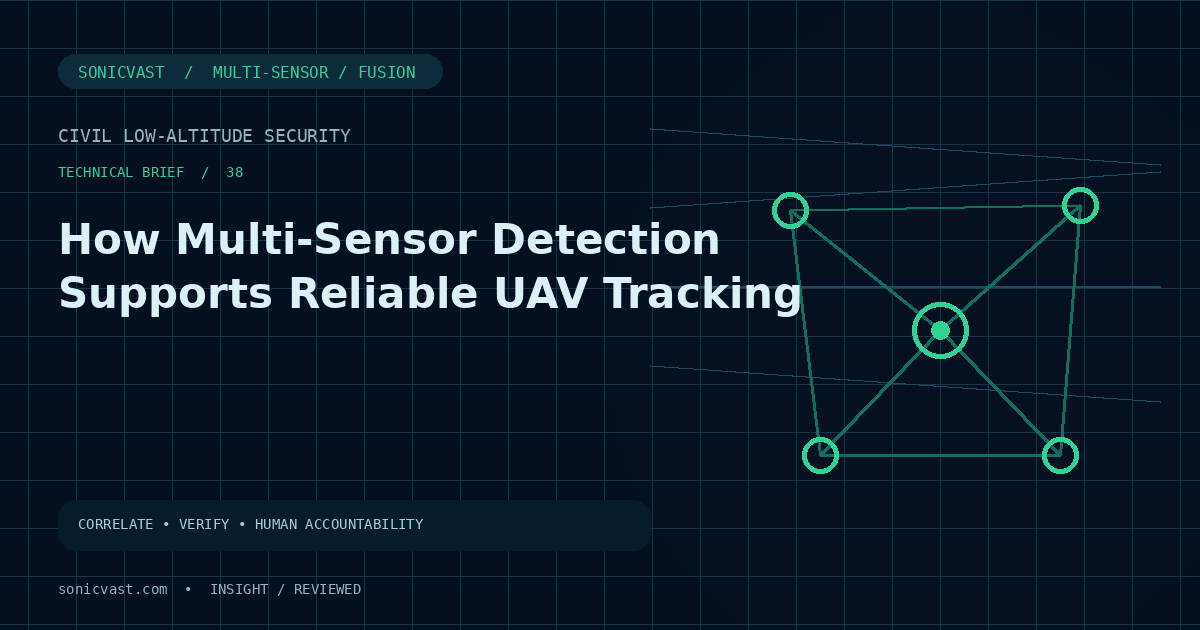
A compliance-first guide to using acoustic, RF and optical observations as corroborating evidence for responsible human review.
Start with complementary observations, not a single answer
Sensor fusion is strongest when each source has a clearly bounded role. Acoustic data can add contextual support in places where sound is usable, while RF observations can help describe signal activity without claiming that a particular aircraft or operator has been identified. Optical imagery can contribute visual context when lighting, weather, line of sight and privacy controls permit. The objective is not to make every source agree at all times; it is to show where observations converge, where they differ and where coverage is incomplete. Site assessment should come before configuration. Teams should document background noise, reflective surfaces, expected RF activity, camera viewpoints, restricted areas, access controls and legitimate site operations that could create misleading patterns. A shared time reference and consistent location naming make later comparison possible. If a source is unavailable, degraded or affected by maintenance, the record should say so plainly. A system that preserves absence and ambiguity is more useful than one that presents an uninterrupted story.
Make correlation transparent enough to challenge
A practical tracking workflow links observations through explainable associations: time windows, site zones, movement continuity, sensor health and relevant environmental notes. It should retain the underlying event details so a reviewer can understand why records were grouped, separated or left unresolved. Correlation may reduce duplicate review work, but it must not silently convert a compatible signal into proof of a vehicle, pilot or permission. Data governance is part of the evidence chain. Define which observations are retained, how long they are kept, who may access them and how exports are logged. Apply privacy-aware handling to imagery and incidental communications data, with role-based access and documented redaction practices where appropriate. Authorized people should review the evidence in line with site procedures before any notification, access decision or other consequential action. The review record should capture the basis for the decision, remaining uncertainty and any request for additional observation.
Treat reliability as an integration and maintenance task
A fused tracking capability remains dependable only when its surrounding operating model is dependable. Procurement teams should test interoperability with existing site systems, identity and access controls, evidence storage, incident workflows and authorized mission records. They should ask vendors to describe interfaces, data formats, clock handling, health indicators, update practices, auditability and failure modes in terms that site staff can verify. Demonstrations should include normal activity, missing data and conflicting observations rather than only ideal conditions. Maintenance planning should cover sensor cleaning, calibration checks, firmware governance, replacement paths, configuration backups and periodic review of site assumptions. Staff need a concise way to mark a sensor as unavailable and to prevent that gap from being mistaken for absence of activity. Governance owners should also revisit retention, permissions and review procedures as the site changes. This discipline makes a track more useful for safety coordination and authorized mission documentation while preserving human accountability and avoiding automated adverse decisions.
A record built for responsible review
Prefer traceable evidence, clear uncertainty, interoperable data and documented human decisions over opaque labels or promises of guaranteed outcomes.
Talk with SonicVast about a site-assessment conversation focused on evidence handling, integration and responsible human review.General information only; not legal, aviation, security or emergency-response advice.