
TECHNOLOGY INSIGHT / PASSIVE ACOUSTIC SENSING
Passive Acoustic Drone Detection for Low-Altitude Security
A microphone-based sensor can observe the acoustic environment and flag sound patterns that merit review. It is a listening function, not an intervention function: the system does not command, disrupt, intercept, or control an aircraft.
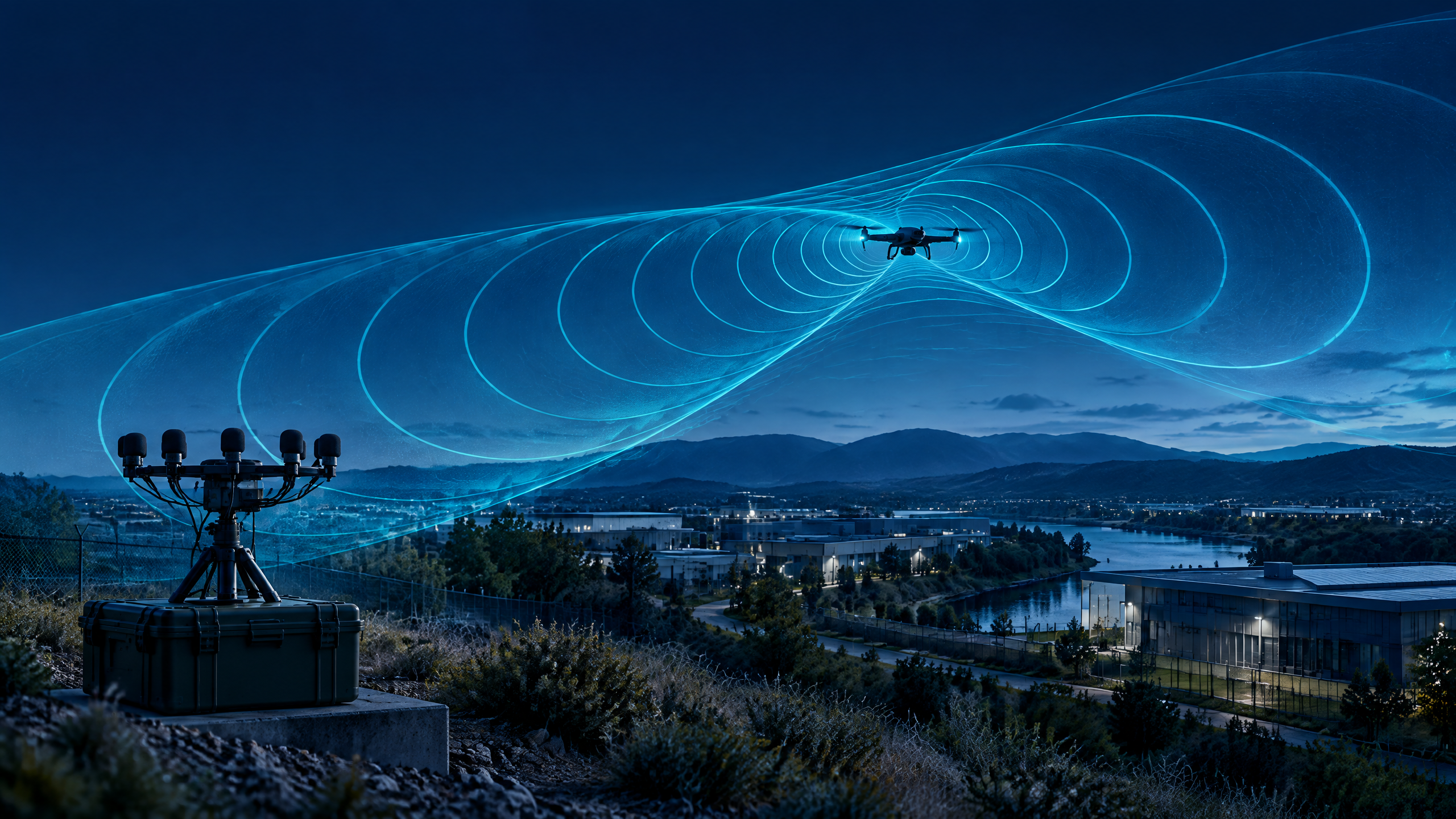
Passive acoustic sensing listens for sound patterns associated with drone propulsion without transmitting a signal. For civil low-altitude security, it can provide an additional awareness input while remaining subject to environmental noise, privacy governance, and human review.
TECHNICAL PRINCIPLE / PASSIVE → QUALIFIED → ACCOUNTABLE
Acoustic sensing technical principle
Passive awareness for low-altitude safety.
Listening can create a civil awareness input while leaving interpretation, privacy and response authority with the right people.
Observe without active transmission
The sensing layer listens to the surrounding acoustic environment for a defined civil purpose.
Treat cues as uncertain
Environmental variation means the resulting indication is reviewed rather than assumed to be final.
Follow the approved process
The recorded event is handled through lawful site, aviation and privacy governance.
Civil safety infographic / For understanding and review; not operating guidance.
| What passive acoustic sensing observes
Microphones capture ambient sound, and software can examine time-and-frequency patterns that may be consistent with propellers or motors. An array may help estimate a direction of arrival, but an acoustic indication alone is not proof of an aircraft identity, intent, or authorization. The output should therefore be presented as an alert for verification rather than a definitive conclusion.
| Why context changes the result
Wind, rain, traffic, construction, vegetation, buildings, birds, and other machinery can mask or resemble a drone sound. Vehicle type, operating condition, distance, and site acoustics also affect the signal. These limits mean that a responsible system must communicate uncertainty and avoid unsupported coverage, accuracy, or response-time claims.
| A civil, compliance-first role
In a civil setting, acoustic sensing can support situational awareness, safety escalation, and an auditable review workflow. Governance should define lawful collection, retention, access, and human decision authority. Where appropriate, acoustic information can be considered alongside other lawful observations, but it should not trigger countermeasures or enforcement automatically.
A civil technology explainer
Passive acoustic sensing listens for sound patterns associated with drone propulsion without transmitting a signal. For civil low-altitude security, it can provide an additional awareness input while remaining subject to environmental noise, privacy governance, and human review.
Request an Acoustic Integration BriefingThis overview is educational and intentionally high level. It does not provide instructions for deployment, targeting, interception, jamming, countermeasures, or operational performance. Organizations must assess applicable aviation, privacy, data-protection, workplace, and local laws with qualified professionals. Source names are displayed for editorial transparency; no external links are shown.