
ACOUSTIC SENSING / ENGINEERING AND PROCUREMENT
Passive Acoustic Drone Detection System: Assess Wind, Rain and Machinery Noise Without Universal Claims
A passive acoustic drone detection system does not listen in a laboratory. It listens at a site where wind moves across microphones, rain strikes nearby surfaces, and pumps, fans or transformers operate on changing schedules. The useful question is therefore not whether the system works in all weather or has one guaranteed range. It is whether the project team can define environmental states, record what the sensors heard, and show how those states affect detection, bearing or classification outputs. This article focuses on that assessment boundary.
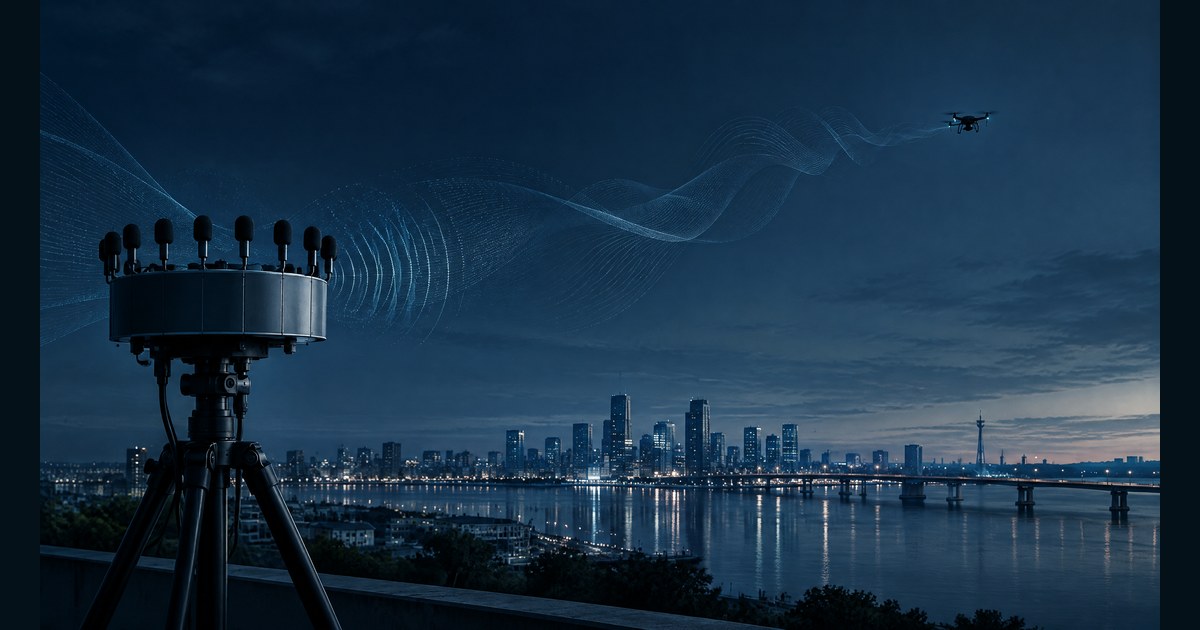
A procurement-focused method for judging how weather and industrial sound affect passive acoustic drone observation, with evidence requirements that keep site results separate from universal performance promises.
Treat weather as an input condition, not a footnote
Outdoor acoustic evidence is inseparable from the conditions under which it was collected. The U.S. Environmental Protection Agency's noise-measurement material identifies wind across a microphone as a source of extraneous noise and discusses windscreens as a mitigation measure. That does not establish a universal wind limit for a drone sensor. It establishes why a test record should include weather and microphone-protection details alongside the acoustic data.
Wind creates both self-noise and changing propagation conditions
Wind can disturb the microphone and its protective assembly, creating flow noise that may occupy the same recording as a candidate aircraft sound. Wind direction and speed can also vary across a site because of buildings, stacks, trees and terrain. A specification that lists one wind number without describing microphone protection, installation and signal-processing behaviour is incomplete. Ask for the measured wind at the sensor, the time window, the protection configuration and the treatment of intervals affected by gusts.
Rain should be logged as an acoustic state
Rain is not merely a weather label. Drops can strike housings, roofs, foliage and other surfaces, while heavy rainfall raises the local sound floor and can change what frequencies remain usable. NASA's public acoustic work on weather-robust microphone configurations illustrates that outdoor measurement performance depends on configuration and weather exposure. A buyer should therefore ask whether light, moderate and heavy rain are represented in the test plan, and whether the system reports degraded, unavailable or simply untested conditions rather than silently treating them as normal.
Separate machinery noise from the aircraft observation
Industrial sites rarely have one stable background. Ventilation fans may cycle, pumps may change load, vehicles may pass, and rotating equipment may produce tonal or broadband components. OSHA's technical guidance describes identifying noise sources, documenting levels and conducting follow-up monitoring as part of a workplace noise investigation. For acoustic drone sensing, the same discipline helps the team understand whether an alert is associated with an aircraft-like change, a known machine state or an unresolved mixture.
Build a background sound inventory before tuning thresholds
Record the operating states that matter to the site: normal production, start-up, shutdown, maintenance and abnormal but permitted conditions. For each state, note which machines are running, where the sound is observed, how long it persists and whether its spectrum or direction changes. This inventory can support feature selection and review rules, but it should not be presented as proof that every industrial noise source can be rejected automatically.
Use controlled comparisons instead of a single noise-floor number
A single decibel value cannot describe every interference case. Compare recordings from matched periods with the relevant machinery on and off, while keeping weather and sensor configuration visible. Then examine the outputs separately: an acoustic event, a bearing estimate, a track, and a classification suggestion are different results. A system may preserve one output while another becomes uncertain. The acceptance record should say which output was tested and what uncertainty remained.
Design an environmental test matrix that can be repeated
The most useful field test is a matrix of known conditions, not a single demonstration on a convenient day. It should combine representative target observations with environmental states that the site actually experiences. The goal is not to manufacture a universal performance number. The goal is to show where the evidence is strong, where it is conditional and where the system should defer to another approved source or human review.
Define states and labels before collecting data
Agree in advance on labels such as dry and calm, windy, light rain, heavy rain, quiet plant, normal plant load and high machinery activity. Record sensor configuration, timestamp, weather observations, machinery state and target test identity under a controlled procedure. If a condition cannot be measured reliably, label it as unknown instead of assigning a precise value after the fact.
Measure more than detection counts
A useful report distinguishes candidate-event count from confirmed observation, bearing stability, track continuity, classification confidence and false-alarm review. It also records missing data, dropped channels and periods excluded by the protocol. This prevents a high event count from being mistaken for high-quality situational awareness. It also makes later model or installation changes comparable to the original baseline.
Ask vendors for evidence that matches the site
Environmental claims become meaningful only when their test conditions resemble the intended installation. A project team should request the underlying test description, not only a headline range or accuracy figure. The evidence can be vendor-generated, independently observed or jointly collected, but its provenance and limitations should be explicit.
Questions for wind and rain evidence
Ask: Where was wind measured? Was it measured at the microphone or at a nearby weather station? What windscreen, housing and drainage arrangements were used? How was rain intensity determined? Were wet periods included in the scoring or excluded? Did the result concern raw audio, an alert, a bearing, a track or a classification? These questions expose whether a weather statement is a measured boundary or a marketing shorthand.
Questions for machinery evidence
Ask for representative recordings or feature summaries for the site's dominant machines, including operating changes and maintenance events. Ask how labels were created and whether reviewers knew the expected answer. Request a confusion review for birds, vehicles, construction activity and other local sounds where relevant. Do not accept a claim that artificial intelligence removes background noise unless the supplier can describe the tested conditions and the residual error cases.
Turn uncertainty into a governed operating rule
Environmental degradation is not automatically a product failure, and an alert is not automatically an aircraft identification. It is a reason to define what the system should show, when it should mark data as degraded and when another approved sensor or an accountable operator should review the event. The U.S. EPA and OSHA materials both reinforce the value of documented measurement conditions, equipment care and repeatable investigation rather than unsupported certainty.
Use condition-aware review states
A practical interface can distinguish normal confidence, weather-affected, machinery-confounded, channel-quality concern and insufficient evidence. The exact labels should fit the project workflow. What matters is that the state is visible in the event record and does not imply that passive acoustic reception can identify a unique aircraft, establish flight permission or authorize a response.
Illustrative example: a refinery perimeter
Illustrative example only: a refinery team might compare a dry-night baseline with a period of rain and a period when a large compressor is operating. The team could find that bearing remains reviewable in the first condition, event confidence becomes conditional in the second, and a persistent machinery tone requires corroboration in the third. This example is a method for structuring evidence, not a SonicVast specification, customer result or performance promise.
Make environmental conditions part of the acceptance plan
Before selecting a passive acoustic layer, list the site's recurring weather and machinery states, define the outputs that matter, and require a repeatable test record for each state. Confirm any hardware, software, interface and support assumptions in writing for the actual project.
Discuss your projectAcoustic performance depends on site, weather, installation, target and processing conditions. Passive acoustic sensing does not detect literally silent targets or by itself establish aircraft identity, flight permission or response authority. No universal accuracy, coverage or weather guarantee is implied.