
ACOUSTIC SENSING / ENGINEERING AND PROCUREMENT
Passive Acoustic UAV Detection: What Changes When UAVs Get Quieter?
For procurement teams, passive acoustic UAV detection depends on a sound reaching a microphone with enough separation from the local acoustic scene. That separation is not fixed. A quieter aircraft, a longer path, a gusty day, a new building reflection, or an unfamiliar background can reduce the evidence available to the detector. The central question is therefore not whether a microphone can hear a drone in one demonstration. It is whether the sensing method remains useful as the aircraft and the environment vary.
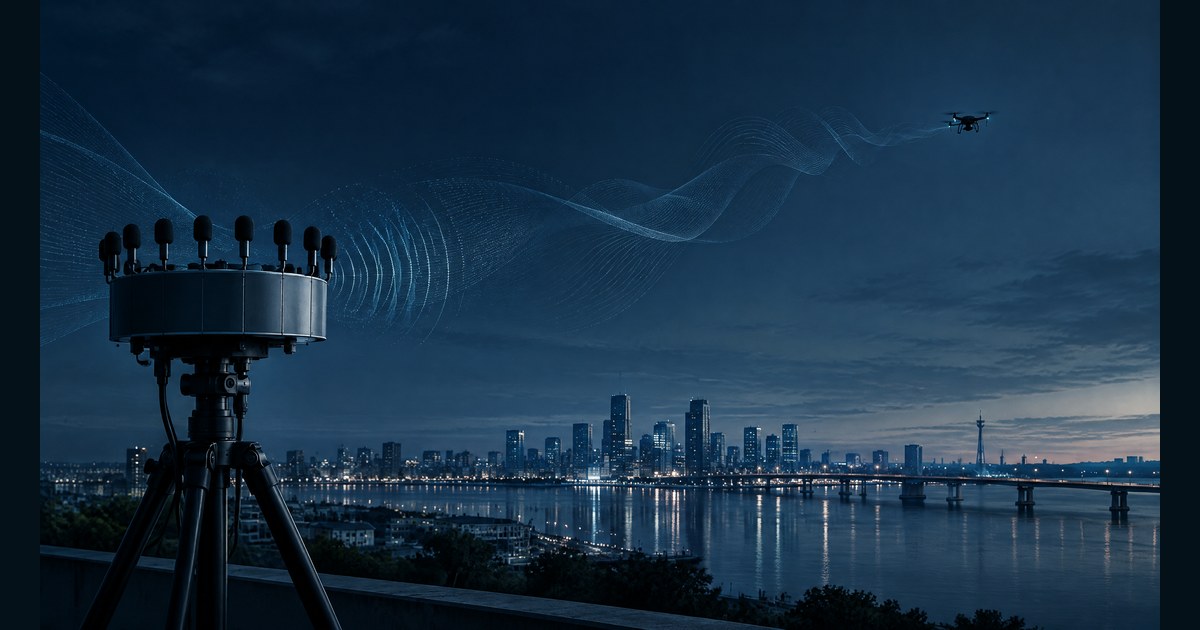
A procurement-oriented guide to the limits of listening for quieter UAVs when distance, weather, site noise, and training data change.
Why a quieter UAV changes the detection problem
An acoustic detector does not observe an abstract label called ‘drone’. It receives pressure variations that are altered by the source, the propagation path, the microphone, and the surrounding sound field. As rotor and motor sound becomes less prominent, the system has less signal margin for separating the candidate event from ordinary environmental sound.
Detectability is not the same as identification
A system may detect that an acoustic event resembles a UAV without proving the aircraft model, operator, authorization status, or exact position. An array can add bearing or localization estimates, but those are separate outputs with their own uncertainty. The Defense Systems Information Analysis Center describes acoustic systems as using microphone signals, timestamps, and processing to estimate drone presence and location, while also identifying background-noise differentiation as a central challenge.
Quiet does not mean acoustically invisible
A quieter platform may still produce tones or harmonics, but their practical usefulness depends on how strongly they stand above the local noise floor and how consistently they appear across operating states. Procurement language should avoid treating a published frequency feature as a guaranteed detection range. It is an input to a site-specific test, not a substitute for one.
Distance removes signal margin before an algorithm can help
Sound weakens and changes as it travels. The detector therefore sees a different signal at 50 metres than it sees near the source, even before wind, structures, or other noise are considered. A model trained only on close recordings can learn conditions that do not represent the intended field.
Training data must represent the operating distances
A 2024 study in MDPI Electronics evaluated recordings with distance-related attenuation and found that performance depended on whether training data covered multiple distances. Its reported results improved when the dataset included distance-diverse examples, while performance became more difficult at longer distances as signal-to-noise ratio fell. The practical lesson is not that any particular distance is universal; it is that distance and propagation belong in the acceptance dataset.
Coverage should be stated as a tested condition
A coverage statement is incomplete without the aircraft type, flight state, background level, microphone arrangement, weather, false-alarm criterion, and required observation time. A project team should ask for a detection probability or alert metric under declared conditions, rather than accepting a single maximum range. If the environment changes materially, the original figure may no longer describe the same sensing task.
Weather and site acoustics can mask or reshape the cue
Changing environments affect both the sound arriving at the sensor and the background against which it is judged. Wind can create microphone self-noise and moving turbulence. Rain and waves add broadband or intermittent energy. Walls, roofs, vegetation, and hard surfaces can reflect sound and alter arrival timing. Traffic, machinery, birds, and aircraft can resemble or cover portions of a UAV signature.
Wind protection is part of the sensing chain
A 2025 Sensors outdoor microphone comparison measured differences in signal-to-noise ratio, attenuation, and effective range across microphone configurations and wind conditions. The study reported that wind protection changed the low-frequency noise floor and observed range, while a directional parabolic arrangement also narrowed angular coverage and showed sensitivity to gust transients. This is a reminder that the microphone, windshield, mounting, and orientation are not incidental accessories.
Reflections can affect localization as well as detection
A sound that arrives directly and a reflection that arrives later can complicate time-difference-of-arrival calculations. In a 2026 Acta Acustica study, the tested system reported reduced performance at longer ranges and with overhead flight geometry, and described wind, multipath, and interference as observed limitations. These reported results belong to that experiment, not to every array, but they illustrate why a localization claim needs a site-relevant geometry test.
How to validate a quieter-UAV use case
The right response to environmental variability is a documented validation plan, not a promise that software will remove every limitation. The plan should compare representative aircraft and benign background events under the conditions in which the civil facility actually operates.
Build a condition matrix
Record at least the aircraft configuration, operating mode, distance bands, direction of arrival, time of day, wind and precipitation state, and major site sound sources. Include negative examples such as vehicles, rotating equipment, birds, aircraft, and ordinary facility operations where relevant. Repeat trials after meaningful seasonal or construction changes instead of assuming that one commissioning campaign remains representative.
Measure the decision output, not only a score
Ask how an alert is logged, how long it persists, what confidence means, how false alarms are reviewed, and which outputs are available to an approved operator. Bearing, track, classification, and model confidence should be recorded separately. An acoustic indication should support a governed review workflow; it should not by itself authorize an intervention or establish an aircraft’s identity.
Where passive acoustic sensing fits in a changing environment
Passive acoustic observation can provide useful environmental context without an active RF emission from the acoustic sensing layer. Its strongest role is often as one evidence stream in a broader, approved awareness workflow, especially when another source can test an ambiguous observation or provide context that sound alone cannot establish.
Use complementary evidence deliberately
A radio observation, visual or infrared observation, radar track, or authorized operational record may answer a different question from an acoustic cue. Combining sources does not make uncertainty disappear. It can, however, make the review record more informative when timestamps, coordinate references, and confidence fields are preserved and the integration rules are documented.
Ask the supplier questions that expose the boundary
Request the test protocol, aircraft and background recordings, environmental conditions, alert definition, false-alarm handling, microphone and mounting details, data-retention approach, and change-management process. Ask how new aircraft, new machinery, seasonal weather, or a changed building layout would trigger revalidation. Also confirm which outputs are available through the intended interface and which claims require written project-specific confirmation.
Turn ‘quiet UAV’ into a revalidation question
For a civil site, define the aircraft and operating conditions that matter, capture representative positive and negative recordings, and agree on alert and review metrics before comparing systems. SonicVast can discuss acoustic sensing, integration boundaries, and project-specific validation questions; capability, interface, service, and environmental performance should be confirmed in writing for the actual project.
Discuss your projectAcoustic sensing cannot detect a literally silent target, establish a unique aircraft identity or flight permission, or guarantee a universal range. The cited studies report results under their own hardware, datasets, geometries, and environmental conditions. Passive reception by the acoustic layer does not mean every device in an overall system emits no energy.