
RF ENGINEERING SERIES / 10 OF 10
Why RF Amplifier Revision History Matters More Than Peak Power Alone
A radio-frequency (RF) amplifier can meet a headline power figure and still create procurement problems if the delivered configuration differs from the tested sample. For civilian communications, laboratory equipment and original equipment manufacturer (OEM) integration, revision history matters because it connects performance evidence to the hardware being purchased. Peak power remains important; it simply cannot make that connection alone.
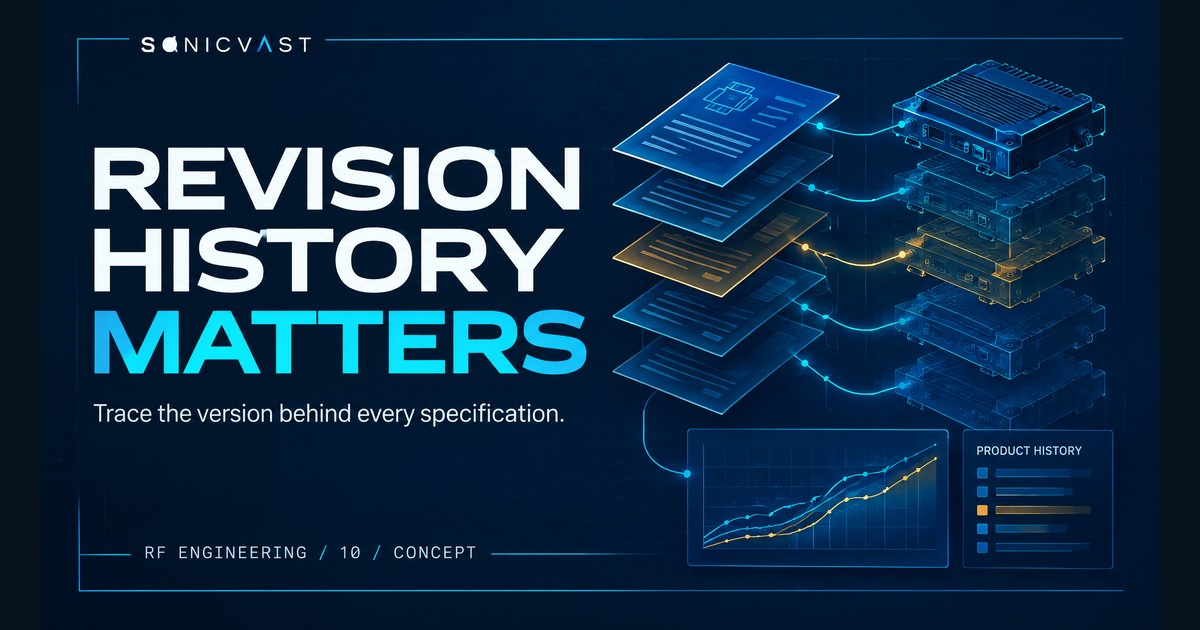
Peak power helps screen an RF amplifier. Revision-linked test evidence, configuration records and change notices help establish what you can accept, integrate and reorder.
A revision number identifies change, not maturity
The supplied reference highlights revision markers alongside unresolved fields and production-status notes. Its useful lesson is to read those items together, rather than rank modules by a power column. Those reference notes are not a verified history of current SonicVast products.
A label such as Revision 2 says that an identifier has advanced within a particular numbering system. It does not establish better performance, production readiness or a longer support life. A first release may be thoroughly qualified, while a later release may introduce a change that still needs evaluation.
Ask what the revision identifies and what evidence applies to it. A document revision can correct wording without changing hardware. Conversely, a manufacturing change may require notification even when the commercial product name remains unchanged.
Peak power is useful when the definition matches
Before comparing power figures, establish whether each describes an envelope peak, average output, a compression point or saturated output. These are not interchangeable descriptions of usable performance.
Analog Devices defines the output 1 dB compression point as the output level where gain has fallen by 1 dB from its linear value. Saturated output power describes the region where increasing input no longer increases output. Its engineering guidance also explains that nonlinear operation generates unwanted frequency components. A saturation figure therefore does not, by itself, establish acceptable signal quality for a communications waveform.
Keysight explains that pulsed and modulated signals require appropriate envelope sampling to characterize peak, average and statistical power behavior. Retain the waveform, measurement definition and acquisition conditions with the number. Peak power is meaningful when those conditions match the requirement—not when its qualifiers disappear during transcription.
Hardware, BOM and firmware need separate identities
A purchasing baseline should identify the orderable part and hardware revision, then connect them to the relevant bill of materials (BOM), the controlled component list used for the build. Suppliers need not disclose every proprietary component to provide traceable configuration identifiers and a description of relevant changes.
Where a module contains firmware—the software embedded in its controller—record that version too. Calibration data may need a separate identifier because it can vary between units without changing the firmware release. For a module without programmable control, firmware identification is simply not applicable.
Tie these identifiers to the unit serial number or production lot and the associated report. This distinguishes the revision of the amplifier from the revision of its datasheet, drawing or test procedure. They should be connected, but they need not advance together.
The change description determines what to recheck
A useful change log gives the reason for a change, the affected configuration and the evidence used to assess it. Generic statements such as “optimized design” do not reveal whether earlier acceptance results remain applicable.
For example, a revised matching network could change the frequency response. A substituted component could require electrical or mechanical checks. On a controlled module, a firmware change could alter command handling or reported measurements. These are possible engineering scenarios, not claims about SonicVast releases.
NXP describes a change-review process that considers risks, qualification plans and success criteria, followed by review of the results. That is a useful model for the question to ask: what testing supports this specific change? Targeted regression testing—repeating relevant checks after a modification—is more informative than assuming all previous results still apply.
Status labels should follow the specification
The reference distinguishes recorded fields, missing values, conflicting records and claims requiring validation. Keep that discipline when copying information into a requirements document or supplier comparison. A provisional figure does not become verified because a spreadsheet has no room for its note.
“Not provided” means missing, not zero. “Conflicting records” means the discrepancy needs resolution, not that either value is an acceptable option. Ambiguous notation needs an unambiguous restatement before comparison.
Visible uncertainty helps identify the next question, but it does not prove supplier honesty or product quality. Ask which field is unresolved, what evidence will resolve it and which confirmed document will supersede the earlier record. Preserve the original source title rather than silently rewriting it to remove the conflict.
An acceptance report needs a configuration and a method
Agree acceptance criteria before testing, then attach results to the actual build. A useful report identifies the unit, configuration and procedure, together with the relevant frequency points, waveform, supply conditions and thermal boundary conditions. Include the measurement setup, instrument calibration status and how measurement uncertainty is handled when judging compliance.
When comparing revisions, retain the same method or explain the differences. Changed fixtures, cable-loss correction or measurement settings can otherwise obscure whether the amplifier changed. Keysight's envelope-measurement guidance reinforces why peak and average results require suitable acquisition rather than interchangeable readings.
Distinguish design-qualification evidence from a delivered unit's acceptance result. A report from one sample may support evaluation, but it does not prove every later configuration or production lot meets the agreed limits. Nor does module acceptance certify the finished host assembly.
Change notices and obsolescence deserve their own questions
A product change notification (PCN) is a formal notice describing a relevant product or process change. NXP states that its PCNs cover changes affecting fit, form, function, quality or reliability and identify the affected parts and effective date. This is NXP's practice, not a SonicVast commitment. Ask each module supplier what its own notification process covers.
Support planning also needs an end-of-life (EOL) process: how discontinuation is communicated, whether final orders are possible and when delivery ends. NXP's discontinuation notices distinguish last-time-buy from last-time-delivery dates and describe availability restrictions. Do not assume another supplier offers the same terms.
A suggested replacement is not automatic approval. NXP explicitly qualifies replacement listings as reference information pending customer qualification. Ask what differences remain, what support covers repairs or firmware issues, and what evidence is needed before a replacement enters the host design.
Turn revision history into a purchasing decision
Keep the reference's four questions, but make the answers specific. Which hardware, BOM and applicable firmware configuration will be supplied? What changed from the previously evaluated configuration, and why? What qualification and production evidence supports the offered build? Which fields remain unconfirmed?
Connect those answers to the order and acceptance criteria, with an agreed process for reviewing substitutions or later changes. A development programme may welcome an evolving design; a repeat production build may need tighter configuration control. Neither preference follows from a revision number alone.
Peak power helps determine whether an amplifier is a candidate. Traceable revision history, comparable measurements and explicit lifecycle terms help determine whether that candidate is a defensible purchase—and whether the evidence will still apply when it is reordered.
For repeatable OEM integration
Use revision-linked evidence when comparing evaluation samples, accepting production modules or reviewing a proposed replacement in lawful communications and test equipment.
Discuss revision-linked acceptanceThis SonicVast article proposes engineering and procurement practices. It does not establish current product revisions, support periods, certification, safety approval or replacement compatibility. Product-specific requirements need written confirmation.