
ACOUSTIC SENSING / ENGINEERING AND PROCUREMENT
UAV Acoustic Detection System: How Acoustic Features Relate to Classification
A UAV acoustic detection system does not classify an aircraft because one tone proves its identity. Classification is a relationship between measured sound features, a reference library, and the conditions under which the model was trained and tested. For civil infrastructure buyers and integrators, the important question is therefore not simply whether a system shows a label. It is whether the label remains meaningful when distance, flight state, background noise, and the local fleet change.
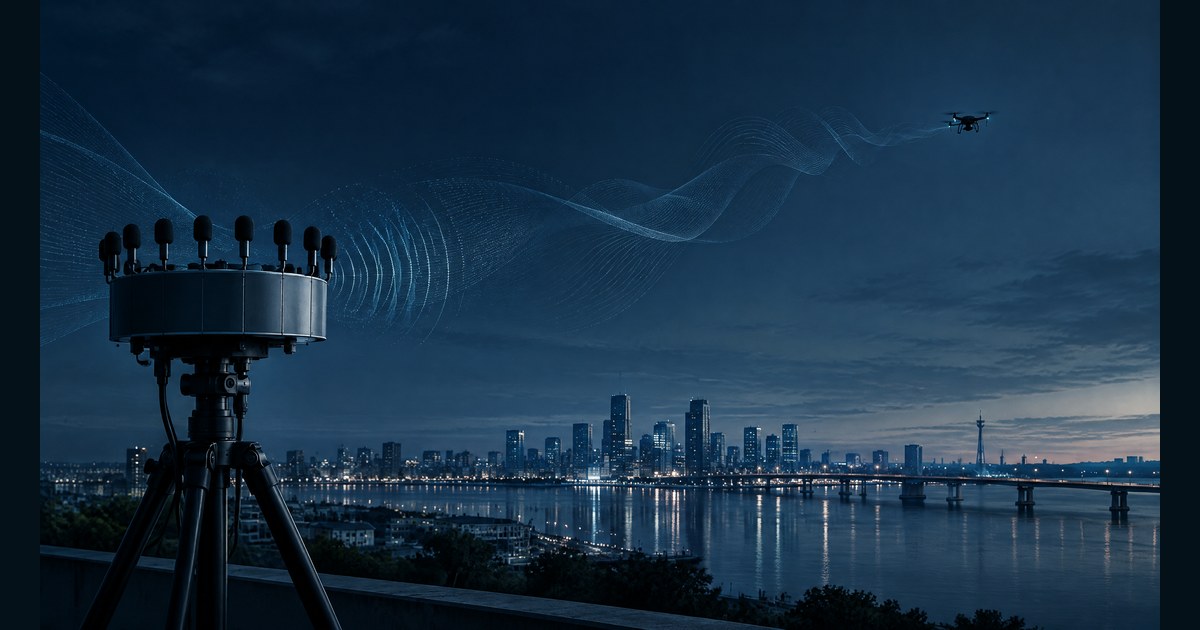
A procurement-oriented guide to the acoustic evidence behind UAV classification, and to the validation needed before a class or model label is trusted.
What the acoustic signal can reveal
UAV sound is produced mainly by motors and blades. Research describes the signal as non-stationary because rotor speed can change during manoeuvres and different rotors may not turn at the same rate. That makes the observation richer than a single fixed frequency, but also less stable than a laboratory tone.
Rotor harmonics are useful features, not fingerprints
A short-time Fourier transform can show energy concentrated around frequencies related to rotor rotation and its harmonics. The spacing and envelope of peaks and valleys can vary with aircraft design, size and propulsion system. These patterns can help a classifier distinguish broad candidate classes or compare an observation with known recordings. They should be treated as evidence about a sound-producing configuration, not as a guaranteed serial-level identity.
Time, frequency and spatial features answer different questions
Spectral shape and harmonic structure describe what the sound contains. Time variation describes how that structure changes during flight. An array can add directional or arrival-time information, which helps associate a sound with a location. A procurement specification should state which of these features feed detection, classification or localization, because a direction estimate is not a model classification and a class score is not an aircraft authorization decision.
Why the same UAV can produce different classification evidence
A classifier sees the received signal after propagation and site conditions have changed it. The relationship between an aircraft and its acoustic features is therefore conditional. A model that performs well on recordings made in one setting may not transfer unchanged to another site.
Distance changes the feature balance
Sound attenuation is frequency-dependent. As distance increases, some parts of the spectrum become less prominent relative to background sound, and the signal-to-noise ratio can fall. A 2024 Electronics study found that training with signals representing different distances improved detection performance compared with relying only on unattenuated training data. This is a strong reason to ask whether evaluation data include the intended distance range rather than accepting a single headline result.
Flight state and site noise can alter the input
Acceleration, turns, altitude changes and payload or operating-state differences can change rotor speed and the resulting harmonics. Roads, HVAC equipment, machinery, birds and wind can mask or imitate parts of the signal. CISA advises that loud persistent noise, extreme weather and terrain can limit acoustic performance, and notes that make or model identification relies on comparison libraries. These are not footnotes; they define the conditions under which a classification output should be reviewed.
How to evaluate a classification claim
A buyer should evaluate the chain from recording to label. The objective is not to reject machine learning, but to understand what the reported class means and how often it remains reliable outside the demonstration dataset.
Ask what classes the library actually contains
Request the class list, recording conditions and update process for the reference library. A system may distinguish several tested aircraft while returning only a broader category for an unfamiliar design. Ask how it handles unknown or out-of-library sounds, similar airframes with different propellers, and the same model under different operating states. A label such as drone detected, multirotor likely, manufacturer family or specific model should not be treated as interchangeable.
Separate accuracy from transferability
Ask for a confusion matrix or equivalent results, not only an overall accuracy number. Check whether test recordings came from people, sites, days and distances that were separate from training recordings. The 2024 Sensors study classified recordings from 17 UAVs in external conditions using acoustic analysis and MFCC-based discriminant analysis; its value for a buyer is the explicit connection between measured features, tested aircraft and outdoor conditions, not a promise that the same result applies to every site.
Require an abstention and review path
A useful system should expose uncertainty or an unknown result when the input does not support a stable class. Define what happens when confidence is low, classes overlap, or the sound is contaminated. Human review and corroboration from approved sensing layers can be part of the workflow. Classification should organize evidence for a civil decision process, not trigger an automatic enforcement or response action by itself.
A practical validation plan for integrators
Classification is best assessed as a site-specific validation exercise. The test record should make it possible to tell whether a failure came from the acoustic feature, the classifier, the library or the operating environment.
Build a representative acoustic test set
Record approved reference flights across the relevant aircraft classes and operating states, while documenting distance, weather, background activity, array configuration and signal-processing settings. Include ordinary non-UAV sounds that could create false alerts. Keep some recordings fully separate for evaluation so the result measures generalization rather than memorization.
Report class-level errors and unknowns
For each class, report missed detections, false classifications and cases returned as unknown. A confusion matrix can reveal that two classes are repeatedly swapped even when the overall score looks strong. Also record whether localization was available and whether it was independently checked, because a well-localized sound can still be incorrectly classified.
Turn the result into a written acceptance boundary
The acceptance record should state the tested classes, conditions, decision thresholds, data-retention rules and known gaps. It should also say whether the output is detection, broad classification or model comparison. This gives operators and procurement teams a defensible understanding of what the system can support without converting a research result into an unverified guarantee.
Make classification conditions part of the procurement question
When reviewing a UAV acoustic detection system, ask for the feature families used, the reference classes, the outdoor test design, the confusion matrix, the unknown or abstention behavior and the process for updating comparison libraries. Then define a site validation that reflects the approved aircraft and acoustic environment your team actually needs to monitor.
Discuss your projectAcoustic classification can support evidence review but does not by itself establish an aircraft's identity, authorization, operator, intent or required response. Actual performance depends on the selected system, site conditions, reference data and written project validation.