
TECHNOLOGY INSIGHT / PASSIVE ACOUSTIC SENSING
What Is Acoustic Drone Detection and How Does It Work?
A drone may be difficult to see in haze, darkness, or cluttered surroundings. Its motors and propellers still create sound that microphones can record. An acoustic system turns those recordings into an evidence signal for human or software review.
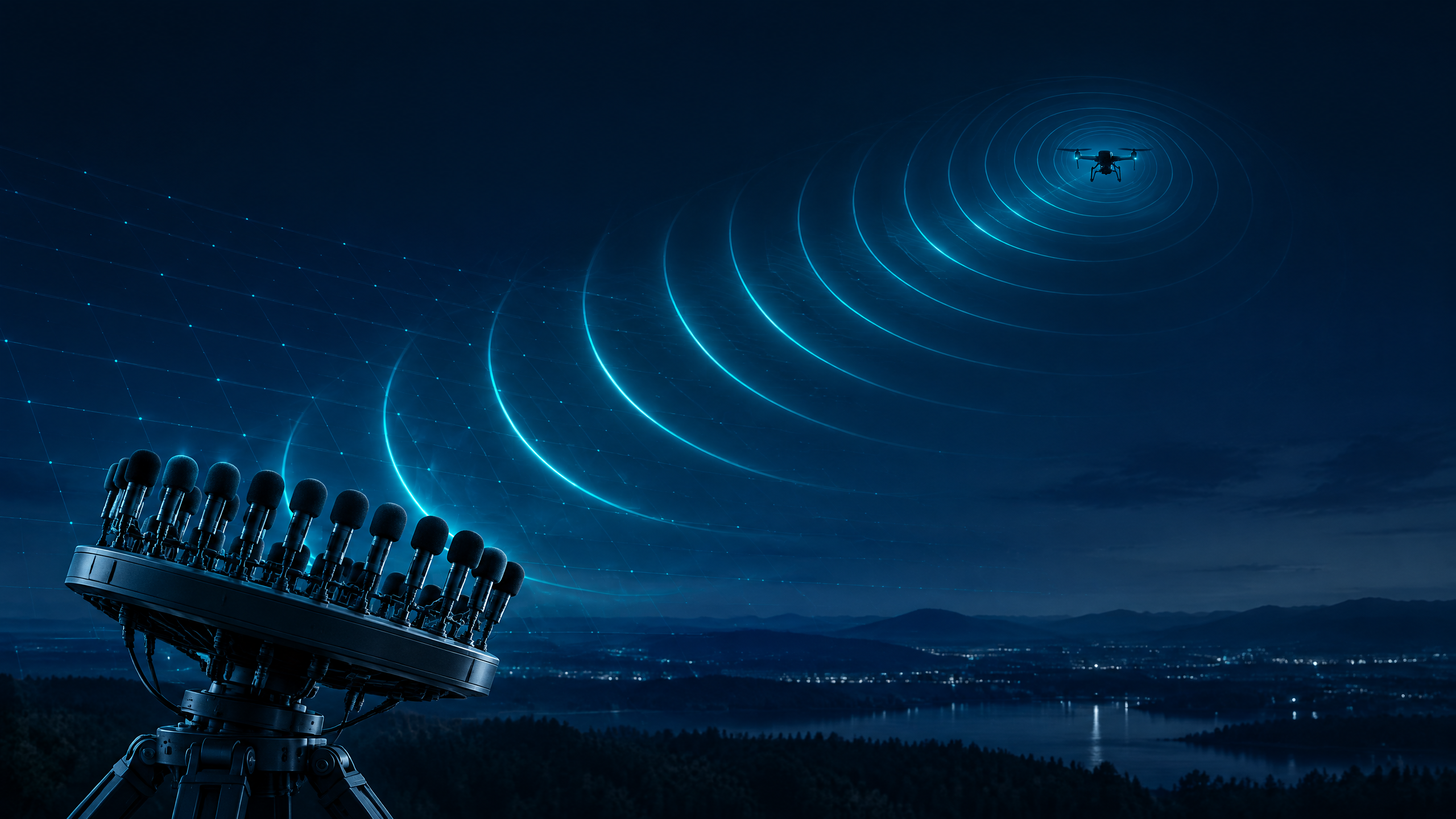
Acoustic drone detection listens for sound produced by an aircraft’s propulsion system and uses signal processing to assess whether the sound is consistent with a drone. It is a passive sensing method that can add context to a civil low-altitude safety picture, but it is not a complete identification or response system by itself.
TECHNICAL PRINCIPLE / LISTEN → ASSESS → REVIEW
Acoustic sensing technical principle
From ambient sound to a reviewable observation.
A passive listening layer turns environmental sound into context for a governed civil safety workflow.
Capture ambient sound
Microphones observe the surrounding acoustic environment without emitting an active sensing signal.
Compare relevant patterns
Signal-processing context helps distinguish a reviewable indication from ordinary background activity.
Preserve uncertainty
A qualified reviewer compares the observation with approved records and other lawful information.
Civil safety infographic / For understanding and review; not operating guidance.
Listening to the sound
An acoustic detector uses one microphone or a microphone array to capture air-pressure changes. The sensor records the sound together with basic metadata such as time and sensor identity. The system then filters and analyzes the recording to separate potentially relevant sound from background noise. Wind, traffic, construction, birds, and other aircraft can all affect the observation.
Turning sound into an assessment
Motors and propellers can create recurring acoustic patterns. Signal-processing software examines features of the recorded sound, while trained classification models may help distinguish a likely drone-like signal from other sounds. The result should be treated as an assessment with uncertainty, not as proof of an aircraft’s identity. Local conditions, aircraft design, distance, and changing operating states can all influence the result.
Estimating where the sound came from
When several synchronized microphones hear the same event, the differences in arrival time can help estimate a direction or source position. A system may combine those observations over time to present a track or alert for review. Acoustic information is normally most useful when interpreted alongside other lawful safety information, site procedures, and human judgment. It does not authorize interception or other physical action.
A civil technology explainer
Acoustic drone detection listens for sound produced by an aircraft’s propulsion system and uses signal processing to assess whether the sound is consistent with a drone. It is a passive sensing method that can add context to a civil low-altitude safety picture, but it is not a complete identification or response system by itself.
Request an Acoustic Integration BriefingThis educational overview addresses passive acoustic sensing for civil safety and compliance workflows. It does not provide instructions for jamming, interception, targeting, countermeasures, or deployment. Applicable aviation, privacy, data-protection, noise, and local safety requirements must be reviewed before any system is used. Source names are displayed for editorial transparency; no external links are shown.