
TECHNOLOGY INSIGHT / ANALYTIC RF
What Is Analytic RF C-UAS? A Guide to RF-Based Drone Detection
Analytic RF C-UAS is a civil safety approach that helps authorized teams understand relevant radio-frequency activity as one source of contextual evidence for assessing possible drone activity; it is not a substitute for legal authority, human judgment, or a complete safety…
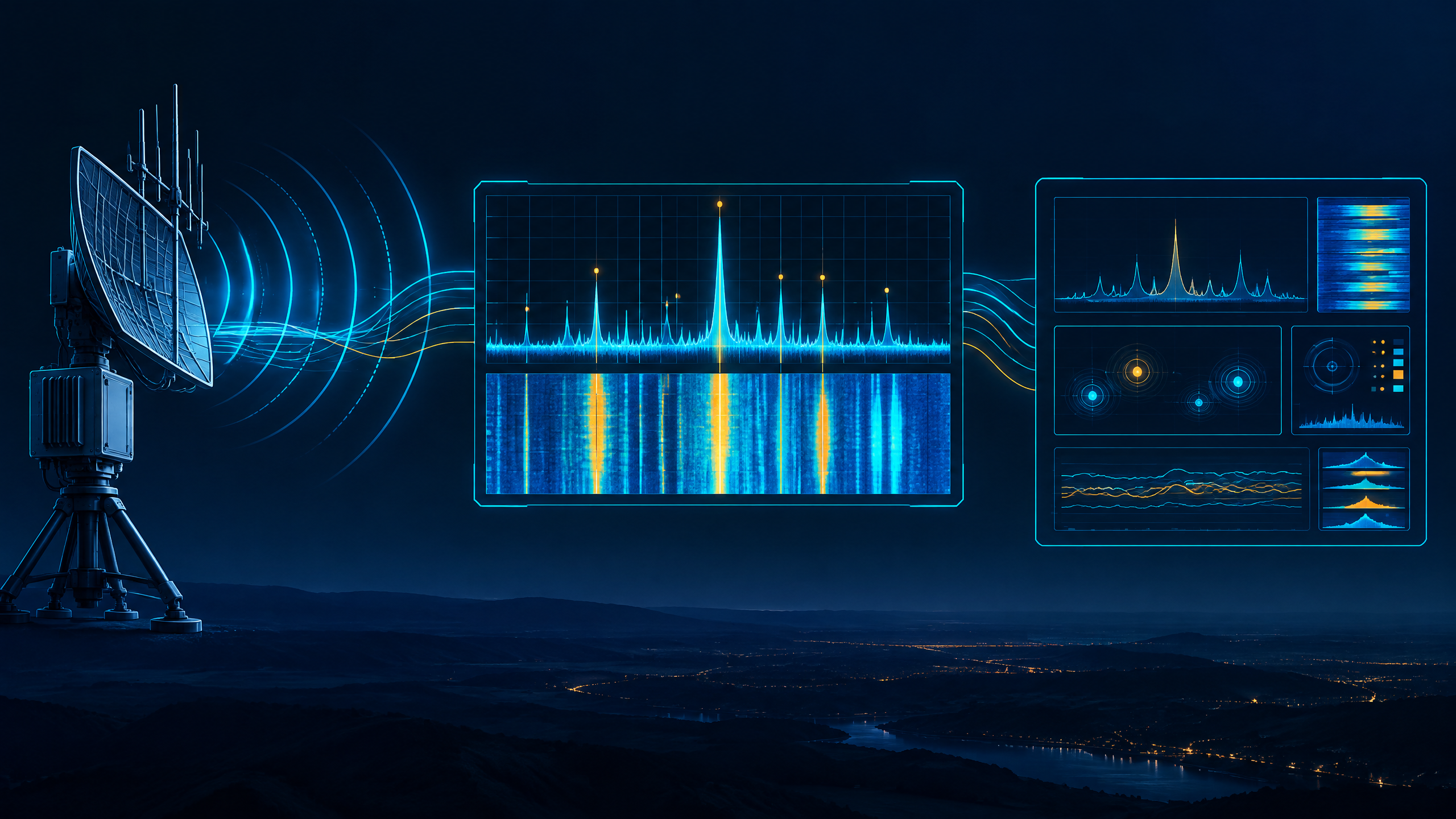
Analytic RF C-UAS is a civil safety approach that helps authorized teams understand relevant radio-frequency activity as one source of contextual evidence…
TECHNICAL PRINCIPLE / RECEIVE → CONTEXT → REVIEW
Analytic RF technical principle
From authorised RF awareness to a reviewable record.
Analytic RF is a passive context layer: it helps qualified teams compare relevant wireless observations without treating any signal as a final conclusion.
Observe the permitted spectrum context
A passive receiving layer records relevant radio context under the site’s authorisation and data-governance boundary.
Compare time and environmental cues
Observed patterns are assessed alongside available site information while uncertainty and legitimate activity remain visible.
Preserve accountable judgement
A qualified reviewer uses documented policy, corroboration and authorised escalation channels to determine the next civil-safety step.
Civil safety infographic / For understanding and review; not a spectrum-action or response guide.
The concept in plain language
“Analytic RF” refers to the analysis of radio-frequency observations to support situational awareness. In a civil low-altitude safety context, an authorized system may help identify patterns that are potentially consistent with a nearby drone-related signal and present them alongside time, location, and other approved observations. The purpose is to help people ask better safety questions—not to make an automatic conclusion about a person, device, or event. “C-UAS” is a broad term for counter-uncrewed-aircraft-system capabilities. For civil organizations, the responsible starting point is detection, assessment, documentation, and coordination within the organization’s mandate. Any interpretation should remain subject to authorization, local radio rules, electromagnetic-compatibility requirements, privacy safeguards, and trained human review.
What evidence can—and cannot—tell you
RF awareness can add a useful layer to a broader picture. When combined with approved inputs such as visual observation, airspace information, site reports, or other safety sensors, it may help a team compare observations, identify a developing situation, and preserve an auditable record for follow-up. RF evidence is contextual rather than conclusive. The same radio environment can contain many legitimate sources, and conditions can change because of infrastructure, weather, equipment, or other environmental factors. A responsible workflow therefore distinguishes an observation from an assessment and an assessment from an action. Human review, corroboration, confidence handling, and clear escalation rules are essential.
Where civil organizations may use the approach
Potential use cases include protecting the continuity of airport operations, supporting safety at energy and port facilities, and improving awareness around industrial sites or other sensitive locations. In each case, the system should be designed around a documented safety objective, a defined operating authority, and a proportional data-governance plan. System integration matters as much as any individual sensor. Teams should define who may view information, how alerts are reviewed, how records are retained, and how findings are shared with site security, aviation stakeholders, emergency services, or regulators when appropriate. Multi-sensor fusion can improve context, but it does not remove the need for accountable decisions.
Governance principles for civil low-altitude safety
Airports, energy and port facilities, and industrial sites should define the safety objective, accountability boundaries, records, and escalation path before deciding how Analytic RF can contribute one authorized input to multi-source awareness.
Discuss an RF Governance ReviewEditorial note: this article is civil, compliance-first technology education only, not operational instruction or legal advice. Any RF observation, data handling, or follow-on action must remain within local authorization, electromagnetic-compatibility, privacy, aviation, and site-governance requirements, with qualified human review.