
MULTI-SENSOR INDUSTRIAL AWARENESS
Why Multi-Sensor Drone Detection Is Essential for Oil & Gas Facilities
Oil, gas and LNG facilities combine large footprints, noisy equipment, safety-critical work, authorised aviation activity and privacy responsibilities. A responsible low-altitude awareness programme therefore starts with lawful purpose, site safety and an evidence workflow—not with a claim that one sensor solves every question. This brief explains how passive acoustic, authorised RF, radar and EO/IR observations can contribute distinct context for qualified human review. It does not provide tactical deployment, sensitive specifications, countermeasures, automatic decisions or performance guarantees.
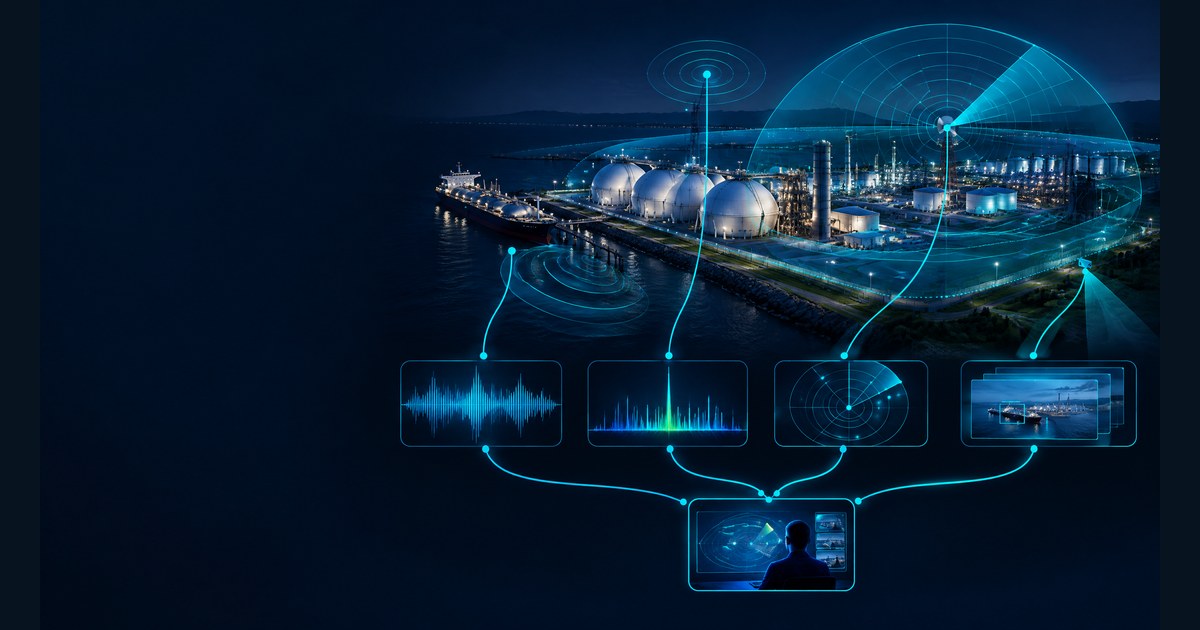
A civil guide to how acoustic, RF, radar and EO/IR observations can support governed low-altitude awareness at oil, gas and LNG facilities without treating one sensor as proof.
Industrial facilities need evidence questions tailored to the work they actually perform.
A refinery, LNG terminal, tank farm or remote processing facility may have different safety zones, ambient-noise conditions, operating schedules, authorised contractors and aviation coordination duties. Start by defining what authorised reviewers need to know and what they are permitted to observe. A detection indication does not itself prove that an object is a drone, that a person is involved, that an activity is unauthorised or that an action is appropriate. Documented purpose, roles, escalation boundaries, retention limits and coordination responsibilities should exist before choosing or connecting sensors.
Acoustic, RF, radar and EO/IR can add context, but their limits must remain visible.
Passive acoustic observation may add local sound context in an industrial environment; authorised RF analysis may add radio-environment context; radar may add track-like context; and EO/IR may support visual review where lawful and appropriate. Background machinery, weather, reflections, connectivity and local policies can affect what each source means. A common display should retain source identity, timestamp, sensor health, confidence and disagreement. Correlation can help a reviewer form a better question, but it must never silently become identity, intent, authorisation or an automatic adverse decision.
The value of integration is traceability and review, not a promise of automatic control.
Many facilities already operate process-safety, perimeter-security, access-control, maintenance and incident-management workflows. Any new awareness source should be evaluated for data minimisation, cyber assurance, interface ownership, maintenance evidence, change control and operator training. Open APIs and SDKs can support responsible systems integration when qualified teams set data contracts and access rules. Integration should preserve evidence provenance and make uncertainty legible to human reviewers rather than creating a black-box decision layer.
A useful programme is maintained, audited and adapted as the facility changes.
Industrial layouts, background noise, approved site activity and digital systems evolve. Civil programmes need documented commissioning, calibration and health review; periodic testing against ordinary conditions; role-based access; privacy review; incident communications; and a route for correcting a mistaken assessment. Qualified legal, aviation, safety, privacy, cybersecurity and engineering teams should set local policy. This educational brief intentionally excludes tactical sensor placement, response procedures, jamming, interception and sensitive performance claims.
Build an evidence-aware industrial picture
Retain lawful purpose, source provenance, timing, health state, uncertainty, safety context, privacy controls and named decision ownership in every site workflow.
Discuss a civil, compliance-first industrial airspace-awareness and systems-integration review with SonicVast.Editorial boundary: this civil technical brief covers authorised observation, evidence governance, industrial safety, privacy, lifecycle assurance and non-operational integration. It does not provide tactical deployment, sensitive specifications, targeting, interception, jamming, response procedures or performance guarantees. Each site requires qualified legal, aviation, safety, privacy, cybersecurity and engineering review.