
ACOUSTIC SENSING / ENGINEERING AND PROCUREMENT
Acoustic Counter UAV System: Review Dependencies in a Civil Safety Case
An acoustic counter UAV system should not enter a civil safety case as a single box labelled “drone detected.” Its value depends on the acoustic environment, array and timing design, calibration, communications, software interpretation, operator workflow and lawful decision path around it. The practical question is therefore not whether a microphone can hear a drone in principle. It is whether the complete system can produce a bounded, reviewable observation that a civil organisation can use without confusing detection with identification or authorisation.
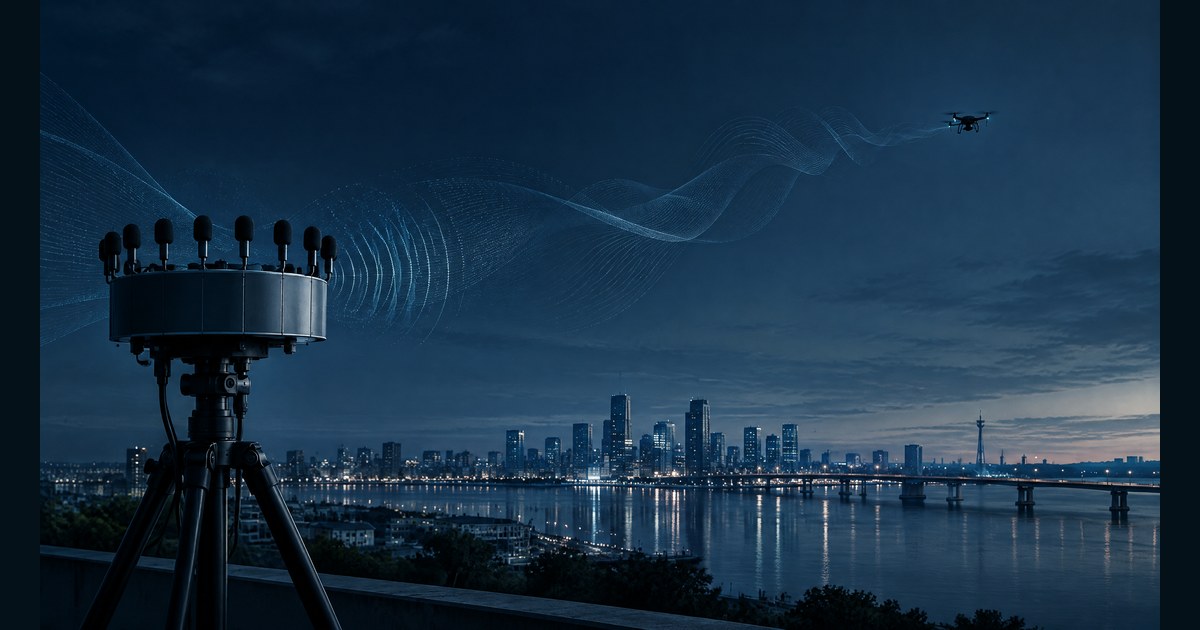
A procurement-oriented review of the evidence and dependencies a civil operator should examine before treating acoustic awareness as part of a counter-UAV safety case.
Start with the safety claim, not the sensor name
A safety case should state what decision the system is expected to support and what evidence is needed for that decision. EASA’s SORA framework is a useful civil reference because it connects an operation to hazards, mitigations, safety objectives, operational limitations and documented procedures. That does not make a SORA a certification route for an acoustic detector. It does show why a sensor specification alone is an incomplete safety argument.
Define the observation boundary
A microphone array may provide sound measurements, a bearing estimate or a candidate classification, depending on its design and processing. Those outputs are not interchangeable. A bearing is not a track, a classification is not a unique aircraft identity, and an observation does not establish whether a flight is authorised. The safety case should name the exact output that enters the next review step and state what remains unknown. This prevents a high-confidence label from being treated as permission to act.
Separate hazard control from awareness
In a civil facility, acoustic awareness may help staff notice an event, correlate it with approved activity or request another form of verification. It does not automatically grant authority to warn, interfere with, seize or disable an aircraft. CISA’s legal-authorities factsheet describes those actions as distinct and tied to specific U.S. federal authorities, privacy protections and aviation coordination. A buyer in another jurisdiction needs its own legal review and should not inherit a response authority from a detection purchase.
Review the physical and acoustic environment
The site is part of the sensing system. CISA advises that detection requirements account for facility location, layout, airspace, security protocols and available resources. For acoustics, that principle becomes concrete: machinery, road traffic, ventilation, construction, weather, reflections and nearby activity can alter the sound field and the quality of a candidate observation.
Build a local sound baseline
A credible review should record representative background conditions rather than rely on a quiet demonstration. The baseline can include time-of-day variation, recurring tonal sources, intermittent alarms, wind exposure, rain and maintenance states. The purpose is not to promise that every nuisance sound can be removed. It is to show which conditions create ambiguity, how the system labels that ambiguity and when a human or another sensor must review it.
Treat placement as an engineering dependency
A microphone location affects exposure to shielding, reflections, vibration, weather and access for maintenance. A distributed arrangement adds network, power and enclosure decisions at each node. These are not cosmetic installation details: they influence whether the recorded signal is comparable across nodes and whether a later investigation can explain a missing or degraded observation. Site acceptance should therefore document the installed configuration, not only the product model.
Check timing, calibration and data integrity
A civil safety case needs evidence that the measurement chain behaves as the design assumes. NI’s distributed-measurement guidance describes sensors, signal conditioning, data acquisition, processing, storage and the operator interface as connected components. It also explains that distributed microphone nodes need a shared concept of time when arrival-time differences are used for correlation or localization.
Ask how nodes share time
If multiple nodes contribute to a directional or location estimate, procurement documents should identify the synchronization method, expected timing uncertainty, clock-drift handling and what happens when a timing reference is unavailable. A network connection that carries data is not, by itself, proof of adequate measurement synchronization. The acceptance record should show the system’s behaviour under the timing conditions expected at the site.
Make calibration evidence operational
IEC 60942 specifies performance requirements for sound calibrators and includes measurement uncertainty in its conformity logic. The relevant buyer question is not whether a vendor uses the word calibrated. Ask which components are calibrated, against what procedure, at what interval, with which records, and how out-of-tolerance results affect stored observations. Calibration does not remove environmental uncertainty or prove drone classification, but it makes the measurement chain more defensible.
Preserve the evidence trail
A safety case is weakened if an alert cannot be reconstructed. Define retention for timestamps, node identity, health state, relevant waveform or feature data, software version, configuration changes and operator acknowledgement. Also define access controls and privacy handling. The retained record should make clear what the system observed, what an algorithm inferred and what a person decided.
Test the dependency chain, not only the detection headline
A useful civil evaluation tests the complete path from sound to accountable decision. A laboratory demonstration may answer whether an algorithm can separate selected examples. It does not by itself answer whether the installed system remains useful during changing background noise, partial node loss, network delay, maintenance or an authorised flight nearby.
Use scenario-based acceptance questions
Ask the project team to define expected behaviour for normal background noise, a known authorised aircraft, an unknown candidate, a missing node, a failed time reference, a communications interruption and a sensor requiring maintenance. For each scenario, record the available output, its uncertainty, who reviews it and what evidence is retained. This turns vague resilience language into observable acceptance criteria without inventing a universal accuracy target.
Measure service dependencies explicitly
The system may depend on power quality, network availability, edge computing, central storage, time services, weather protection and software updates. Map each dependency to a failure indication and a recovery responsibility. If the system continues to display an old track after a node or link fails, that behaviour must be visible to operators. A graceful degradation policy is more useful than an assumption of uninterrupted coverage.
Convert the review into procurement evidence
The buyer does not need a promise that an acoustic layer solves the entire counter-UAV problem. The buyer needs a clear boundary around what it contributes and the evidence required to integrate it responsibly. CISA’s detection guidance recommends selecting technology for the site and integrating it into existing security plans; that is a better starting point than selecting a sensor by a headline range or classification label.
Put these questions in the request for information
Request the intended outputs and uncertainty statements; acoustic and environmental assumptions; array geometry and synchronization method; calibration and maintenance records; node health and failure reporting; interfaces and time formats; data retention and privacy controls; software versioning; test conditions; and the division of responsibility between supplier, integrator and operator. Ask which items are standard, configurable or subject to project confirmation.
Define the civil decision boundary
The final document should show how an acoustic indication is reviewed against approved flight information and other lawful evidence, who can classify an event, who can notify an aviation or public-safety authority and who is permitted to consider any countermeasure. The acoustic system can support awareness while remaining outside the authority to intervene. Keeping that boundary explicit reduces both safety risk and procurement misunderstanding.
Request a system-dependency evidence pack
For a civil pilot or procurement review, ask the supplier and integrator to provide a site assumptions register, node and timing architecture, calibration plan, failure-state examples, data-governance description, test scenarios and responsibility matrix. SonicVast project discussions can then be assessed against the site’s confirmed requirements rather than against an assumed universal capability.
Discuss your projectAcoustic sensing is passive observation of sound. It cannot detect a literally silent target, establish flight permission or create countermeasure authority. Site performance, interfaces, calibration, environmental suitability, privacy controls and service terms require written project confirmation. CISA and EASA materials cited here are jurisdiction- and framework-specific; they are not a universal legal approval for a product or deployment.