
ACOUSTIC SENSING / ENGINEERING AND PROCUREMENT
Acoustic Counter UAV System: What Passive Sensing Can and Cannot Do in Counter-UAV Awareness
An acoustic counter UAV system is best understood as an observation layer, not an automatic permission checker or response authority. Microphones can receive sound associated with an aircraft and help a team decide whether an event deserves review. They cannot, from sound alone, establish a unique aircraft identity, prove that a flight is unauthorized, reveal the operator's intent, or authorize any countermeasure. For civil infrastructure buyers, that boundary is not a weakness to hide. It is the starting point for a defensible sensing and governance design.
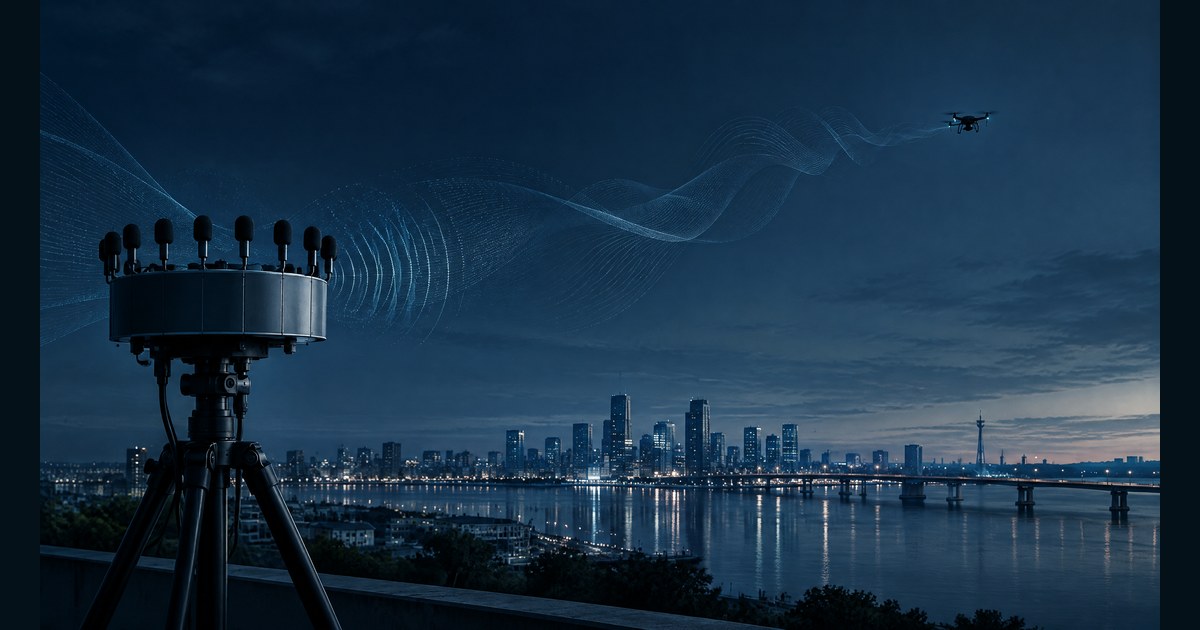
Passive acoustic sensing can add an observable sound cue to a civil low-altitude awareness programme. Its value is strongest when the buyer defines what the cue means, what evidence must corroborate it, and who is allowed to make the next decision.
Start with the observation question, not the countermeasure label
The phrase counter-UAV covers very different functions. Detection may mean that a system produces an alert when a signal or sound is consistent with an aircraft. Tracking may mean maintaining a time-linked position estimate. Identification may refer to a specific aircraft, broadcast identifier, or other evidence. Mitigation is a separate activity that attempts to disrupt, disable, redirect, or otherwise stop a flight. A procurement document should keep those outputs separate.
What a passive acoustic layer can contribute
A microphone array can capture environmental sound and, when the signal is usable, provide a candidate acoustic event. With suitable processing and site validation, the system may support a bearing or directional cue and help organize repeated observations over time. That cue can be useful for alert triage, camera cueing, incident logging, or deciding whether another approved sensor should be consulted. The exact output must be stated in the supplier's documentation rather than inferred from the word detection.
Why an alert is not an aircraft identity
Sound is produced and altered by the aircraft, its operating condition, distance, reflections, weather, and the surrounding soundscape. Similar propulsion arrangements can produce overlapping acoustic features, while the same aircraft can sound different as its position and operating state change. A classifier can rank patterns or produce a confidence score, but a score is not a registration record. Buyers should ask whether the system reports an acoustic event, a class hypothesis, a direction, or a track, and should not let those terms collapse into one claim.
Keep four decisions outside the microphone
The most important design boundary is the handoff from sensing to accountable review. CISA's guidance for critical-infrastructure operators recommends distinguishing routine from suspicious UAS activity and considering the wider context. That approach is compatible with passive acoustic sensing because the sensor contributes evidence while people and approved systems determine what the evidence means for the site.
Identity is a separate evidence question
An acoustic observation does not substitute for Remote ID, visual confirmation, a validated track, or another approved identity source. The FAA describes Remote ID as broadcast identification and location information that can be received by other parties, with different information depending on the compliant configuration. A sound alert may therefore be useful for prompting a search for corroboration, but it should not be presented as a Remote ID result or as proof of a particular make, model, or operator.
Authorization and intent require context
A sensor cannot hear a permit, a scheduled inspection, or an emergency exemption. Nor can it infer intent reliably from a flight path or from the absence of a broadcast. A site needs a current picture of planned and routine operations, relevant airspace information, local procedures, and a way to contact the responsible authority or operator where appropriate. CISA specifically emphasizes that activity may be routine, suspicious without enough evidence of criminal conduct, or serious enough to report. Those categories require documented review, not an acoustic threshold alone.
Mitigation authority is not created by detection
The fact that a device produces an alert does not grant a facility permission to interfere with an aircraft. GAO distinguishes drone detection technologies from mitigation technologies and describes statutory authority that applies to specified U.S. federal departments and circumstances. Rules vary by jurisdiction and facility. A civil buyer should obtain legal and operational advice before connecting any detection event to a response action, and should specify who can approve escalation.
Treat the acoustic environment as part of the system
Passive sensing does not remove engineering dependencies. It changes where they appear. A buyer should evaluate the site soundscape and the evidence chain under representative conditions instead of assuming that a laboratory demonstration transfers directly to a working perimeter.
Background sound changes the decision problem
Road traffic, ventilation equipment, pumps, generators, construction, birds, wind, rain, and nearby aircraft can all affect the signal presented to an acoustic algorithm. Reflections from buildings and hard surfaces can also alter the apparent direction. The relevant question is not whether the target has a sound signature in a quiet recording. It is whether the proposed workflow can distinguish a useful candidate event from ordinary site activity at the times and locations that matter.
Coverage is a site-specific claim
A nominal sensing distance or an attractive demonstration does not establish coverage for every aircraft, altitude, weather state, or background condition. Array placement, obstructions, maintenance, wind exposure, data links, and power continuity all affect the usable observation area. CISA advises selecting detection technology with the facility's location, layout, airspace, security protocols, and available resources in mind. A procurement team should therefore request a site survey, an assumptions register, and test results that identify when the system is expected to produce no reliable cue.
Passive refers to the sensing layer, not the whole installation
A passive acoustic receiver does not intentionally transmit RF energy as part of its listening function. That does not mean every component in a complete installation is energy-silent. Network radios, backhaul equipment, cameras, edge computers, and power systems may transmit or consume energy. Nor does passive reception establish explosion-proof approval or suitability for a hazardous area. Those are separate system-level and regulatory questions requiring written confirmation for the project.
Design an evidence path from sound cue to civil decision
The practical value of an acoustic layer comes from making its output reviewable. The system should preserve enough context for a trained team to understand what happened, what was uncertain, and why the next step was chosen.
Define the event record
A useful event record can include the time, sensor or zone, reported direction or location estimate, confidence or quality indicator, relevant environmental notes, and the other approved observations available at that moment. It should also show whether the event was acknowledged, correlated, escalated, closed as routine, or referred to an authority. This is more valuable than a dashboard that displays a single unexplained red icon.
Use correlation to test a cue, not to manufacture certainty
A camera, Remote ID receiver, radar, visual observer, or authorized operational record may provide a different perspective. Agreement can raise confidence in a candidate event, while disagreement can reveal a false alarm, timing problem, coverage gap, or an assumption that needs review. Correlation should preserve the individual source records and their limitations. It should not turn several uncertain observations into an automatically certain identity.
Make routine flights visible
A civil programme becomes more proportionate when approved and expected operations are part of the review context. Maintenance flights, surveying, emergency work, and community activities may create legitimate acoustic events. CISA recommends mapping routine activity and sharing expected operations with security personnel and relevant stakeholders. The site can then focus attention on deviations and patterns rather than treating every sound cue as hostile.
Procurement questions that expose the real boundary
A buyer does not need a promise that passive acoustics solves every low-altitude problem. The buyer needs a clear statement of the observation it can support, the conditions that limit it, and the workflow around it.
Questions about the sensing output
Ask: Does the output represent sound energy, a candidate aircraft event, a class hypothesis, a bearing, or a maintained track? What quality indicators are shown? Which environmental conditions are outside the tested envelope? How are overlapping events, birds, machinery, and other recurring sounds handled? What data is retained for an incident review, and can the integrator access the event schema or interface documentation?
Questions about acceptance evidence
Ask for a site-specific test plan that defines representative background conditions, approved test aircraft or recordings, observer procedures, timestamps, expected outputs, and failure handling. Do not accept a generic range statement as proof of detection probability, classification accuracy, or continuous coverage. If a supplier proposes AI classification, request the tested classes, dataset boundaries, update process, and a clear description of false-alarm handling.
Questions about governance and integration
Ask who may acknowledge an alert, who may contact an operator or authority, what records must be preserved, and what actions are explicitly outside the facility's role. Confirm how the acoustic layer connects to existing security and continuity procedures without assuming that an SDK, API, warranty, certification, or legal authorization is included. SonicVast can discuss acoustic sensing, customization, and integration options for a defined project, but those details require written project confirmation.
Turn the boundary into a written acceptance and response workflow
Before comparing an acoustic counter UAV system with other options, write the event definition, site conditions, corroborating sources, routine-flight register, escalation roles, legal review point, and acceptance evidence you require. Then ask each supplier to map its actual outputs to that workflow. The strongest proposal will explain what the acoustic layer can show, what it cannot show, and how uncertainty is carried into the next civil decision.
Discuss your projectThis article is general procurement and sensing guidance, not legal advice or an authorization to operate, monitor, contact, or mitigate an aircraft. Detection, Remote ID access, data retention, privacy, airspace permissions, and any intervention authority depend on the applicable jurisdiction, facility role, and written project review.