
ACOUSTIC SENSING / ENGINEERING AND PROCUREMENT
Acoustic Drone Detection OEM: Who Owns the Classification Updates?
An acoustic drone detection OEM programme can look complete when the sensor, interface and branded enclosure are delivered. The harder question appears later: when a new aircraft, propeller, site noise or false-alarm pattern requires a classification update, who may create it, approve it, distribute it and use it? Buyers should settle that question before a pilot becomes a production commitment. The agreement should distinguish the licensed product from the classification assets that change over time, rather than treating every update as an undefined part of support.
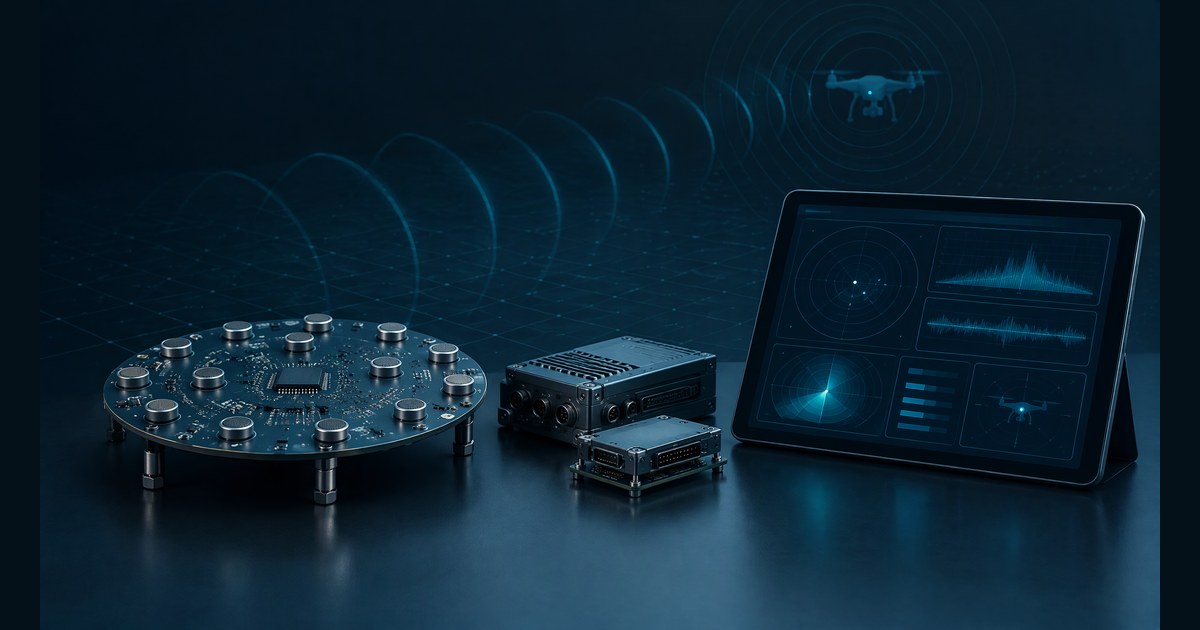
A procurement guide to separating the acoustic sensing core, classification know-how, project data, and future update obligations in an OEM agreement.
Start with four different assets, not one vague ‘algorithm’
Classification is usually a chain of assets and activities. An OEM contract becomes difficult to operate when it calls all of them ‘the software’ and then assigns ownership in one sentence. A clearer schedule separates the items that existed before the project from those created for the project and from the evidence used to validate a release.
The sensing and integration baseline
The first layer may include the microphone-array design, embedded firmware, signal-processing components, SDK or API, interface specifications and the OEM’s pre-existing classifier. The commercial question is not simply whether the buyer receives a copy. It is whether the buyer receives a right to use, modify, reproduce, sublicense, maintain or transfer each component, and in which territory and product family. A licence can be broad enough for deployment without transferring ownership of the supplier’s reusable core. Those are different outcomes and should be named separately.
Classification know-how and project-specific assets
The second layer covers feature definitions, labelling rules, threshold or confidence policies, evaluation scripts, tuning decisions and any model weights or rule sets produced during the engagement. Some may be the supplier’s general know-how; some may be a paid-for work product; some may contain the buyer’s confidential site information. The schedule should label each category instead of assuming that payment automatically transfers every associated right.
Data, evidence and release records
The third layer is the evidence: raw or processed acoustic recordings, annotations, environmental descriptors, test cases, confusion matrices, release notes and incident-review records. Google’s model-card research recommends documenting intended use, performance characteristics, evaluation conditions and limitations for released machine-learning models. That principle is useful here even when the classifier is narrow: a new version should arrive with enough context for the buyer to understand what changed and what was actually tested.
Define ownership by lifecycle event
Ownership language is most useful when it answers what happens at each event in the update lifecycle. A single statement such as ‘all improvements belong to the OEM’ may leave the buyer unable to maintain a site-specific release, while ‘all project work belongs to the customer’ may conflict with the supplier’s pre-existing platform and obligations to other customers.
Who can request and fund an update?
Specify whether an update may be triggered by a buyer observation, a supplier research programme, a security fix, a new target class or a change in the operating environment. State who supplies recordings and labels, who pays for collection and evaluation, and whether the supplier may combine de-identified or aggregated learnings with its general product development. These are commercial decisions, not assumptions about technical necessity.
Who approves a release for use?
The party that trains a candidate model need not be the party that authorises it for a civil site. Require a release record with a unique version identifier, change summary, affected components, intended use, known limitations, evaluation set, test conditions, rollback method and named approvers. NIST’s AI Risk Management Framework is voluntary guidance, but its emphasis on managing trustworthiness across design, development, use and evaluation supports this kind of accountable release boundary.
What survives termination or supplier change?
The agreement should state whether the buyer may continue using the last accepted version, receive paid-for project data and documentation, obtain a transition licence, or appoint another maintainer. It should also state what cannot be exported, such as a supplier’s general-purpose model or confidential third-party data. A continuity clause is valuable only if it identifies concrete artefacts and a practical format for delivery.
Treat licensing and confidentiality as separate controls
A right to operate a classifier is not the same as ownership of its underlying intellectual property. Nor does a confidentiality promise automatically tell the buyer whether it can share an update with an approved system integrator. The contract should connect these controls without collapsing them.
Licence the use cases the buyer actually needs
List the permitted deployment sites, internal users, affiliates, integrators, cloud or on-premises environments, test systems and disaster-recovery copies. Clarify whether the OEM may brand the classifier, whether the buyer may make configuration changes, and whether a downstream integrator receives access to source, binaries, weights, documentation or only an API. Avoid promising unrestricted sublicensing when the supplier’s third-party components or data do not permit it.
Protect confidential update material
WIPO explains that trade secrets can include source code and technical information and may be sold or licensed, while protection depends on reasonable steps such as confidentiality agreements and access controls. In an OEM programme, a useful schedule identifies confidential model artefacts, permitted recipients, retention periods, security measures and the process for returning or deleting material. It should also preserve the buyer’s ability to retain records needed for safety, audit or regulatory review where applicable.
Do not confuse secrecy with validation
A supplier may legitimately withhold source code or proprietary training recipes while still providing meaningful release evidence. Ask for test-set provenance at an appropriate level, evaluation protocol, version hashes or equivalent identifiers, known failure classes and change impact. The goal is not to expose every trade secret; it is to give the accountable operator enough evidence to decide whether a release is fit for its approved use.
Make update governance operational for the OEM team
A good rights clause still fails if the delivery process cannot identify the version running at a site. The OEM, integrator and buyer should agree on a small release-control workflow that can be followed by engineering, procurement and operations.
Use a versioned update packet
For each accepted update, request a packet containing the release identifier, date, compatible sensor and software baseline, change rationale, training-data or rule-set scope, evaluation summary, limitations, cybersecurity notes, installation steps, rollback package and support contact. NIST’s Secure Software Development Framework highlights protecting software from tampering and collecting provenance data for release components. Those ideas translate into a practical requirement for traceable packages and controlled distribution.
Separate safety fixes from classification improvements
A security patch, a signal-processing change and a new target-class update may have different urgency and test requirements. Define notification windows and acceptance gates by change type. Do not let a rapid safety fix silently change classification behaviour without a record, and do not let a classifier update be described as a guaranteed accuracy improvement unless project evidence supports that statement.
Keep a site decision record
The buyer should record which version was evaluated, which environmental conditions were represented, who accepted it and what restrictions apply. Acoustic sensing observes sound and classification remains an analytical output; it does not by itself establish unique aircraft identity, flight permission or authority for an automatic response. A version record helps reviewers distinguish a candidate indication from a later operational decision.
Questions to put in the OEM schedule before signature
The following questions turn an abstract ownership discussion into a document that procurement and engineering can review together. They are project questions, not universal legal requirements; local counsel should address governing law and enforceability.
Rights and boundaries
Which items are pre-existing background technology? Which deliverables are project-specific? Who owns raw recordings, labels, derived features, evaluation sets, model weights, configuration files and release notes? What licence is granted if ownership does not transfer? May an approved integrator access or maintain the package?
Change and acceptance
Who may request an update, define the acceptance test and approve production use? What evidence accompanies a release? What happens when an update fails the agreed test or creates a new false-alarm pattern? Is rollback available, and who decides whether the prior version remains supported?
Continuity and exit
What must be delivered at project close or termination? In what machine-readable and human-readable formats? How long may the buyer use the last accepted release? Can a successor integrator receive the necessary interface and documentation? Which confidential assets must be returned, deleted or retained for accountable records?
Request an ownership-and-update matrix with the technical quotation
Ask the OEM to map every classification-related asset to an owner, licence, access level, update trigger, acceptance record and exit obligation. Have engineering, procurement, security and the intended integrator review the same matrix before commercial terms are finalised. SonicVast project discussions can then confirm which sensing, PCBA, SDK and support elements are suitable for the proposed programme; the written agreement should control the final scope.
Discuss your projectLicensing, ownership, confidentiality and data rights depend on the contract and applicable law. The article provides procurement questions, not legal advice. Acoustic classification is not a guaranteed identification or response authority, and update performance requires project-specific evidence.