
ACOUSTIC SENSING / ENGINEERING AND PROCUREMENT
Acoustic Drone Detection OEM: White-Label Branding Without Blurred Engineering Responsibility
An acoustic drone detection OEM arrangement can put a partner’s name on the enclosure, dashboard, proposal, or complete solution. That visible brand does not automatically mean the partner designed the microphone array, owns the classifier, controls software releases, or accepts responsibility for site performance. A sound white-label programme separates those questions before a quotation becomes a system commitment.
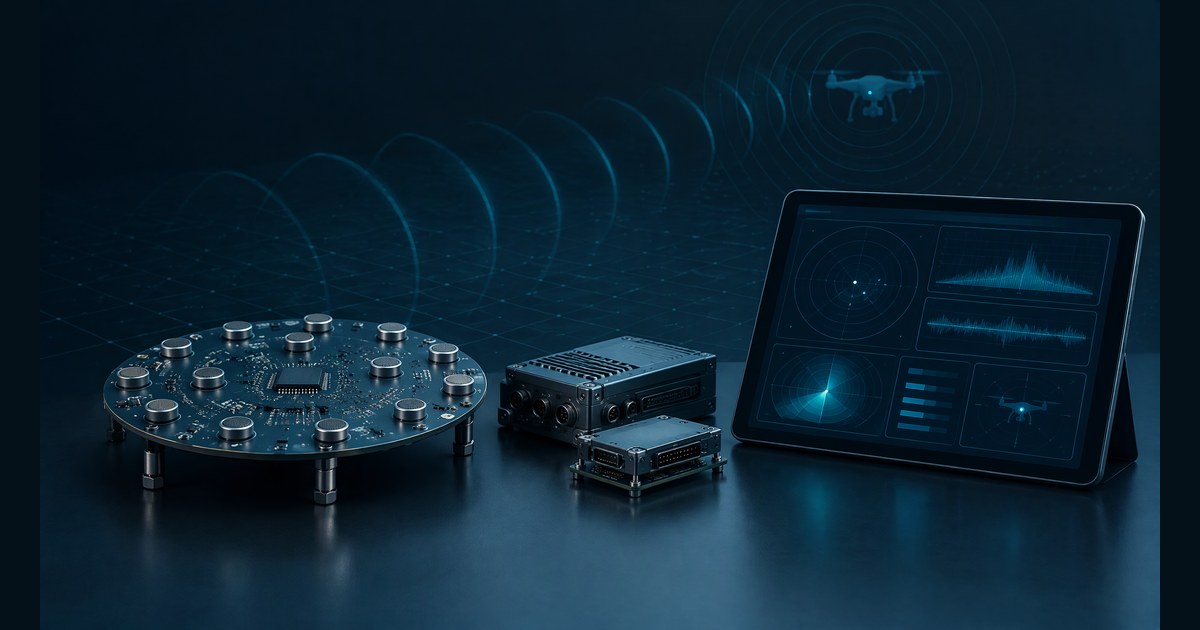
A practical guide for buyers and solution partners deciding what a white-label acoustic drone detection OEM should own, document, test, and support.
White-label branding is a commercial layer, not an engineering shortcut
White-labeling usually describes how a product is presented and sold. It may include a partner logo, localized packaging, a branded user interface, or a solution identity assembled by an integrator. None of those choices, by themselves, establish who is responsible for the sensing hardware, embedded software, classification logic, installation design, or operational decision process.
Separate the four identities in the project record
Ask the project team to name four parties or roles where applicable: the component or product supplier, the white-label brand owner, the system integrator, and the asset owner. One company may perform more than one role, but the contract and technical documents should say so. IEC Academy’s overview of the IEC 62443 series uses a similar distinction: a product supplier develops and supports, an integration service provider designs and deploys, and an asset owner commissions, validates, operates, and remains accountable for the asset. This is a useful responsibility model, not proof of any particular product certification.
Define what the brand may and may not claim
A brand owner should control approved names, artwork, translations, datasheet language, and statements about intended use. It should not silently turn a supplier’s laboratory result into a guaranteed site range or turn an acoustic observation into an aircraft identity. Marketing approval should cover the sensing modality, expected outputs, environmental limitations, integration dependencies, and whether a statement is a supplier claim, a project result, or an independently verified finding.
Assign engineering ownership by deliverable
The most useful OEM schedule is not a vague promise of technical support. It is a list of deliverables with an owner, reviewer, acceptance evidence, and change path. The list should cover the acoustic sensing unit, mounting and power interfaces, data transport, configuration tools, classification software, APIs or SDKs if included, cybersecurity documentation, installation instructions, and test records.
The OEM supplier’s engineering boundary
The supplier should identify what it actually designs and supports. That may include the sensor electronics, firmware, array processing, supplied software, reference interfaces, manufacturing test, and documented configuration limits. The agreement should also state which functions are outside that boundary, such as civil works, network design, third-party video integration, site acoustic studies, or the customer’s command-and-control workflow. Do not assume that a supplier providing a core or PCBA also accepts responsibility for the completed perimeter system.
The integrator’s engineering boundary
The integrator normally translates a product into a site solution. Its work may include network and power coordination, mounting, time synchronization, data routing, user permissions, dashboard integration, and the procedure for reviewing alerts alongside approved evidence. The integrator should not relabel an interface as compatible until the version, transport, authentication, data fields, timing behaviour, and failure handling have been tested in the intended configuration.
The asset owner’s acceptance boundary
The asset owner defines the operational purpose, approved use, local constraints, escalation authority, and acceptance evidence needed for the site. Detection, bearing, position, track, classification, and model confidence are different outputs. Acceptance should name which outputs matter and what evidence demonstrates them. Acoustic sensing observes sound; it does not detect a literally silent target or independently establish flight permission, operator identity, or automatic response authority.
Put software and classification updates on a named responsibility map
Acoustic classification is not a one-time label printed on a box. A project may involve firmware, signal-processing parameters, model files, application software, dependencies, and site configuration. A white-label contract should state who can propose, approve, test, package, distribute, install, roll back, and document a change. This article does not assume that a supplier provides a particular update service or that a customer receives model ownership; both require written confirmation.
Ask for release evidence, not only a version number
For each production release, request a version identifier, change summary, affected components, compatibility notes, test scope, known limitations, and rollback method. CISA describes an SBOM as an inventory of software components and separately discusses software producers, integrators, authors, consumers, and distributors. That terminology helps an OEM team ask who creates component information and who passes it to the downstream customer. It does not mean every project must deliver a specific SBOM format unless the contract or applicable requirement says so.
Protect the distinction between improvement and revalidation
A classifier update may improve performance in one sound environment while changing behaviour in another. The party responsible for the update should identify the intended change and the evidence behind it. The integrator and asset owner should decide whether the changed release requires regression testing, a controlled pilot, renewed site acceptance, or only a documented maintenance update. No update should be marketed as universally more accurate without evidence that supports that claim.
Treat brand, background IP, and project deliverables as separate questions
White-label discussions often fail because ownership is discussed as one large yes-or-no question. A buyer may need a right to use a brand, a right to distribute a configured product, access to interface documentation, continued use of delivered data, or a transition path to another integrator. None of those rights necessarily requires transfer of source code, algorithms, manufacturing know-how, or the supplier’s pre-existing intellectual property.
Build an IP schedule before the first branded release
List background IP, project-specific modifications, customer-supplied materials, brand assets, documentation, configuration files, test data, trained models, and third-party components. For each item, record owner, permitted users, territory if relevant, term, sublicensing or distribution limits, confidentiality treatment, and what happens when the relationship ends. UK Government IPR guidance recommends agreeing an IP contract-management plan early, clarifying party responsibilities, and maintaining the IP position when deliverables change. Its discussion of supplier ownership and customer rights illustrates why licensing scope should be negotiated instead of inferred.
Specify usable documentation without demanding hidden trade secrets
A customer may need installation, operation, maintenance, interface, troubleshooting, and acceptance documentation without receiving proprietary source code. U.S. Federal Acquisition Regulation Part 27 distinguishes data, technical data, and computer software, and says contracts should define the data to be delivered as well as the parties’ rights to use, reproduce, or disclose it. That is a U.S. federal procurement framework, not a universal private-contract rule, but it reinforces a practical principle: name the deliverables and the usage rights separately.
Use a responsibility matrix before approving the OEM design
A short responsibility matrix can expose gaps before the project reaches a site. It should be reviewed by the brand owner, supplier, integrator, and asset owner rather than left inside a sales presentation. NIST’s supply-chain guidance supports identifying and managing risks across supply-chain levels; in an OEM project, that means making the handoffs visible and reviewable.
Questions for the supplier and brand owner
Who owns the base hardware and embedded software? Who approves branded claims? Which interfaces and versions are committed? Who supplies manufacturing and pre-shipment test records? Who receives defect reports? Who decides whether a classifier or firmware change is a maintenance release, a new configuration, or a reacceptance event? What documentation can the customer retain if the white-label relationship ends?
Questions for the integrator and asset owner
Who owns the site survey and installation design? Who tests network, power, timing, storage, access control, and third-party integrations? What counts as an acceptable observation in the local sound environment? Which alarms are advisory, and who is authorized to make an operational decision? How are approved flights, environmental conditions, false alarms, outages, and uncertain classifications recorded? These questions turn a logo-led purchase into an accountable civil infrastructure project.
Make the next document a responsibility-and-deliverables schedule
Before requesting a final OEM quotation, prepare a schedule covering brand assets, hardware and software scope, interfaces, classification updates, test evidence, documentation, IP rights, support contacts, change control, and exit or transition needs. Ask SonicVast to confirm the applicable scope, interfaces, customization options, and support terms for the actual project in writing; do not treat this article as proof of a universal SonicVast OEM package.
Discuss your projectThe cited standards and procurement guidance help structure responsibilities; they do not establish a universal OEM contract, certification, performance level, availability, accuracy, or ownership arrangement. Acoustic observations remain dependent on the site, environment, configuration, and agreed validation method.