
TECHNOLOGY INSIGHT / PASSIVE ACOUSTIC
Acoustic Drone Detection: The Passive Layer of Modern C-UAS
Modern civil low-altitude safety systems should not promise certainty from a single sensor. Radar, RF observation, passive acoustics and EO/IR each contribute a different kind of context. Passive acoustic sensing listens rather than transmits, which can make it a valuable additional evidence layer in suitable settings. Yet a sound pattern is not proof of identity, authorization or intent. The practical goal is a clear, reviewable chain: observe, compare, verify within lawful authority and document the human decision.
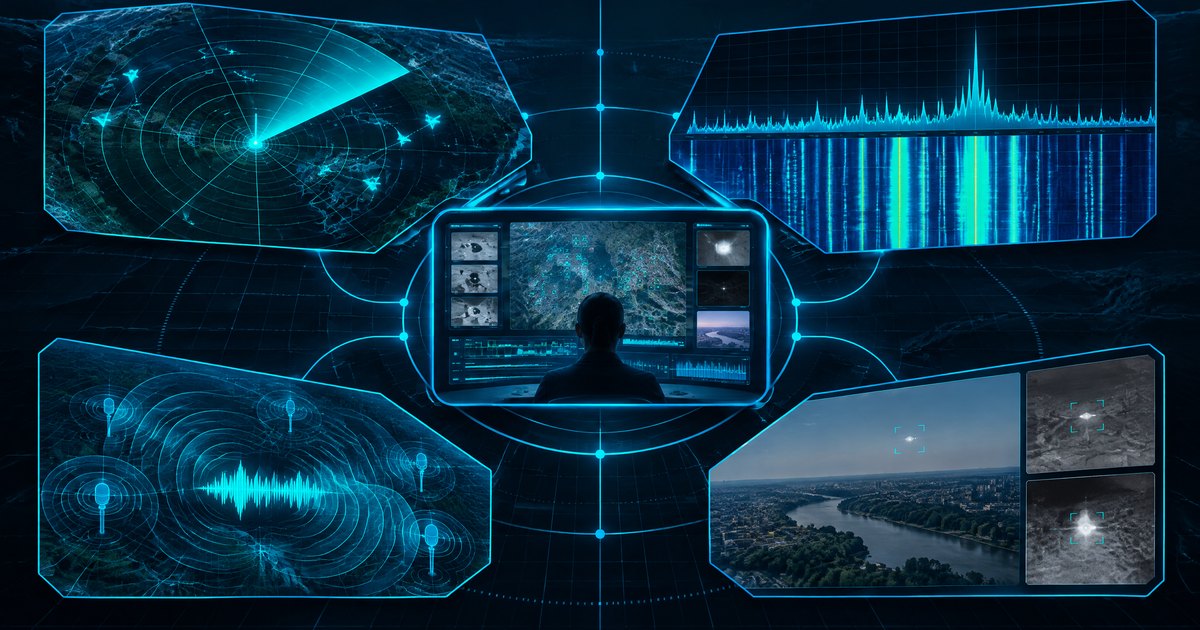
Passive acoustic sensing adds a listening layer to a modern C-UAS evidence workflow. It supports contextual observation and localization estimates, while RF, radar, EO/IR and human review each retain distinct roles and limits.
Acoustic sensing contributes audible context and time-stamped observations.
Microphone arrays listen to the local sound field and can extract features associated with an aerial sound event. Depending on site conditions and system design, those observations may help estimate direction or persistence. They should be displayed with time, sensor-health information, confidence and known environmental limitations. Traffic, plant equipment, weather, terrain and ordinary aviation can all affect a record, so a sound observation remains evidence to assess—not a final label.
Different modalities add different evidence rather than redundant certainty.
Radar may contribute airspace context, RF observation may contribute information about observable emissions, and EO/IR can help authorized reviewers assess visual context when conditions allow. These sources have their own blind spots and governance requirements. Correlation should make agreement, conflict and missing evidence understandable. It should never imply that a fused event has automatically established who an aircraft is, who controls it, whether it is authorized or what it intends.
A C2 layer should organize evidence for people, not make unaccountable decisions.
A responsible command view preserves the underlying observations, their timestamps, confidence indicators and access boundaries. It gives a trained reviewer a way to compare sources, record an assessment and state what remains unresolved. Civil programmes should define who is permitted to access data, which verification steps are lawful, how long records are retained and who may authorize escalation. Human review is the control that prevents a plausible signal from being mistaken for certainty.
Build a reviewable low-altitude evidence chain
Start with lawful purpose and site conditions. Preserve data provenance, state uncertainty, protect privacy, define review roles and test whether a human can understand the record before any action is considered.
Discuss a civil, compliance-first passive acoustic and multi-sensor evidence workflow with SonicVast.Editorial technical brief: this article describes a civil, compliance-first evidence workflow. It does not provide technical deployment settings, countermeasure, interception, jamming, targeting or operational response instruction, and it makes no unsupported performance claim.