
ACOUSTIC SENSING / ENGINEERING AND PROCUREMENT
Acoustic Drone Detection Solution: Choosing Between Sensor-Only and Integrated Delivery
An acoustic drone detection solution can be delivered as a sensor core, an integration-ready subsystem, or a broader system that connects sensing, software, displays, and operating procedures. Those options are not interchangeable. The right choice depends on who owns the interfaces, who validates performance in the real acoustic environment, and who remains responsible when the site, software, or connected systems change.
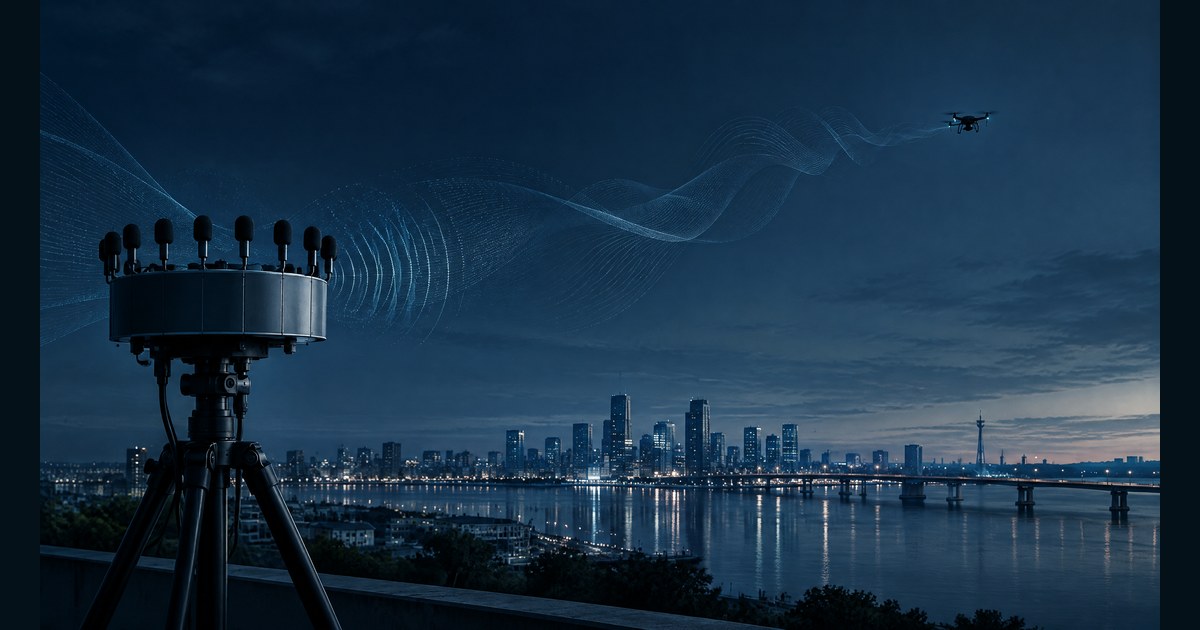
A procurement guide for deciding whether an acoustic drone detection project needs a sensing core, an integration-ready subsystem, or a fuller managed solution.
Start with the delivery boundary, not the product label
The first procurement question is not whether a supplier calls an offer a platform or a sensor. It is where the supplier's responsibility ends. A sensor-only delivery may provide microphones, embedded processing, firmware, event outputs, documentation, and technical support. An integrated delivery may add a network layer, an operator view, correlation with approved data sources, installation work, configuration, and acceptance support. The contract should make that boundary visible.
What sensor-only delivery usually leaves with the buyer
With a sensor-only scope, the buyer or integrator normally remains responsible for mounting decisions, power and network design, time synchronisation, data transport, user-interface work, alert logic, and the relationship between acoustic events and other approved evidence. This can be the best route when an organisation already operates a command system or has an engineering team that needs a reusable sensing component. It is not automatically the lower-effort route; it moves effort into integration and verification.
What an integrated delivery should make explicit
An integrated scope should identify the supplied sensing layer and every connected layer around it. Ask whether the offer includes installation, site survey, acoustic baseline work, configuration, software, data retention, operator displays, interface testing, training, documentation, and post-acceptance support. Do not infer these items from the word integrated. Require a written responsibility matrix that identifies the supplier, buyer, and any third-party integrator for each item.
Choose sensor-only when control and reuse matter most
A sensor-only model is often suitable for a qualified OEM, system integrator, or infrastructure operator with an existing data and operations architecture. It can preserve freedom to select the site controller, storage policy, network path, and presentation layer. It may also make it easier to use the same sensing core in more than one project, subject to written interface and licensing terms.
The strongest fit is an existing integration capability
Sensor-only delivery is more defensible when the buyer can name the team that will own the interface specification and test plan. That team should be able to define required event fields, timestamps, health status, configuration controls, update procedures, and failure handling before purchase. NASA's interface-management guidance treats physical, electrical, mechanical, data, and human interfaces as items to define and control, not assumptions to resolve at the end of installation.
The main risk is an unpriced integration gap
A quote for hardware can look clear while leaving important work undefined. Before choosing this model, ask who will build the adapter, who will handle clock drift or packet loss, who will tune alert presentation, and who will repeat tests after a software or network change. If the answer is still 'to be decided,' the project is not yet ready for a sensor-only purchase.
Choose integrated delivery when one accountable workflow is the priority
An integrated delivery can be preferable when the buyer needs a defined operator workflow and does not want to coordinate several technical parties. It can reduce the number of handoffs for site survey, configuration, display integration, and acceptance. It does not remove the buyer's responsibilities. The buyer still needs to define the protected area, operating hours, authorised activities, escalation rules, data governance, and the evidence needed to accept the system.
Integration should mean tested interfaces, not a larger brochure
The UK government's guidance on countering drone threats to shipping notes that integrated sensor solutions may require compatible command-and-control software to overlay different outputs. It also recommends in-situ testing for compatibility, power, installation, interference, and existing management-system impacts. Apply the same discipline to a civil site: name each interface, identify its owner, define the test condition, and record the result. A single screen does not prove that the underlying data are correctly associated or that an alert is suitable for a real decision.
Integrated delivery creates lifecycle dependency
A fuller solution can simplify the first deployment while making future changes more dependent on the original supplier or integrator. Clarify how configuration backups, software updates, API changes, component substitutions, cybersecurity notices, training refreshes, and fault diagnosis will be handled. Confirm which functions remain usable if a connected service is unavailable. These are commercial and technical terms to document for the project, not capabilities to assume universally.
Make the acoustic environment part of the delivery scope
The delivery model should be selected together with the evidence plan for the site. CISA states that loud and persistent noise can interfere with acoustic sensors and that terrain, weather, and structural conditions can affect operation or location accuracy. UK maritime guidance similarly identifies microphone sensitivity, drone noisiness, wind, engines, heavy seas, sound-signature libraries, and installation location as relevant acoustic considerations. A sensor-only buyer must own this assessment or assign it to an integrator. An integrated supplier should state what it will measure and what remains a site assumption.
Define the observation that will be accepted
Do not write a requirement that simply says 'detect drones.' Specify the event or output that matters to the workflow: for example, a candidate acoustic event, a bearing estimate, a location estimate, a track update, a confidence value, or an operator-review cue. Detection, classification, bearing, position, and identity are different outputs. Acoustic reception cannot detect a literally silent target or establish flight permission, operator identity, or an automatic response authority.
Test representative noise and authorised activity
Acceptance evidence should include the site's normal sound conditions and its known benign activities. The test plan can compare quiet periods, persistent machinery, wind or weather variation, and approved flight activity where lawful and safe. It should record what was observed, what was not observed, the operating configuration, and any review decision. Avoid treating a demonstration in a quiet location as proof of performance at a noisy facility.
Use a delivery decision matrix before requesting a final quote
A short decision matrix helps prevent a procurement team from comparing unlike scopes. The purpose is not to rank sensor-only or integrated delivery universally. It is to expose which model fits the project's authority, engineering capacity, evidence needs, and change horizon.
Questions that favour sensor-only delivery
Choose the sensor-only path when the buyer already has a controlled command or data environment, needs an OEM or PCBA building block, can maintain interface documentation, and wants to retain responsibility for application logic. Ask for the output specification, SDK or API scope where applicable, configuration method, update process, diagnostic data, environmental assumptions, and a bench-to-site verification plan. Confirm all compatibility and licensing terms in writing.
Questions that favour integrated delivery
Choose the integrated path when the buyer needs a defined operator experience, has limited internal integration capacity, requires one coordinated acceptance plan, or must connect acoustic observations to an existing security workflow. Ask what is included at the boundary, which third-party systems are supported, who controls changes, how failures are isolated, and how the solution will be retested after a connected-system change. Require a clear handover package rather than relying on a product demonstration.
The common acceptance questions
For either model, ask: What exactly is the system output? Under which acoustic and weather conditions is it evaluated? What data and logs are retained? Who can change thresholds or libraries? How are false alarms reviewed? What happens when a node, network path, clock source, or display is unavailable? Which claims are measured at this site, and which are only general product descriptions? These questions turn a delivery preference into a verifiable project scope.
Turn the preferred model into a bounded statement of work
Before asking SonicVast or another qualified supplier for a project proposal, prepare a one-page boundary document covering the sensing output, site conditions, connected systems, installation responsibilities, acceptance evidence, data handling, and lifecycle owner. Then request separate scope and confirmation for the sensor core, integration work, and site validation. This makes a sensor-only quote and an integrated quote comparable without implying that either is universally suitable.
Discuss your projectAcoustic sensing is environmental observation, not a guarantee of detection, identification, coverage, or response authority. Performance depends on the site, target acoustics, background noise, weather, installation, configuration, and validation method. Integration compatibility, SDK/API contents, warranty, updates, support, certification, and commercial terms require written project confirmation.