
ACOUSTIC SENSING / ENGINEERING AND PROCUREMENT
Acoustic Drone Detection Solution: Turn a Customer Problem into a Bounded Sensing Scope
A request for an acoustic drone detection solution often starts with a reasonable concern: staff need earlier notice of low-altitude activity near a perimeter, roof, port area, or other civil facility. The request becomes difficult when “detect drones” is treated as a complete specification. A useful solution proposal begins by naming the decision the customer needs to support, then limits the sensing package to outputs that can be measured, integrated, and reviewed. That is the difference between a bounded sensing solution and a universal promise.
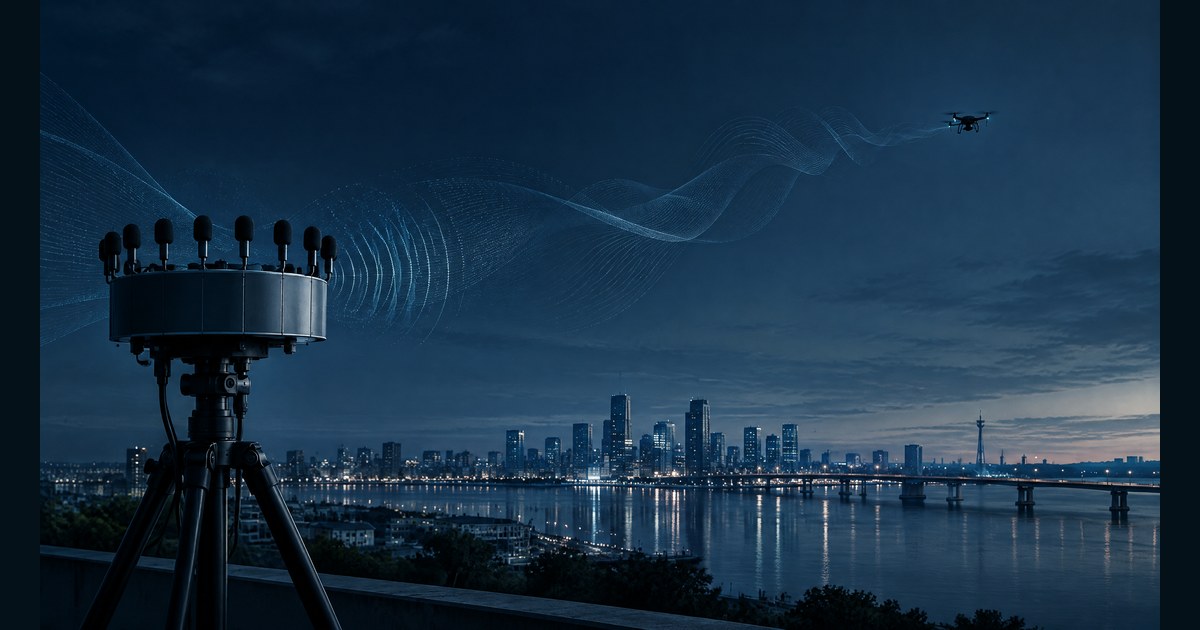
A procurement-oriented method for translating an operational concern into acoustic sensing outputs, site evidence, integration boundaries, and a defensible acceptance plan.
Start with the decision, not the sensor
The first question is not how many microphones to install. It is what a responsible operator must decide after an alert. The answer might be whether to ask a patrol team to inspect an area, whether to correlate an acoustic indication with an approved camera or radar source, or whether to record an event for later review. Each decision needs different evidence and timing.
Convert the customer’s concern into a use case
Write the concern as a short operational scenario: a candidate aerial sound is observed near a defined area; an operator receives a time-stamped indication; the operator checks approved evidence; and the organisation follows its own escalation or observation procedure. This keeps the project civil and accountable. It also prevents the proposal from quietly promising identification, intent assessment, or intervention when the customer only asked for early awareness. NASA’s systems-engineering guidance treats the operational concept and stakeholder expectations as inputs to requirements, rather than leaving the system purpose implicit.
Separate the required output types
Detection, direction, position, track, classification, and model confidence are different outputs. A first-stage requirement may only be an event indication with a timestamp and quality flag. A later stage may ask for a directional cue or correlation with another approved sensor. A make or model label requires suitable comparison data and should not be assumed merely because a sound was detected. The UK Government and CISA both describe acoustic systems in terms of motor-sound signatures while also noting environmental and library limitations.
Define the acoustic problem at the site
Acoustic performance is not a single number that transfers unchanged from one location to another. Wind, machinery, traffic, marine engines, structures, terrain, weather, and the sound characteristics of the aircraft of concern can affect whether a candidate signal is observable and how confidently it can be assessed.
Describe the sound environment before discussing coverage
A useful site brief records recurring sources, time-of-day changes, reflective surfaces, sheltered or exposed locations, access for maintenance, and any periods when the customer would accept reduced confidence. The UK Government’s maritime guidance specifically advises considering background acoustics and notes that wind and other noise can make long-range drone sound difficult to detect. CISA likewise warns that ambient noise, extreme weather, and obstacles can reduce range or location accuracy. These are reasons to gather site evidence, not reasons to invent a guaranteed range.
Name the target set and the non-targets
Ask which aircraft types, operating modes, and expected sound profiles matter to the project. Also list likely confounders such as birds, machinery, vehicles, or other aircraft. The purpose is not to claim that an acoustic system can recognise every object. It is to define the candidate events that the evaluation will include and the events that should be logged as uncertain or non-target observations. A library or model update process should be discussed if the target set changes.
Bound the proposed delivery
Once the problem is described, the proposal can be divided into a sensing core, data and interface outputs, site work, and acceptance evidence. This makes quotations and responsibilities clearer without implying that every project needs the same package.
Specify what the sensing layer will and will not provide
A written scope might include microphone-array data capture, acoustic event processing, an alert record, a directional estimate, or an interface for an approved management platform. It should state whether outputs are raw, processed, or confidence-scored, and whether time synchronisation, health status, and event export are included. It should also say what is outside scope: automatic threat judgement, operator attribution, flight authorisation, mitigation, or a guaranteed aircraft identity. FAA guidance makes the same functional distinction by stating that detection systems do not determine intent or the threat level posed by a UAS.
Treat interfaces and site work as explicit work packages
Integration is more than a connector. Confirm data format, time references, network path, power, mounting, environmental protection, access, cybersecurity review, alarm ownership, and how the receiving platform handles uncertain events. If the customer wants a sensor-only delivery, say who supplies the display, recording, storage, and operator workflow. If an integrated solution is requested, define which party is responsible for system-level testing. The UK Government’s procurement guidance similarly calls for in-situ integration testing and review of power, installation, compatibility, and operating procedures.
Make evidence part of the solution
A proposal is stronger when each important requirement has a corresponding way to verify it. This does not require a large trial or a universal performance claim. It requires an agreed method, configuration, scenario, and record.
Use verification for the defined requirements
Verification asks whether the delivered item meets the written requirement. Examples include checking that an event record contains the agreed fields, that a health message is generated under a defined fault condition, or that an interface passes a specified test message. NASA distinguishes this proof of compliance from validation, which asks whether the product serves its intended purpose in the intended environment. Keeping the two questions separate prevents a successful bench test from being described as proof of site-wide operational suitability.
Use site validation for the customer’s real question
Validation should use representative site conditions and the customer’s review workflow. The record can include the test aircraft or sound source category, weather and background conditions, sensor configuration, time window, observed output, missed or uncertain cases, and operator interpretation. The aim is not to manufacture a headline detection rate. It is to show whether the bounded output is useful for the defined decision and to identify conditions that require another sensing layer or a revised operating rule.
Ask suppliers questions that expose the boundary
A buyer can often learn more from a supplier’s exclusions and evidence plan than from a headline range. Questions should force the proposed solution to connect its capability to the site, target set, and receiving workflow.
Questions about sensing evidence
Ask: Which target sound profiles were evaluated? Under what background and weather conditions? What is the defined output when confidence is low? How are false alarms, missed observations, and uncertain classifications recorded? What changes when the microphone location, structure, or noise environment changes? CISA notes that accurate make/model identification relies on comparison libraries, while the UK Government advises checking whether the relevant drone signature is represented. These questions turn a generic demonstration into evidence that can be compared with the customer’s problem.
Questions about ownership and lifecycle
Ask who owns calibration, firmware or model updates, event-data retention, interface changes, and revalidation after a site change. Confirm which features are included in the proposed configuration and which require written project confirmation. A supplier may be able to discuss a sensor core, PCBA, software interface, or integration support, but those options should be treated as scope items to confirm rather than as assumed universal capabilities.
Write a one-page sensing boundary before requesting a quotation
State the operational decision, target and non-target set, expected output, site sound conditions, receiving system, acceptance evidence, and exclusions. Then ask potential suppliers to respond against that same boundary. SonicVast can discuss acoustic sensing, integration, and project-specific customisation as applicable, but the final sensor, interface, support, and validation scope should be confirmed in writing for the actual site.
Discuss your projectAcoustic sensing responds to observable sound and cannot detect a literally silent target. Environmental conditions affect performance. Detection does not by itself establish aircraft identity, operator identity, flight permission, intent, or authority to take action. No universal range, accuracy, certification, availability, or integration result is implied.