
ACOUSTIC DETECTION / CIVIL SECURITY
How Far Can an Acoustic Drone Detection System Detect a UAV?
For a critical-infrastructure team, the useful question is not simply how far a microphone can hear. It is whether the complete detection workflow can produce a timely, explainable, and authorized alert in the conditions that matter at a particular site. Acoustic sensing can contribute an early warning layer, but its responsible use depends on validation, human review, and disciplined data governance.
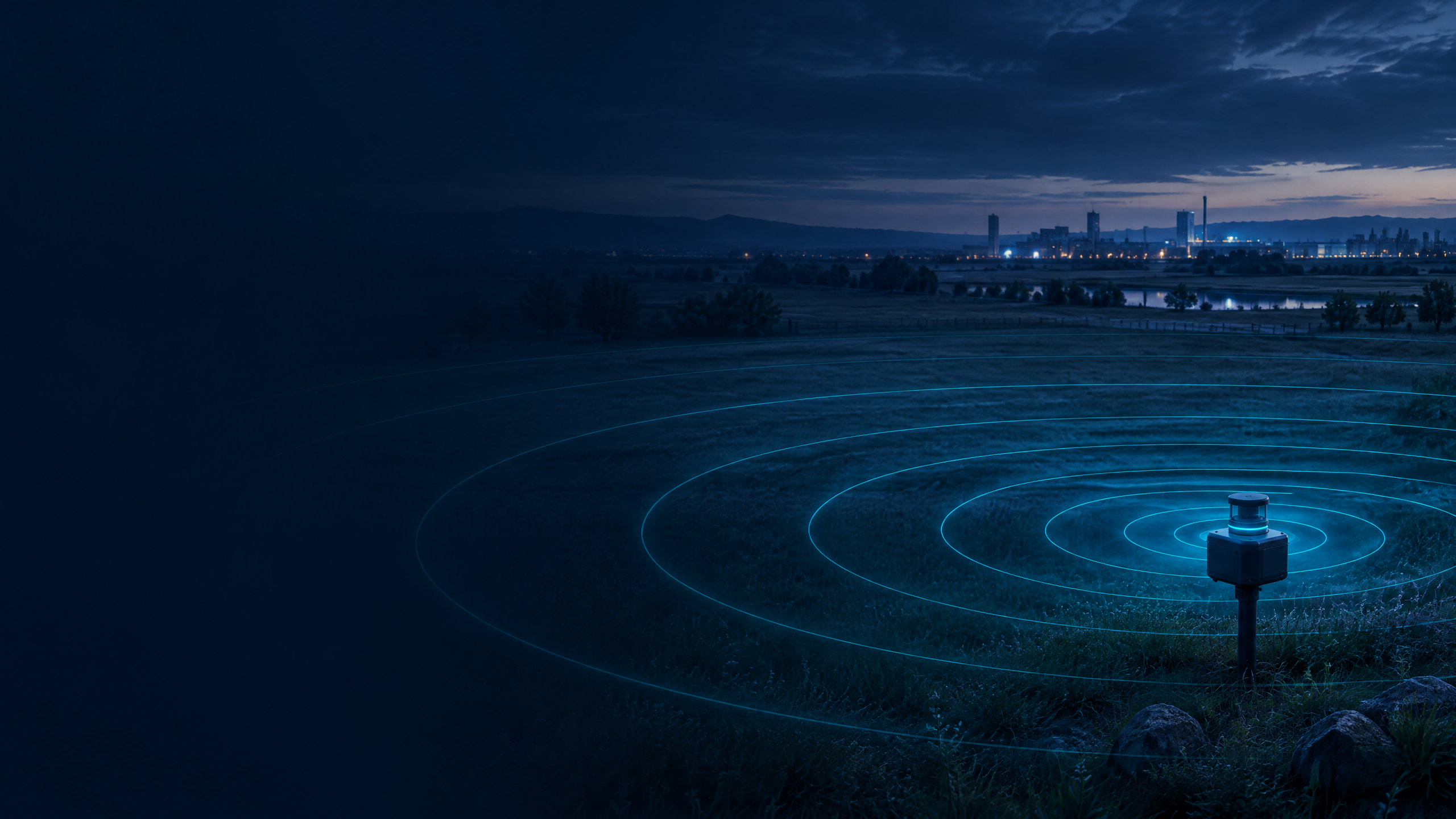
Acoustic detection range is not a universal product number. It is a site-dependent assessment shaped by ambient sound, architecture, weather, sensor placement, aircraft behavior, and the governance process used to review alerts.
Why distance alone is the wrong measure
An acoustic system responds to an evolving sound field, not a fixed circle on a map. Propagation is affected by background noise, reflections, terrain, structures, vegetation, wind, temperature, humidity, and the aircraft’s operating state. A useful assessment therefore describes conditions and confidence, rather than presenting one universal boundary. Integrators should document what the system is intended to detect, what may obscure it, and how uncertainty is communicated to reviewers.
Treat acoustic alerts as a layer
Acoustic sensing is strongest when its alert is considered alongside an authorized sensor workflow, which may include optical review or other approved inputs. Corroboration can help a reviewer distinguish a plausible aircraft event from machinery, traffic, weather, wildlife, or other sources of noise. The purpose is not to promise identification from sound alone; it is to support a measured decision process with clear confidence states and an auditable handoff.
Separate detection from attribution
An acoustic signature may indicate that an airborne sound event deserves attention, but it does not by itself establish identity, intent, ownership, or authorization. Approved RF, C2, or other site inputs may provide context only where their use is lawful, documented, and within the system’s stated scope. Teams should avoid turning a correlation into a conclusion, and should record which evidence was available, which was absent, and who made the final assessment.
Build a repeatable site test
Before relying on an alert, define a site-specific validation plan with authorized stakeholders. It should cover representative operating conditions, known noise sources, sensor health, placement assumptions, alert thresholds, maintenance, accessibility, and human-review timing without publishing sensitive specifications. Results should be versioned, reproducible, and revisited after construction, landscaping, traffic, equipment, or policy changes. A deployment is ready when its limitations are as clear as its intended use.
Where this guidance applies
Use this framework when planning or reviewing civil low-altitude security for facilities such as utilities, transport sites, campuses, industrial locations, and other critical infrastructure. It is intended for system integrators, security owners, privacy and compliance teams, and operations leaders who need to compare sensing layers and define acceptance criteria. It is not a substitute for local law, an aviation authority’s direction, a privacy impact assessment, or a site-specific engineering review.
Ask SonicVast for a site-validation conversation focused on assumptions, authorized evidence, human review, and governance before discussing any deployment decision.Disclosure: This educational record is editorial guidance for civil security planning. It contains no guaranteed range, superiority claim, tactical instruction, countermeasure guidance, interception guidance, or sensitive specification. Conditions and lawful requirements vary by site; obtain qualified local review before implementation.