
ACOUSTIC SENSING / ENGINEERING AND PROCUREMENT
Acoustic Drone Identification System: How to Read Class Labels, Confidence and Unknowns
An acoustic drone identification system can organise an observation into labels such as multirotor, fixed-wing aircraft, bird, vehicle or background noise. That label is useful only when the buyer understands what the training classes represent, how the confidence value was produced, and what happens when the sound does not fit any known class. Acoustic classification is an observation layer. It does not, by itself, establish a unique aircraft, operator, registration, permission status or intent.
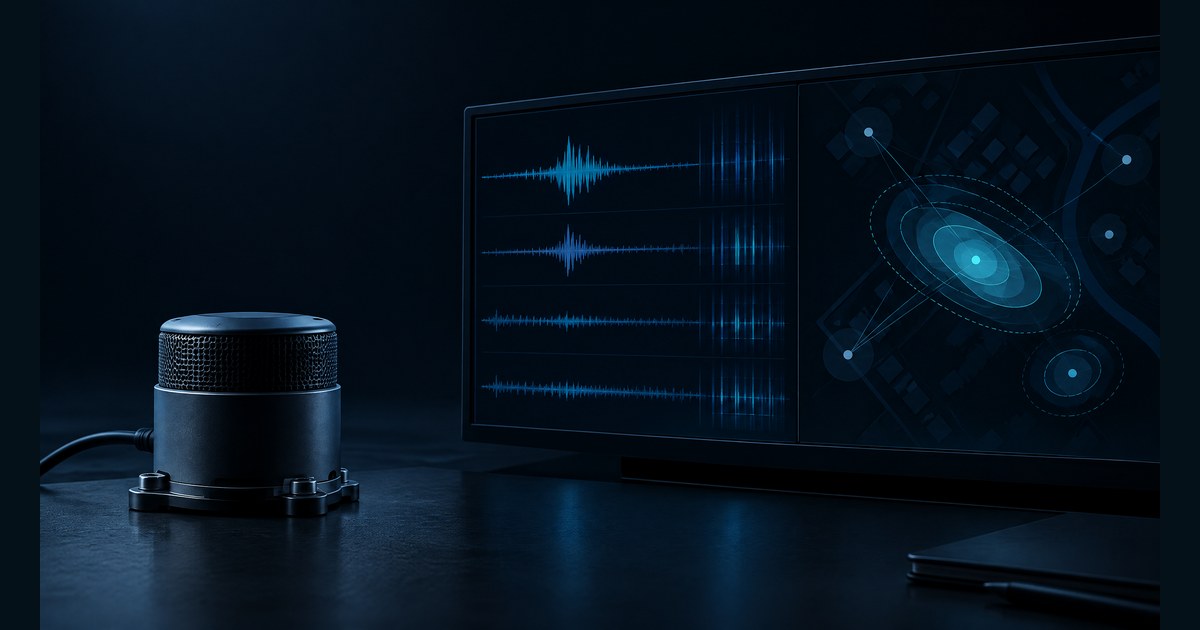
A procurement guide to interpreting acoustic class labels without confusing a model prediction with a confirmed aircraft identity.
A class label is a model category, not an aircraft identity
The first question for a buyer is not whether a screen shows a familiar drone name. It is what that name means in the system's data model. A class label normally describes the category the algorithm was trained or configured to distinguish. It may refer to an acoustic family, an object type, a site-specific nuisance source or a broad event category. The label should be read as a statement about the observed signal under defined conditions, not as proof of ownership or registration.
Ask what the label covers and what it excludes
A label such as multirotor may combine many airframes, payloads, flight states and distances. A label such as a named model implies a much narrower claim and therefore needs stronger evidence about the training set, separation from similar models and validation conditions. Ask the supplier for the class dictionary, version history, examples of confusing classes and the minimum evidence required before a label is displayed. If the list includes birds, machinery or other environmental sources, ask whether those are detection classes, nuisance classes or simply items used in testing.
Separate observation, classification and identity
A microphone array may provide sound features and a direction estimate. A classifier may attach a candidate class. A separate authorised source may provide a device identifier or flight record. These are different outputs and should remain different fields in the event record. Treating the first two as if they were the third can create an unjustified identity claim, especially when several aircraft share similar propulsion sounds or when the signal is incomplete.
Confidence is meaningful only with calibration and context
A displayed value of 0.82, 82% or high confidence is not automatically an 82% chance that the aircraft is the named class. Google’s machine-learning guidance explains that a classification threshold converts a model score into a decision, while scikit-learn’s calibration documentation notes that a probability can be interpreted as confidence only for a well-calibrated classifier. Buyers should therefore request evidence for the meaning of the score rather than compare percentages across suppliers as if they used a common scale.
Request a reliability view, not one impressive number
Useful evidence groups predictions into score bands and compares them with labelled test outcomes. For example, if a system calls a set of events 0.8, the evaluation should show how often that group actually belonged to the stated class under the test definition. Also request the sample count, class balance, recording conditions, distance or signal-quality range, and whether the evaluation data was independent of training data. A high score on a narrow, clean dataset may not transfer to a reverberant industrial perimeter.
Thresholds encode operating priorities
The threshold for showing a candidate label is a policy and engineering choice, not a universal truth. A low threshold may surface more possible events but also increase review workload. A high threshold may suppress ambiguous events and create a risk of missed observations. Google describes this trade-off through false positives and false negatives. Define separate outcomes such as candidate, review required and no reliable class instead of forcing every event into a binary answer.
Unknown and abstain states are signs of honest system design
A closed list of classes creates pressure to choose the nearest known label even when the signal comes from an unseen aircraft, a new propeller configuration, weather, construction noise or overlapping sources. An unknown, out-of-distribution or abstain state gives the workflow a way to say that the available evidence is insufficient. It should not be treated as a system failure or silently converted into a familiar drone category.
Define the unknown state in the interface and data
Ask whether unknown means low signal quality, disagreement between models, a score below threshold, a source outside the training taxonomy, or a temporary processing condition. Those causes have different follow-up actions. The event record should preserve the raw reason, top candidate classes if available, confidence or score semantics, timestamp, sensor health and any human disposition. A single generic unknown label is better than an overconfident identity, but a reason code makes it operationally useful.
Use unknown events for controlled improvement
Unknown events can be sampled for review and, where lawful and appropriate, labelled for later evaluation. Do not automatically add every reviewed sound to a training set. Confirm the provenance, consent or retention basis, label quality and whether the new material represents the site rather than one unusual incident. Version any revised class list or model, then compare performance before and after the change using a held-out evaluation set.
Design the review record around evidence, not a single verdict
For civil infrastructure, the valuable output is often a traceable observation record. It can include the acoustic event time, sensor or array status, directional estimate where available, candidate classes, score semantics, unknown reason, environmental context and reviewer disposition. This structure lets an operations team distinguish a recurring nuisance source from a genuine candidate event without claiming more than the sensor observed.
Create human-review states that are easy to audit
A practical state model might include observed, candidate class, unknown or insufficient evidence, corroborated by an approved source, and closed after review. These are workflow states rather than universal technical standards. Document who may change a state, what evidence is required, and whether the original machine output remains immutable. This prevents a later human decision from overwriting the initial observation and makes model changes easier to explain.
Test the hard cases deliberately
Acceptance work should include recordings with background machinery, wind, reverberation, intermittent sound, multiple sources and classes absent from training. Measure not only correct labels but also false-label rate, unknown rate, review burden and behaviour when sensor quality degrades. A responsible requirement may be that uncertain events remain uncertain, rather than that the system always produce a named answer.
Link acoustic classification to identity evidence only through an authorised workflow
Identity is a separate evidence question. The U.S. Federal Aviation Administration describes Remote ID as a broadcast of identification and location information that can be received by other parties. If a project is permitted to use Remote ID or another authorised registry, the integration should document how an acoustic observation is associated with that external record, what time and location tolerances apply, and what happens when no matching signal is available. No match is not proof that the aircraft is absent, unregistered or malicious.
Keep correlation probabilistic and reviewable
A nearby Remote ID record may support a correlation hypothesis, but it does not retroactively change the acoustic class into a serial-number identification. Preserve the two source records and show the association logic, timing, location uncertainty and data-quality status. If the external source is unavailable or inconsistent, the acoustic record should remain a classified or unknown observation rather than inherit an identity.
Turn procurement questions into written requirements
Ask the supplier to define class taxonomy, score semantics, calibration method, threshold configuration, unknown behaviour, model and firmware versioning, event export fields, audit logs, data retention, and integration boundaries. Ask for representative validation evidence and a site-specific test plan. Confirm in writing which functions are available in the proposed configuration; do not infer accuracy, identity coverage, certification or deployment results from a product label alone.
Make unknown handling an acceptance criterion
Before comparing acoustic systems, write down the class dictionary, score interpretation, calibration evidence, threshold policy, unknown states and review record you need. Then evaluate representative site sounds and require the system to preserve ambiguous cases for accountable review.
Discuss your projectAcoustic classification is not a unique aircraft, operator or authorisation identity. Remote ID and other external identity sources depend on lawful availability, signal reception and project-specific correlation rules. SonicVast capabilities, interfaces and integration scope require written confirmation for the actual project.