
ACOUSTIC SENSING / ENGINEERING AND PROCUREMENT
Why an Acoustic Drone Identification System Does Not Establish Drone Identity
An acoustic drone identification system is often expected to answer a stronger question than its sensor can support. Microphones receive sound produced by motors, propellers and the surrounding environment. A classifier can compare those observations with a trained set of sound classes. It cannot, from sound alone, establish a unique aircraft identity, the operator behind it, or permission to fly. That boundary matters when a civil infrastructure team turns an alert into a documented decision.
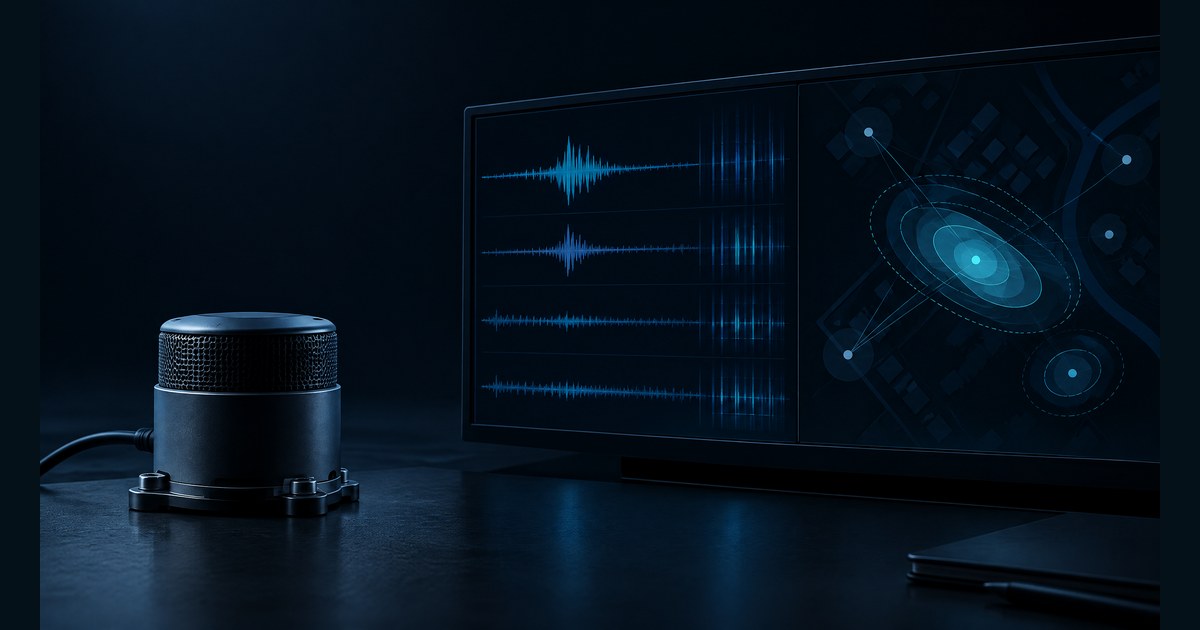
Acoustic analytics can help a site decide whether an observed sound resembles a learned drone class. That useful classification result is still different from proving which aircraft is present, who operates it, or whether its flight is authorized.
Classification answers a different question from identity
The first procurement task is to name the output precisely. Detection asks whether a signal may contain a target-like acoustic event. Classification asks which learned category best fits the measured features. Localization or tracking adds where the sound may be coming from and how that estimate changes over time. Identity is a separate assertion about a particular aircraft, registration, serial number, operator, or other accountable entity.
A class label is a comparison result
A label such as drone-like sound, multirotor, or a particular trained family describes similarity to reference data. It does not mean the sensor read a serial number or verified the aircraft's physical markings. Two aircraft can produce acoustically similar observations, while one aircraft can sound different as distance, load, speed, orientation, weather, and background noise change. The label should therefore be stored as an observation with time, sensor context and model version, not as an identity record.
Track and identity must remain separate fields
A directional estimate or track can help a review team follow a moving acoustic source. It still does not prove that every later measurement belongs to the same aircraft, nor that the source is the aircraft named in an operational plan. A well-designed workflow keeps bearing, location estimate, track association and identity evidence as separate fields so that a plausible movement path is not mistaken for proof of ownership or authorization.
Confidence is not a certificate of truth
Machine-learning systems commonly turn model output into a category by applying thresholds and evaluating errors across classes. Google’s machine-learning guidance describes classification as predicting which category an example belongs to and emphasizes thresholds and evaluation metrics. In a site workflow, a displayed confidence value should therefore be read as model evidence under defined test conditions, not as a probability that the aircraft has a particular legal or human identity.
Ask what the score was calibrated against
A buyer should ask whether the score reflects a validated probability, a relative model score, or only the winning class among the classes the model knows. The answer should include the test environment, background sound, microphone arrangement, distance assumptions, class balance and rejection rule. Without that information, a high-looking number can be overinterpreted, especially when the live site differs from the training data.
Require an abstain or unknown path
A practical classifier needs a way to say that the observation is insufficient, outside its known classes, or too contaminated by noise. An unknown result is not a system failure. It is often the most honest output when the signal does not support a defensible class label. Procurement questions should cover the threshold for abstention, the record retained for later review, and whether operators can distinguish unknown from no detection.
Why acoustic observations vary at a real site
Sound is shaped by propagation and context before it reaches the microphone. Industrial fans, transformers, vehicles, birds, construction and weather can mask or imitate portions of a drone signal. The acoustic signature also changes with operating state and geometry. These are not reasons to discard acoustic sensing; they are reasons to define what the system is expected to establish and to validate it in representative conditions.
A reference library is not a universal identity database
A sound library can support comparisons between recorded examples and candidate classes. It cannot automatically cover every aircraft, modification, payload, propeller, firmware state or environmental condition. Ask how new observations are labeled, how version changes are governed, and how the system prevents an unfamiliar sound from being forced into the nearest known class.
Local validation should test the decision boundary
A civil project team should test representative background conditions and include non-drone sources that could create similar features. The acceptance record should show not only successful target examples but also rejected or unknown cases, missing data, conflicting sensors and review outcomes. This turns a classification demonstration into evidence about how the workflow behaves when conditions are imperfect.
Link acoustic results to independent identity evidence
The correct response to the identity gap is correlation, not a stronger-sounding acoustic label. Independent evidence may include an applicable Remote ID observation, an approved flight schedule, site access records, visual confirmation, or another authorized sensor and data source. Each source answers a different question and should retain its own timestamp, provenance and limitations.
Remote ID can provide an attributable data point when available
The FAA describes Remote ID as a broadcast of identification and location information that can be received by other parties. Its stated information is different from a microphone classification. A project can use an available Remote ID record as a candidate identity and location input, then compare timing and location with the acoustic observation. A missing or conflicting Remote ID signal does not prove that no aircraft is present, and the applicable jurisdiction and operating conditions must be checked.
Authorization is a policy record, not an acoustic class
Even a credible aircraft identity does not by itself establish that the flight is authorized at a particular site and time. An approved mission record, geofence or operator workflow belongs to the governance layer. The review result should say whether the acoustic observation was consistent with an authorized activity, unresolved, or inconsistent with available records. It should not silently convert a model label into an enforcement conclusion.
Procurement questions that preserve the boundary
A buyer can obtain more useful answers by specifying evidence handling rather than asking whether a system identifies drones. The NIST AI Risk Management Framework is intended to help organizations incorporate trustworthiness considerations into the design, development, use and evaluation of AI systems. That risk-management framing fits an acoustic project: define the claim, measure it, record uncertainty and assign a humanly accountable review path.
Specify the output contract
Ask the supplier to define detection, class label, confidence or score, unknown output, bearing or position estimate, track association, event time and raw or derived evidence. Request the conditions under which each field is unavailable. Also ask whether model and configuration versions are retained so that an incident review can reproduce what the system presented at the time.
Define the handoff to the approved system of record
The integration should state which external sources may be correlated, who may approve that correlation, how conflicts are displayed, and what is retained for audit. A sensible result might be: acoustic event consistent with a trained class; identity not established by acoustic data; Remote ID or approved schedule not observed in the reviewed window. That wording is more useful than a single green or red status because it preserves the difference between observation and conclusion.
Start with an evidence map, not an identity promise
For a new project, list the acoustic outputs separately from identity and authorization records. Then define test cases for known, unknown, noisy, conflicting and authorized observations. SonicVast can discuss acoustic sensing, integration and project-specific data handling as options to confirm for the actual site and scope; performance, interfaces and service terms require written project confirmation.
Discuss your projectAcoustic sensing does not detect literally silent targets and does not by itself establish aircraft identity, flight permission or automatic response authority. Remote ID rules and other aviation requirements vary by jurisdiction and operation; confirm the applicable requirements with the responsible authority.