
ACOUSTIC SENSING / ENGINEERING AND PROCUREMENT
Acoustic Drone Monitoring System: Keep Health Status Separate from Airspace Events
An acoustic drone monitoring system can produce two very different kinds of information: evidence about the system itself and an observation about the surrounding airspace. A microphone channel may be saturated, disconnected, time-unsynchronised or awaiting maintenance without any drone being present. Conversely, a candidate acoustic event may be recorded while every health indicator is green. Treating both as one alarm makes review harder, weakens evidence, and can cause an equipment problem to be mistaken for an airspace conclusion.
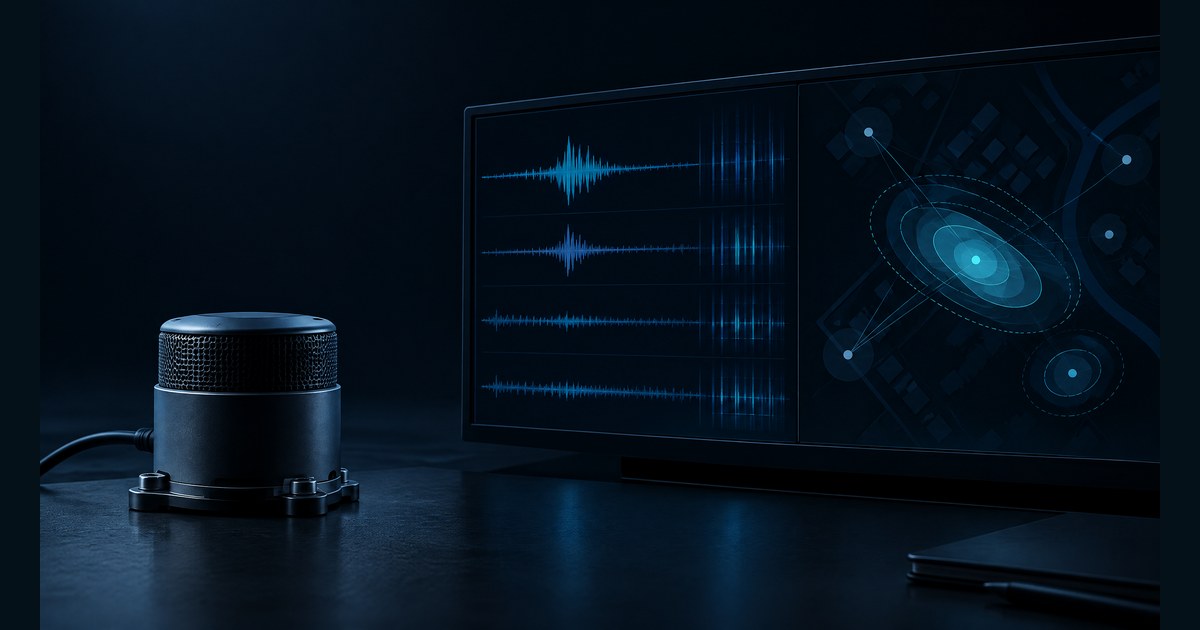
A practical governance guide for distinguishing whether an acoustic monitoring system was ready to observe from what it observed in the airspace.
The two questions every monitoring record should answer
Start by separating readiness from observation. The first question is whether the sensing chain was available and producing data that operators could reasonably review. The second is whether the system generated a candidate airspace event and what that event actually established. The U.S. Federal Aviation Administration describes acoustic sensors as one possible detection source and notes that detection alerts prompt further investigation; a detection system does not determine intent or the level of threat posed by a UAS. That distinction is a useful boundary for civil monitoring design.
Health status describes capability, not aircraft presence
Health records should cover facts such as node connectivity, microphone-channel state, power state, storage capacity, clock synchronisation, software or configuration version, self-test result, and calibration or maintenance status. These fields answer whether the system was operating within its known conditions. A degraded channel is not evidence of a drone, and a healthy channel is not evidence that no aircraft was present. The record should make that difference visible rather than hiding it behind a single green or red label.
An airspace event describes an observation to review
An airspace event should identify the observation window, source or node, reported direction or other available output, processing state, confidence or uncertainty where applicable, and the fact that it is a candidate observation rather than an automatic identity or threat decision. The event can then be correlated with approved evidence such as operations records or another sensor layer. Keep the terms detection, bearing, track, classification and aircraft identity distinct; they are not interchangeable outputs.
Design a record model that prevents misleading conclusions
The interface and data model should preserve two related but separate timelines. A health timeline shows when a node became unavailable, recovered, changed configuration, lost time synchronisation, or entered a maintenance state. An event timeline shows when a candidate sound observation was created, updated, correlated, acknowledged, escalated for review, or closed. Linking the records is useful, but merging them into one event type removes the context needed to interpret either one.
Use explicit state transitions instead of vague availability labels
A practical health record can use states such as available, degraded, unavailable, maintenance, or unverified, provided the project defines them in writing. Each transition should carry a timestamp, source, reason when known, and a record of who or what changed the state. For example, a missed heartbeat may justify an unavailable state, while a later service check may justify recovery. Do not infer an airspace event merely because a health transition occurred.
Preserve the relationship without collapsing the categories
If a candidate event overlaps a period of degraded health, the event record can reference the relevant health interval and display a qualification such as affected channel or reduced data quality. That does not automatically invalidate the observation, nor does it confirm it. It tells the reviewer what evidence was available at the time and which limitation must be considered. This is more useful than rewriting the event as a system fault or silently presenting it as fully reliable.
What belongs in acoustic-system health monitoring
Health monitoring should be specific enough for an integrator or service team to diagnose a problem without turning every engineering message into an operator alarm. NIST’s work on microphone calibration illustrates why measurement quality matters: calibration relates microphone output to a measured sound pressure, and improved calibration can improve the quality of sound-sensing applications. In procurement, that supports asking how calibration state and quality checks are represented in records, not assuming that a calibration checkbox proves field performance.
Separate channel, network and analytic health
Channel health concerns the microphone and signal path. Network health concerns connectivity, packet loss, latency, and time synchronisation. Analytic health concerns whether the processing service is running, whether its input is complete, and whether a software or configuration change occurred. These layers can fail independently. A connected node may still have a muted channel; a functioning channel may feed an unavailable analytic service; an analytic service may run while its timestamps are not aligned. Recording the layer makes troubleshooting and review more precise.
Record quality limitations as data, not as hidden exceptions
Background sound, weather, construction, traffic, shielding, obstructions, and changing site conditions can affect acoustic interpretation. The system should make relevant quality indicators and site notes available beside the event. A quality flag is not a verdict on the airspace. It is a reason for the reviewer to examine the observation with the correct level of caution and, where appropriate, seek an independent approved source.
What belongs in the airspace-event record
The event record should support an accountable review rather than an automatic response. FAA guidance says detection technologies can generate alerts that prompt further investigation and that detection systems cannot determine intent or threat level. For a civil project, the event record should therefore preserve the original observation, the system state at that time, the review steps taken, and the final disposition as a documented human or authorised workflow decision.
Keep original evidence distinct from interpretation
Store the event time, source identifier, relevant signal or feature reference, reported direction or location output when available, and processing version separately from labels such as reviewed, corroborated, unresolved, or dismissed. A later interpretation should not overwrite the initial observation. This allows a project team to understand whether a change came from new evidence, a revised algorithm, or a correction to an earlier record.
Make dispositions explainable
A disposition can state that the observation was corroborated by another approved source, associated with a known authorised activity, judged inconclusive, or closed after review. It should identify the reviewer or workflow role and the evidence considered. Avoid labels that imply aircraft identity, intent, permission status, or threat level unless those conclusions are established by a separate authorised process.
Procurement questions for a clearer monitoring workflow
Buyers should evaluate the record model before evaluating dashboard appearance. NIST describes log management as an enterprise process involving infrastructure and robust processes, while CISA’s event-logging guidance connects logging with operational delivery, visibility, security and resilience. Those principles translate into practical questions for an acoustic project, without assuming that every vendor uses the same schema or retention policy.
Ask how health and event records are linked
Request a sample export or interface walkthrough showing a node outage, a recovery, a calibration or configuration change, and a candidate acoustic event during the same period. Ask whether the event retains the health snapshot or a reference to the applicable health interval. Confirm whether timestamps use a defined time basis and whether corrections are auditable. These questions reveal more than a claim that the system has monitoring.
Ask who reviews each class of record
Define the operational owner for health alarms, the reviewer for candidate airspace events, and the technical owner for maintenance or calibration evidence. Also define when a degraded state requires a service ticket, when an event requires cross-checking, and who can close each record. Responsibilities are project decisions; they should be written into operating procedures rather than inferred from a product screen.
Ask how records remain useful after software changes
Confirm whether software, model, configuration, firmware, and calibration changes are recorded with effective times and version identifiers. A later review may need to distinguish an observation made under one processing version from an observation reprocessed under another. Written confirmation should cover export format, access roles, retention, backup, and the treatment of corrected records.
Specify two linked record types before selecting the interface
For an acoustic monitoring project, request a written health-state dictionary and an airspace-event schema. Test both against a few realistic scenarios, including a disconnected node, a noisy site period, a software update, an authorised flight, and an unresolved candidate observation. Then assign review and maintenance responsibilities, retention rules, and change-control requirements that fit the site’s civil operating procedures.
Discuss your projectAcoustic sensing provides observable sound information. It does not detect literally silent targets or by itself establish unique aircraft identity, flight permission, intent, or automatic response authority. Site conditions, approved procedures, and project-specific validation remain necessary.