
ACOUSTIC SENSING / ENGINEERING AND PROCUREMENT
Acoustic Drone Monitoring System Records: Who Keeps Them, Who Reviews Them, and Why
An acoustic drone monitoring system does not create one uniform kind of evidence. It may produce sound samples or features, a detection event, a directional estimate, system-health data, operator annotations, and a later review decision. Treating all of those outputs as one permanent recording creates avoidable cost, privacy exposure, and confusion about responsibility. A better programme assigns an owner, purpose, retention rule, and review path to each record type before the system enters service.
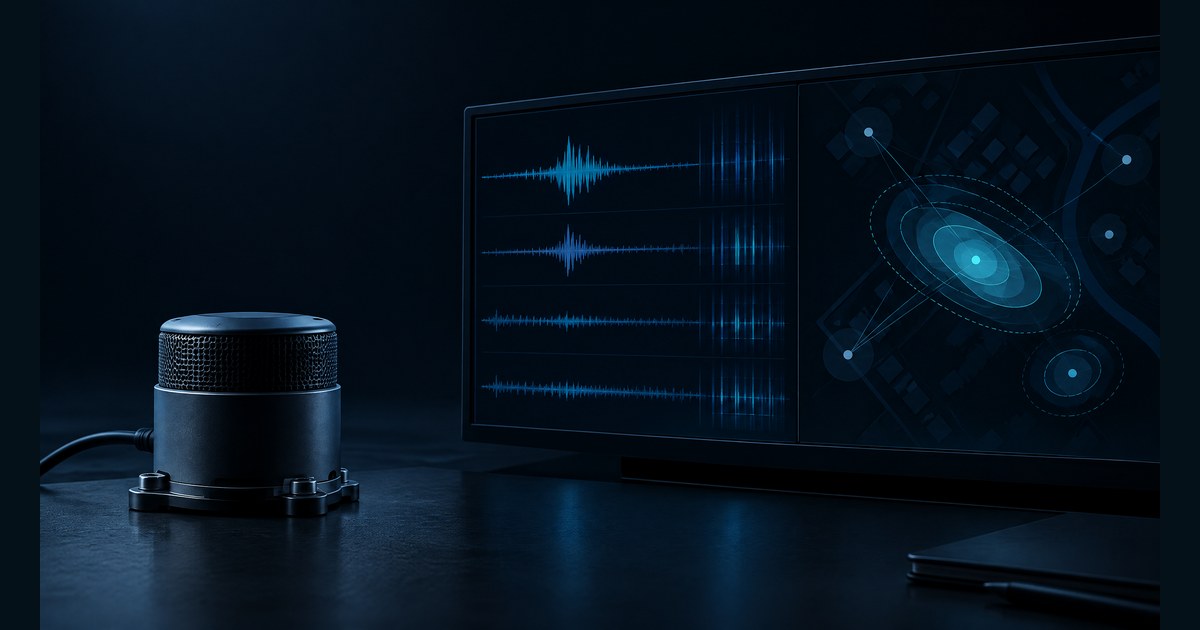
A practical governance guide for deciding what an acoustic monitoring programme records, how long each record type is kept, who may review it, and how a civil infrastructure team can preserve a defensible evidence trail without treating an acoustic indication as an automatic identification.
Start with a record taxonomy, not a single retention number
Retention becomes manageable when the project first defines what it is keeping. The record should be understandable to someone who did not operate the system at the time of the event, while still preserving the distinction between observation and interpretation.
Separate acoustic evidence from the event summary
A raw audio segment, a derived acoustic feature, and an event summary answer different questions. The raw or near-raw material may help a technical team investigate a disputed indication, while the event summary can support routine operational review. The summary should identify the sensor or node, time reference, software or configuration version, quality state, detected indication, and any available direction estimate. It should not silently turn a candidate sound into a confirmed aircraft identity. The UK Government’s counter-drone guidance describes acoustic sensors as using microphones to process motor noise and notes that multi-sensor direction estimates may be rough.
Keep health records separate from airspace events
A missing sample, clock drift, reboot, network interruption, microphone fault, or configuration change is a monitoring-health matter. It should not be represented as an uneventful period in the airspace. Keeping health records alongside, but distinct from, detection events allows a reviewer to ask whether an absence of indication is meaningful. It also gives maintenance and procurement teams evidence about availability without changing the factual status of an event.
Assign responsibility at each stage of the record lifecycle
A useful responsibility model distinguishes the person or team accountable for the record from the people permitted to use it. The installer, sensor supplier, security operator, IT administrator, privacy or compliance lead, and records owner may all have different duties.
Name the records owner and the technical custodian
The records owner decides why a record exists, which policy governs it, and when it may be deleted or placed on hold. The technical custodian keeps timestamps, access controls, backups, export functions, and system documentation working. A supplier may provide a platform or support, but that does not by itself transfer the site’s accountability for deciding what is retained. CISA recommends establishing logging and monitoring policies, protecting logs from unauthorized access or deletion, and designating roles for incident response.
Define who may review and who may amend
Routine reviewers may need the event summary and confidence or quality fields without access to every audio sample. A technical investigator may need a controlled export for troubleshooting. A privacy or legal reviewer may need to approve disclosure or redaction. The original event should remain immutable or versioned; corrections should appear as a new review note that identifies the author, time, reason, and affected record. This prevents a later interpretation from looking like the original sensor output.
Set retention by purpose and trigger, not by habit
There is no universal number of days that is suitable for every acoustic monitoring project. Retention should be justified by the purpose of the record, the likely review window, applicable records rules, privacy requirements, storage design, and the need to preserve an event that has moved into an investigation.
Use different schedules for different record classes
A project may use a short operational window for routine raw audio, a longer period for event summaries and system-health history, and a controlled hold for records linked to an incident, complaint, safety review, or formal investigation. Those are examples of policy categories, not a recommended universal schedule. The schedule should state the start point, such as event creation, case closure, or last review, and the disposal method. The European Data Protection Board says personal data should be kept only as long as necessary for its purpose and that organisations should maintain retention periods and deletion procedures.
Document a preservation hold
When an event becomes relevant to an open review, automatic deletion should pause for the defined record set. A hold notice should identify the case, scope, owner, date, reason, and release authority. It should also cover related exports, review notes, and system-health evidence that may explain whether the sensor was operating properly. Once the matter closes, the records owner should document whether the hold was released, extended under an applicable rule, or converted into an approved archive.
Make review repeatable and proportionate
A retained record has little value if nobody can interpret it consistently. Review duties should be written into the operating model, with a distinction between routine quality checks and event-specific investigation.
Review normal operation as well as alerts
Routine review can examine clock synchronisation, missing data, sensor-health status, background-noise changes, repeated nuisance indications, configuration changes, and unresolved queues. Event review can then focus on the time window, relevant sensors, approved corroborating sources, operator actions, and the final disposition. CISA defines monitoring as reviewing and analysing logs and recommends regular review by trained staff; the same principle is useful when a civil site governs acoustic event records.
Record the reasoning behind the disposition
A disposition such as confirmed, unresolved, environmental noise, equipment issue, authorised activity, or false indication should be accompanied by the evidence considered and the person who made the decision. The categories must be defined locally. An acoustic indication is not, by itself, proof of a unique aircraft identity, flight permission, operator, or intent. If another approved sensor or operational record is used for correlation, the review should say what that source contributed rather than implying that the acoustic system produced it.
Protect privacy, integrity, and evidentiary value together
Acoustic records can contain more than aircraft sound. Depending on placement and processing, they may capture speech, workplace activity, or other identifiable sounds. Security controls and privacy controls therefore belong in the same record-governance design.
Minimise what is collected and exposed
The project team should determine whether continuous audio is necessary, whether event-triggered capture or derived features can meet the stated purpose, and how areas with a reasonable expectation of privacy are excluded or handled. The UK Information Commissioner’s Office states that continuous audio recording is more privacy intrusive than purely visual monitoring and advises a stronger justification, clear information, and a data protection impact assessment where applicable. This is a governance prompt, not a claim that one jurisdiction’s rule automatically applies everywhere.
Preserve integrity with access and change controls
Use role-based access, secure storage, time synchronisation, export records, and access logs appropriate to the project risk. Keep a hash, signature, or equivalent integrity mechanism only if the implementation can explain how it works and how it is verified. NIST describes log management as covering the development, implementation, and maintenance of processes, while CISA recommends secure storage and protection against unauthorised access or deletion. The buyer should request a written description of these controls instead of accepting a generic audit-trail label.
Put record governance into the procurement acceptance plan
Ask each acoustic monitoring supplier or integrator to provide a record dictionary, field-level examples, timestamp and synchronisation behaviour, retention and deletion controls, access roles, export format, audit history, health-event handling, and the procedure for placing a preservation hold. Then test those behaviours with representative events and non-events. SonicVast project discussions can use these questions to define the required sensing, PCBA, software, and integration scope; any specific interface, SDK function, service term, or data-control capability should be confirmed in writing for the project.
Discuss your projectRetention periods, privacy duties, disclosure rules, and evidentiary requirements vary by jurisdiction and organisation. Acoustic sensing observes sound and may support an event review; it does not by itself establish a unique aircraft identity, flight authorisation, or automatic response authority. Environmental conditions and local site evidence remain material.