
ACOUSTIC SENSING / ENGINEERING AND PROCUREMENT
Acoustic Drone Surveillance System: Privacy-by-Design Questions for Passive Acoustic Surveillance
An acoustic drone surveillance system may listen for aircraft sound without transmitting an active RF signal, but that does not make every microphone output private by default. Sound can include conversations, workplace activity or other information about identifiable people, depending on the site and processing chain. For civil infrastructure buyers, the right question is not simply whether sensing is passive. It is whether the project can demonstrate a specific purpose, restrict collection and make the least intrusive design the normal operating state.
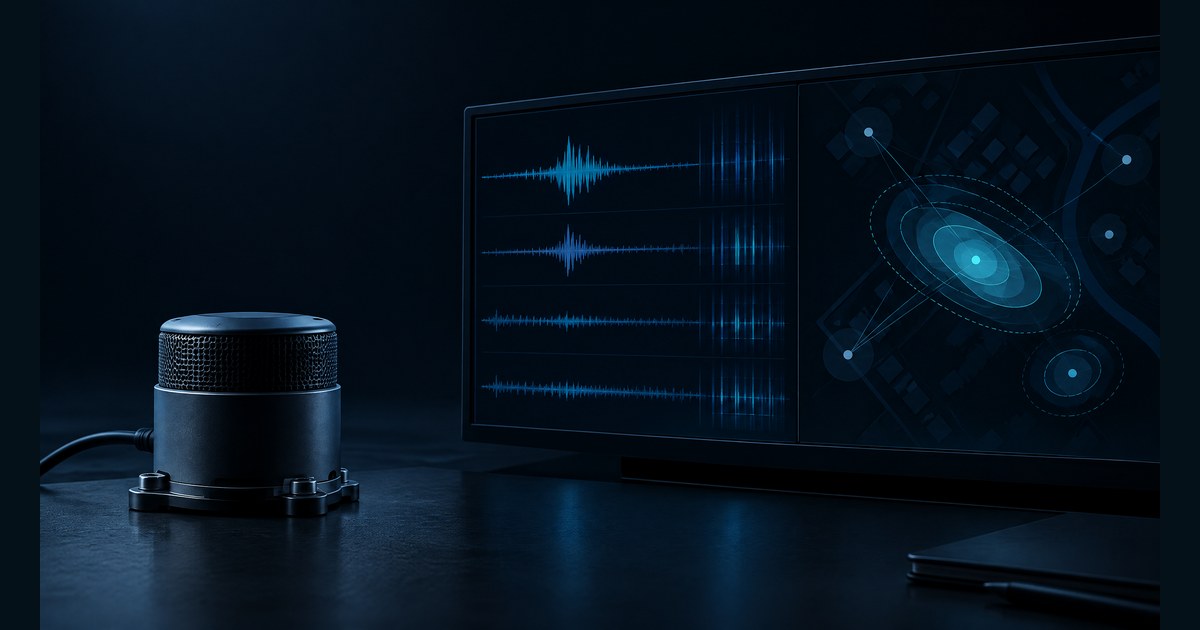
A procurement guide for asking whether a passive acoustic drone surveillance system observes only what a civil security project needs, and whether its processing, storage and disclosure are designed around that limit.
What privacy by design means for passive acoustic sensing
Privacy by design starts before installation. The European Commission describes data protection by design as putting technical and organisational safeguards in place at the earliest stages, while data protection by default means processing only what the stated purpose needs and limiting access. NIST presents its Privacy Framework as a voluntary way to identify and manage privacy risk through enterprise risk management. Together, these ideas give a procurement team a useful test: can the proposed sensing workflow show its privacy choices in architecture, configuration and operating documents?
Passive transmission is not the same as privacy
A passive acoustic layer can contribute environmental sound context without an active RF emission from that sensing layer. That describes the sensing mode, not the legal or social character of the data. A microphone may receive sound from people near a boundary, and an application may store raw audio, derived features, event clips or operator notes. Each stage should be described separately. Buyers should ask what is physically received, what is retained, what is sent to another system and what a person can reasonably infer from the result.
Start with a defined civil purpose
The European Commission and the European Data Protection Board identify purpose limitation, data minimisation, storage limitation, transparency and accountability as core principles. A purpose such as ‘improve low-altitude awareness around a facility’ is a starting point, not a complete design decision. The project should state what decision the acoustic observation supports, which area and time window are relevant, and which uses are outside scope. A broad promise to monitor everything creates a weak basis for deciding what should be collected.
Questions about what the system actually captures
The most important privacy review may happen before software classification is discussed. A buyer should map the acoustic path from microphone to dashboard and identify where unnecessary human speech or unrelated site activity could enter the process. The aim is not to assume that every sound is personal data, but to prevent the design from collecting or exposing more than the civil security purpose requires.
Can the design analyse locally and discard early?
Ask whether the system can derive a detection feature, directional indication or event metadata at the edge and avoid sending continuous raw audio to a central service. If raw audio is required for a documented validation or incident-evidence purpose, ask what starts the capture, what ends it and how unrelated content is excluded. ‘The system can record’ is not a reason to record continuously. The desired answer should be a documented data-flow diagram and a configuration that defaults to the narrower option.
Which outputs are necessary for the decision?
Bearing, position, track, classification and model confidence are different outputs. A project may need a time-stamped candidate event and approximate direction without needing intelligible speech or a persistent audio archive. Ask the supplier to distinguish raw waveform, transformed features, alerts, tracks and operator annotations. This makes it easier to specify a minimum output set and to prevent a dashboard label from being mistaken for a complete identity or an automatic finding of unlawful activity.
Does the site contain spaces with higher privacy expectations?
The ICO warns that surveillance should be necessary and proportionate, and that audio recording is particularly intrusive when it captures conversations. A civil site assessment should therefore identify nearby homes, public walkways, staff rest areas, visitor queues and tenant premises before selecting microphone locations or operating modes. The question is not only whether a sensor can hear an area. It is whether the project can narrow the captured area, use an alternative, or document why a more intrusive mode is necessary.
Privacy-by-default questions for the specification
A privacy requirement is more useful when it can be tested at factory acceptance, commissioning and change review. Instead of asking a vendor to make a general privacy promise, write the intended default state into the requirements and ask for evidence of how an authorised operator changes it.
Is continuous audio off unless justified?
The ICO guidance says organisations should use audio only where there is an evidenced and justified need and should switch audio capabilities off by default. For an acoustic drone project, this does not automatically dictate one universal configuration, because the lawful basis, site context and evidence need vary. It does suggest a concrete procurement question: can the system operate on derived acoustic indicators by default, with any raw-audio function separately controlled, visibly recorded and enabled only for an approved purpose?
Can permissions follow the purpose?
Different users may need different views. A security operator may need a candidate event and direction; an engineering team may need aggregate health information; a narrowly authorised investigator may need a time-bounded evidence export. Ask whether the product can separate these use cases without giving every user access to raw audio or historical event detail. Role-based access and audit records are important governance topics, but the privacy-by-design question comes first: does the data model make unnecessary access difficult by default?
Are changes and exceptions documented?
A system can begin with a privacy-preserving configuration and become more intrusive after a firmware, analytics or integration change. Ask for configuration versioning, change approval, export records and a way to verify that disabled audio features remain disabled. The evidence should show who approved an exception, for what purpose, for how long and what was returned to the default state afterward. These are project controls to specify and test, not claims that any particular product already provides them.
Transparency, impact assessment and supplier evidence
People affected by sensing may not know that acoustic observation is taking place, especially when the equipment is small or the output is presented only as an alert. Privacy-by-design therefore includes communication and accountability, not just signal processing. The European Commission notes that organisations must be able to demonstrate compliance with processing principles, while the ICO recommends assessing impacts on individuals and documenting the lawful basis before deployment.
What should the project explain to affected people?
The project owner should decide how it will explain the purpose, categories of data, responsible organisation, retention approach and contact route in language appropriate to the site. The exact notice depends on local law and context, so a generic sign or copied privacy statement may not be enough. Ask the integrator to identify where notices, public information, staff instructions and contractor procedures belong in the project plan.
What should a privacy impact review test?
A documented impact review should examine necessity, proportionality, alternative methods, affected populations, unintended capture, data flows, retention, disclosure and the consequences of a false or misunderstood alert. It should also address whether an acoustic output could be combined with cameras, access records or other sources to make a person identifiable. The review is not a prediction that the system will violate privacy. It is a way to surface risks while the buyer can still change the architecture.
What evidence should the supplier provide?
Useful evidence includes a data-flow diagram, a description of raw and derived data, default configuration records, interface and export behavior, retention and deletion controls, security assumptions, update procedures and known limitations. Ask the supplier to mark which items are available now, which require integration work and which require written project confirmation. Do not treat a privacy label, a standards reference or a passive-sensing description as proof that a complete civil deployment is compliant.
A practical privacy-by-design review before procurement
The buyer can turn the principles into a short review gate without turning the article into legal advice. The purpose is to make the project’s assumptions visible before a quotation or pilot is treated as approval for wider collection.
Five questions for the project team
First, what specific civil decision does acoustic sensing support? Second, can the same decision be supported with less intrusive data or a shorter retention period? Third, where can raw audio or identifiable content enter the flow? Fourth, which people or organisations can view, export or combine the outputs? Fifth, what test will prove that the approved default and deletion behavior remain in place after integration and updates? Written answers make later acceptance discussions more precise.
Five questions for a supplier or integrator
Ask for the minimum data-flow and interface documentation needed to review the design. Ask which processing occurs at the sensor, gateway, server and operator application. Ask how the system separates event metadata from raw audio. Ask what configuration, audit and export functions are actually included in the proposed scope. Finally, ask which privacy, retention, security and local-law responsibilities remain with the buyer or integrator. These questions protect against buying an undefined ‘privacy-ready’ concept.
Keep the acoustic result in its proper evidentiary role
Acoustic sensing listens for observable sound. It does not detect literally silent targets, establish a unique aircraft identity or grant authority for an automatic response. A candidate acoustic event should be treated as one source of information whose meaning depends on environment, calibration, approved correlation and human review. This boundary is part of privacy design because an overconfident label can cause unnecessary investigation of people, sites or authorised activity.
Request a privacy-by-design evidence pack before a pilot
Before comparing quotations, ask each qualified supplier or integrator for a purpose statement, data-flow diagram, default-mode description, raw-audio and derived-data distinction, retention and deletion approach, access and export assumptions, and a list of items requiring written project confirmation. SonicVast can discuss acoustic sensing, PCBA, SDK and integration options for a defined civil project, but final scope and governance should be confirmed for the actual site and jurisdiction.
Discuss your projectPrivacy, surveillance and data-protection obligations vary by jurisdiction, site role and processing purpose. This article is a procurement and system-design guide, not legal advice. Acoustic observations remain subject to environmental limits and should not be treated as unique identification or automatic authority.