
ACOUSTIC SENSING / ENGINEERING AND PROCUREMENT
Acoustic Drone Surveillance System: Who May See the Data, and What the Record Should Show
An acoustic drone surveillance system may produce more than a notification. Depending on the design, it can create time-stamped detections, directional estimates, audio features, event clips, operator annotations, and links to other approved sensors. The difficult civil-use question is not simply whether a person can open the dashboard. It is who may view each data class, who may change a decision, and whether the system can later show what happened. Role-based access and audit records turn those questions into requirements that a buyer, integrator, and site owner can review together.
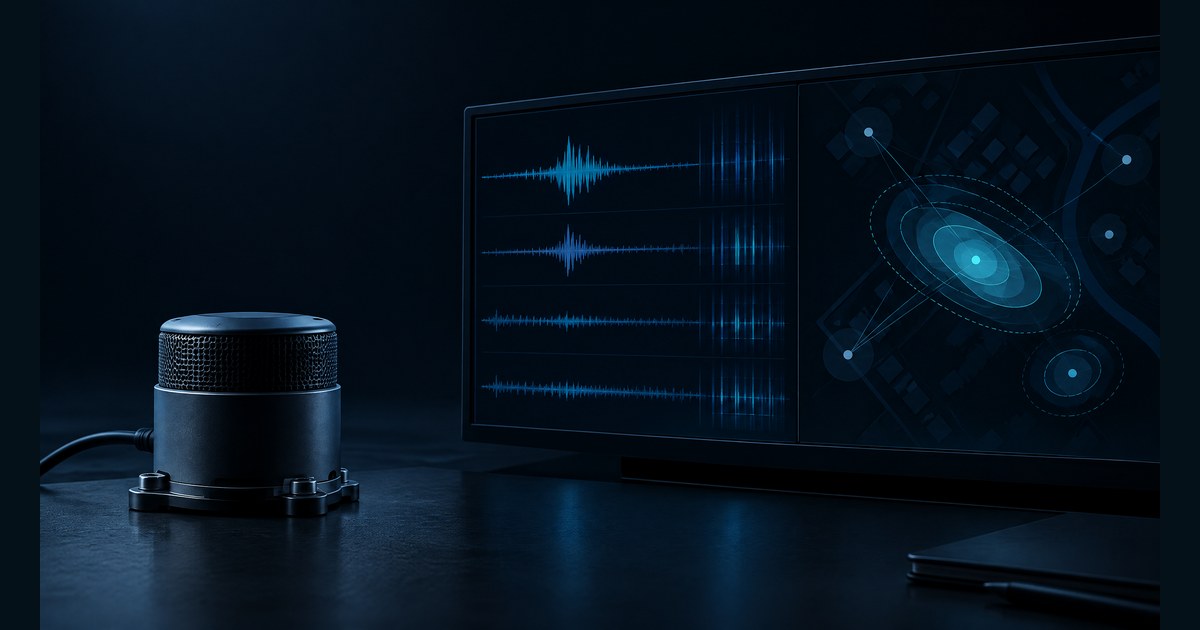
A procurement-focused guide to separating observation, review, administration, and evidence access in a civil acoustic drone surveillance system.
Why access control is part of the sensing specification
Access is often left to the software phase, after microphone locations and network interfaces have already been chosen. That is a mistake for a civil surveillance project. The access model affects which observations are visible, who can export them, who can alter thresholds or labels, and whether an incident review can distinguish an original detection from a later interpretation. NIST treats access control and audit and accountability as separate control families, alongside identification, authentication, authorization, monitoring, and system integrity. That structure is useful as a procurement vocabulary, although it is not a product certification.
Separate data visibility from system authority
A viewer may need to see a current event list without downloading raw audio or changing configuration. An analyst may need access to waveform or feature data for a defined review. A system administrator may manage accounts and retention settings but should not automatically become the person who approves every operational conclusion. A project should describe these permissions separately instead of using one broad administrator role for everyone.
Treat role design as a site decision
The right roles depend on the site, its operating hours, its incident process, and the parties involved. A small facility may combine duties during a pilot, while a port, airport, utility, or public venue may need separate operations, security, IT, compliance, and supplier-support roles. The important requirement is not a universal number of roles. It is a written explanation of why each role can view, export, annotate, configure, or administer a particular function.
A practical role model for civil acoustic surveillance
The following model is a starting point for requirements workshops, not a claim that every deployment must use these exact names. It helps the buyer ask whether the proposed software can enforce least-necessary access without blocking legitimate review.
Operations viewer and event reviewer
An operations viewer can see current health and event status needed for routine work. An event reviewer can open the supporting evidence approved for that role, add a structured assessment, and link the event to an authorized case or work order. Neither role should silently rewrite the original sensor record. If a reviewer changes a classification or closes an event, the system should preserve the earlier state and record the reason, time, and account used.
Evidence custodian and governance reviewer
An evidence custodian manages controlled export, sharing, retention holds, and release records when an event needs formal preservation. A governance reviewer examines access history, exceptions, and configuration changes. These duties can be assigned to different people or teams. Separating them from routine viewing makes it easier to investigate whether an export was necessary and authorized rather than treating every dashboard user as an evidence handler.
System administrator and supplier support
The system administrator handles identity, permissions, integration settings, and service health. Supplier support should be time-limited and approved for a stated purpose, with an identifiable account rather than shared credentials. Ask whether support access can be enabled for a defined window, restricted to selected functions, and reviewed afterward. A supplier's ability to support an integration should not be assumed to mean unrestricted access to stored acoustic material.
What an audit record should make reconstructable
An audit record is useful when it allows an authorized reviewer to reconstruct a material action without relying on memory or an informal message thread. The record does not need to expose every internal implementation detail in the operator interface, but the project should define the fields needed for review and export.
Record the actor, action, object, and time
At minimum, ask the supplier to identify the account or service identity, the action taken, the affected event or data object, and a reliable time reference. Useful actions include viewing restricted evidence, exporting a file, changing a label, modifying a threshold, changing retention or sharing settings, granting access, and using a privileged support function. Device or session context may also matter when an investigation must distinguish a normal workstation from a remote service path.
Preserve before-and-after context for changes
A log that says only ‘configuration changed’ has limited value. For material changes, require a change identifier, the previous and new setting where appropriate, the approving account, the reason, and the effective time. For an event review, preserve the original detection state separately from later annotations. This distinction matters because acoustic sensing can produce an observation or classification aid; it does not by itself establish unique aircraft identity, flight permission, or authority to act.
Make export and sharing visible
Export creates a new governance boundary. The audit trail should show what was exported, by whom, when, for what stated case or purpose, and to which approved destination or recipient category. If a downstream case system receives a copy, the handoff should have an identifier that can be reconciled with the source event. This makes it possible to ask whether the copy was necessary, whether it was altered, and when its retention clock began.
Protect the audit trail from becoming another blind spot
Logs can fail as evidence if the people whose actions they record can edit or delete them. The Information Commissioner's Office states that auditable user-behaviour logs support accountability, recommends periodic review for unauthorized actions and patterns, and advises that users should not be able to alter logging information themselves. It also describes limiting detailed log access to selected personnel. These are strong questions for a civil buyer, while the applicable legal duties still depend on the project's jurisdiction and purpose.
Use controlled write paths and protected copies
Ask how the platform prevents ordinary users from changing audit entries, how administrator actions are themselves recorded, and whether logs can be forwarded to a protected system with restricted write access. Clarify how time is synchronized, how failed log delivery is reported, and whether records can be exported in a form that preserves sequence and integrity. A vendor's use of the word ‘tamper-proof’ is not enough; request a description of the control and an acceptance test.
Review logs as an operating process
A log that nobody reviews is mainly a storage feature. Define who reviews privileged access, unusual exports, repeated failed logins, account changes, and support sessions. Set a review cadence appropriate to the project risk, document exceptions, and identify the route for escalation. The review should be proportionate and accountable rather than an invitation for every operator to inspect every colleague's activity.
Plan retention and legal hold separately
Operational logs, raw acoustic material, derived features, incident notes, and exported evidence may not need identical retention periods. Ask the project owner and legal advisers to define the governing requirements. The system should support a documented hold or preservation process when an event is under review, without turning an indefinite archive into the default. Retention is a governance decision, not a substitute for access control.
Procurement questions before accepting a pilot
A demonstration can show that a dashboard works while leaving access and accountability untested. Include governance cases in the pilot acceptance plan so the buyer evaluates the complete review path rather than only detection display.
Test a normal event and a corrected interpretation
Create a documented test event, let an authorized reviewer add an assessment, then correct that assessment. Confirm that the original observation remains available, the correction is attributed to a named account, and the sequence is understandable to an independent reviewer. The test should not be presented as proof of acoustic accuracy; it tests recordkeeping and workflow behaviour.
Test access changes and supplier support
Add a temporary user, grant a narrowly defined permission, expire it, and confirm that access is removed. Review the record for the approver and effective times. Then run a time-limited supplier-support session and verify that the session, actions, and closure are visible. Ask what happens if the identity service, audit collector, or network link is unavailable.
Test export reconciliation
Export an approved evidence package and compare it with the source event. Confirm that the package has a stable identifier, that the export action is logged, and that a recipient can tell which parts are original observations and which are later notes. If the system cannot provide the required record, treat that as an integration gap to resolve in writing rather than an assumption for production.
Make access and auditability acceptance criteria
Before selecting an acoustic drone surveillance system, provide the supplier and integrator with a role matrix, a list of auditable actions, an export and retention scenario, and a support-access procedure. Request a written mapping from each requirement to the proposed interface, identity method, log behaviour, and pilot test. SonicVast project discussions can then focus on the sensing and integration choices that fit the site's approved governance model.
Discuss your projectRole names, retention periods, privacy duties, evidence rules, and review intervals must be confirmed for the jurisdiction, organization, and intended civil use. Acoustic observations and classifications are not by themselves proof of unique aircraft identity, operator identity, flight authorization, or authority to respond.