
ACOUSTIC SENSING / ENGINEERING AND PROCUREMENT
Acoustic Drone Tracking System: How to Evaluate Multi-Target Tracking Without Assuming Capacity Guarantees
An acoustic drone tracking system should not be judged by a headline such as “supports multiple targets.” A detection is an observation at a time; a track is a maintained estimate that links observations over time. When several aircraft share a sound environment, the useful question is not how many icons appear on a screen. It is whether the system can preserve identity continuity, disclose uncertainty, and show what happened when observations were missed or confused.
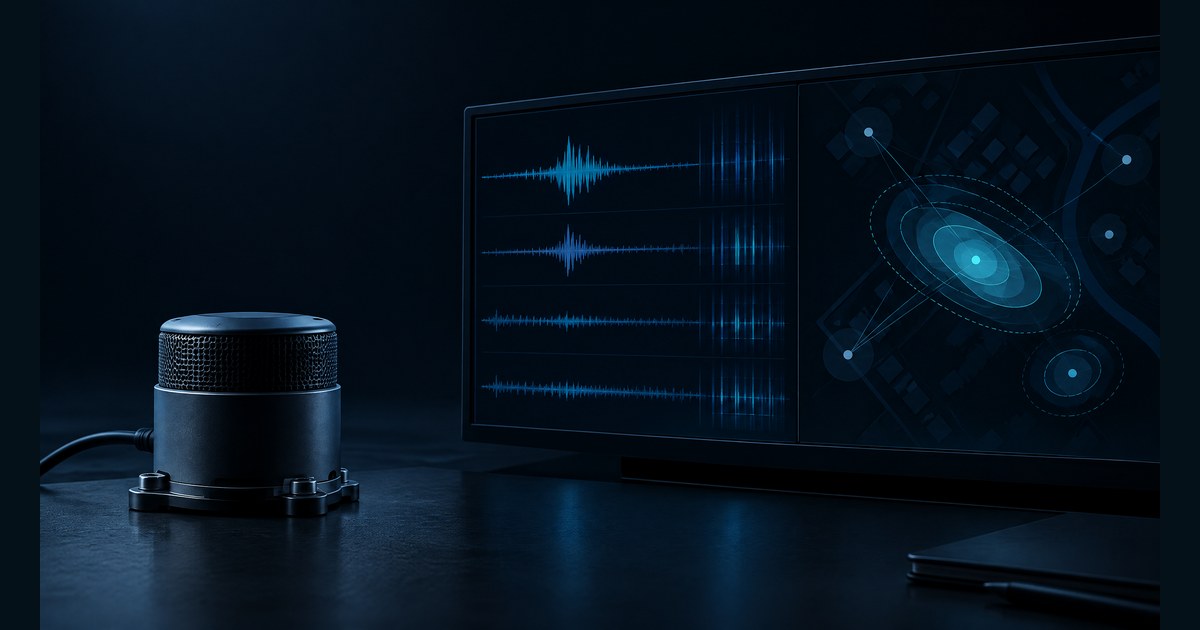
A procurement-oriented guide to testing whether an acoustic system maintains distinct, auditable tracks when several aircraft, false alarms, gaps, or merged observations occur.
Start by defining what counts as a track
Before comparing systems, write an operational definition that can be tested. The definition should separate a fresh acoustic event from a confirmed track and should state which evidence must persist for the track to remain active.
A detection is not a maintained trajectory
A detector may report a bearing, location estimate, or classified sound at one time. A tracker then predicts where an object may be and associates later measurements with that estimate. Stone Soup's multi-target tutorial describes association as the difficult step when there are multiple targets, clutter, false alarms, missed observations, or targets that appear and disappear. For procurement, require the data model to label detections, tentative tracks, confirmed tracks, coasted predictions, and terminated tracks separately.
Set lifecycle rules before counting targets
Ask how many supporting observations are needed to initiate a track, what happens after one missed update, how long a track may remain in prediction-only mode, and what evidence causes termination. These are track-management choices, not proof that the acoustic front end can observe a fixed number of aircraft. A system that keeps a predicted position during a short gap may be useful, but the record should show that the position was predicted rather than freshly measured.
Test association when targets are close or cross
Multi-target tracking becomes informative under ambiguity. A controlled evaluation should create cases in which two candidate tracks have similar bearings or sound signatures, then inspect whether the association decision is explainable and reversible in the record.
Look for globally consistent assignment
A local nearest match can look reasonable for one target while producing a poorer overall assignment for the group. Stone Soup illustrates why global nearest-neighbour methods evaluate a set of valid hypotheses rather than choosing each pairing in isolation. The buyer does not need to prescribe one algorithm, but should ask for an association audit: candidate measurements, rejected alternatives, time stamp, gating rule or score, and the resulting track update.
Treat track swaps as a measurable failure mode
When two aircraft pass near one another acoustically, a track can jump from one source to the other without an obvious break in the display. Testers should compare the system record with independently labelled test events and mark identity swaps, unexplained heading changes, and implausible position jumps. A single aggregate accuracy number can hide these errors, so report them as event-level outcomes.
Document gaps, merges, and confidence changes
A credible multi-target result is a timeline, not a screenshot. Each interval should show what the system received, what it inferred, and how certain that inference was.
Make every gap visible
Record the last directly supported measurement, the duration of the gap, the prediction method used during the gap, and the condition for reacquisition. Do not describe a continuous line as continuous sensing if part of it is model-based prediction. Stone Soup's example explicitly retains a prediction when no detection is good enough, which is a useful conceptual distinction for acceptance records.
Separate merged evidence from two confirmed tracks
Acoustic observations can become ambiguous when sources overlap or when the environment produces clutter. The University of Liverpool's research on distributed acoustic sensing describes the need to handle noisy measurements, missed detections, and merged measurements caused by occlusion. Ask whether the output can show a merged or unresolved state instead of silently presenting one confident track or duplicating one observation into several tracks.
Plot confidence as a time series
Confidence should be tied to an event and a definition. Request the confidence value or band at initiation, during stable updates, after a gap, after a merge, and at termination, together with the factors that changed it. Confidence in an acoustic class is not the same as confidence in bearing, position, track identity, or aircraft model. Keep those outputs separate.
Evaluate capacity as a tested operating envelope
Avoid turning a demonstration count into a universal capacity guarantee. The meaningful result is a documented operating envelope tied to the site, acoustic scene, update rate, network path, and evaluation criteria.
Vary the conditions that affect association
A test matrix can vary the number of simultaneous sources, relative bearings, source separation, movement patterns, background noise, intermittent audibility, and the amount of clutter. Include cases with one source, several well-separated sources, crossing paths, a new source entering, and a source leaving. The goal is not to create a marketing maximum. It is to find where continuity, separation, or confidence begins to degrade.
Report outcomes beyond target count
For each scenario, report confirmed-track count, track fragmentation, identity swaps, false tracks, missed initiations, gap duration, merge duration, reacquisition time, and confidence changes. Also state whether the count refers to simultaneous confirmed tracks, candidate tracks, detections per update, or a software display limit. These are different quantities and should never be collapsed into one capacity figure.
Turn the evaluation into procurement evidence
A buyer can ask for a repeatable evidence package without prescribing the supplier's internal implementation. The package should make later review possible by people who were not present at the demonstration.
Request replayable event records
Ask for synchronized time stamps, sensor configuration, raw or suitably retained measurement references, track state, confidence fields, association decisions, and system alerts. NOAA's passive-acoustic documentation distinguishes long-term recorded data from near-real-time data and notes that technology choice depends on the research goal and operating context. That same discipline applies here: define what is retained, what is transmitted immediately, and what can be replayed after an event.
Write acceptance criteria around behaviour
Acceptance language can require that the system identify gaps, expose tentative status, preserve an audit trail for merges and swaps, and distinguish direct measurements from predictions. It can also require a site-specific test plan and a written explanation of excluded conditions. These requirements evaluate observable behaviour without claiming a universal number of simultaneous targets.
Ask integration questions before deployment
Confirm how track identifiers are exchanged with approved dashboards or other sensors, whether time synchronization is required, which fields are available through the interface, and how software revisions affect the record. Multi-sensor fusion may produce more consistent tracks than one sensor alone, but the NATO AGARD overview emphasizes that integration, correlation, initiation, and track management are distinct technical tasks. Confirm each interface and responsibility in writing.
Specify the evidence package before the live test
For an actual project, ask the supplier to agree on scenario definitions, track-state terminology, event logs, gap and merge reporting, confidence fields, replay access, and pass/fail rules before testing. Treat simultaneous-track capacity as a result to be measured under those conditions, not an assumption embedded in the purchase request.
Discuss your projectAcoustic sensing observes sound that is present at the sensor and does not detect literally silent targets. Track continuity, classification, bearing, position, and model confidence are different outputs. Site noise, propagation, geometry, processing configuration, and approved test conditions can materially affect results. Any SonicVast integration, interface, service term, or performance scope requires written project confirmation.