
ACOUSTIC SENSING / ENGINEERING AND PROCUREMENT
Acoustic Drone Tracking System: What Makes a Track More Than Repeated Detections?
When a microphone array reports sound several times, the result is not automatically one aircraft moving through the site. An acoustic drone tracking system must decide whether observations belong to the same source, a different source, or background sound. For a civil buyer, the important question is not how many alert messages appeared. It is whether the system can show how a track was initiated, updated, interrupted, re-associated and eventually closed.
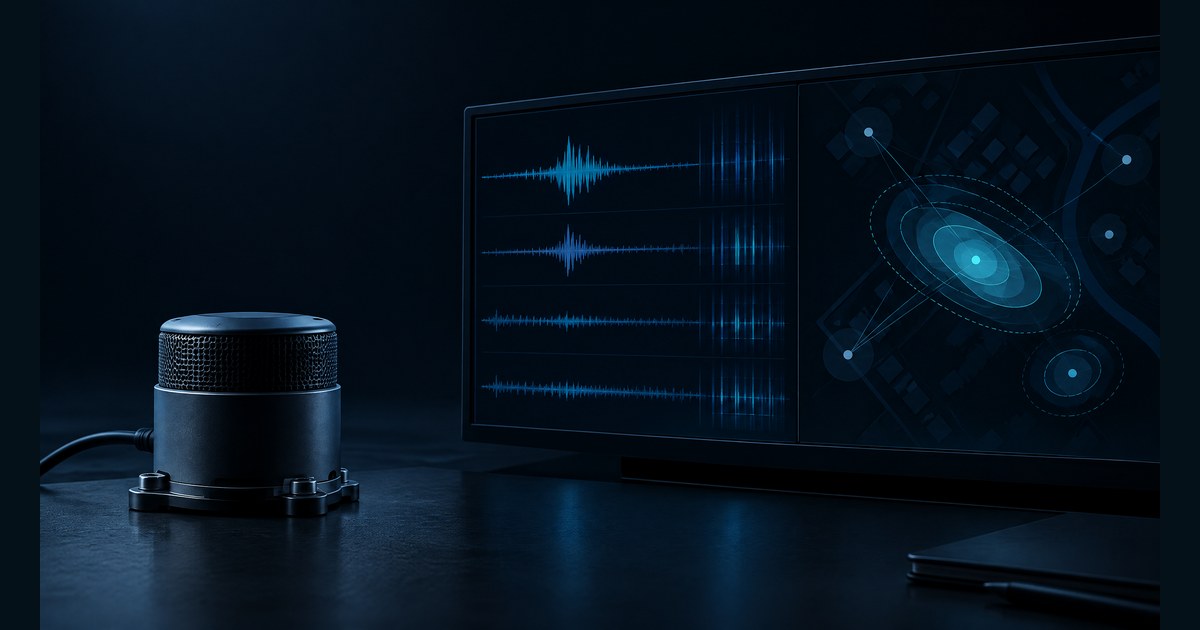
A practical guide to separating repeated acoustic alerts from a defensible time-linked track, with questions for evaluation, integration and acceptance records.
A detection is an observation; a track is a maintained hypothesis
A detection is a time-stamped measurement or report from a sensor. In an acoustic context, it may include a bearing estimate, signal features, quality indicators and a time window. A track adds continuity: the system associates observations over time and maintains an estimate of the source state. MathWorks describes the same distinction in multi-target tracking documentation, where detections are assigned to tracks and track maintenance includes initiation, confirmation and deletion.
Repeated alerts do not prove one moving source
Five alerts can represent five observations of one source, five unrelated sound events, one source plus clutter, or several sources that a low-resolution observation cannot separate. The software needs an association rule based on compatible time, bearing or position, motion assumptions and measurement quality. Without that rule, a dashboard may display repeated detections while leaving the identity of the underlying source unresolved.
A track can remain tentative before it is confirmed
A responsible tracker commonly creates a tentative track when an observation is not assigned to an existing track. It then waits for more evidence before presenting the track as confirmed. This is not a universal formula: confirmation may use a history rule, a score or another project-defined method. The key procurement point is to ask which state is shown to the operator and what evidence moves a candidate from tentative to confirmed.
The four lifecycle events buyers should be able to inspect
A track record becomes meaningful when its lifecycle is visible. The implementation may differ between vendors, but a buyer should be able to identify four events: initiation, update, gap handling and termination. These events make it possible to tell a continuous estimate from a series of loosely related alerts.
Initiation and confirmation
Initiation records the first observation that created a candidate. Confirmation records the rule or evidence threshold that made the candidate operationally usable. Ask for the minimum fields needed to reconstruct both events: time, sensor or node, measured bearing or location, quality indicators, association decision and current status. A confirmed label should not be treated as aircraft identity, authorization status or model identification.
Prediction through a missed update
A source can be temporarily obscured by noise, geometry, interference or an unfavorable acoustic condition. Trackers may coast by predicting a state without a new correction. MathWorks describes this as a track being coasted when no detection is assigned, followed by deletion after the configured miss logic is exceeded. In a buyer review, a gap should be explicit: show the last measured update, the predicted interval, the uncertainty or quality change, and the time at which the track was removed or reacquired.
Termination and reacquisition
A track ending is not the same as the sound source stopping, and a later alert is not automatically a continuation. The system may delete a track after too many misses, or start a new tentative track when a later observation falls outside the association gate. If reacquisition is supported, the rules should be documented. Otherwise, operators may read two track IDs as two sources or read a new source as the continuation of an old one.
What a credible acoustic track should show
Acoustic tracking is built on measurements that can change with ambient sound and source geometry. The U.S. Army Research Laboratory report on a small tetrahedral microphone array describes beamforming for detection and direction-of-arrival estimation, followed by adaptive filtering for angle tracking. It also documents degraded angle tracking when another aircraft sound interfered. That is a useful reminder: a track should expose its evidence and uncertainty rather than hide changing conditions behind a stable icon.
Association evidence, not only a track ID
A track ID is an identifier, not proof of continuity. Request the observations assigned to the track, their timestamps, bearing or position estimates, sensor origin, signal-quality measures and any rejected candidate observations. A map line without this lineage cannot reveal whether the system followed one source, jumped between sources or simply connected alerts after a long interval.
Confidence should be time-varying and defined
Confidence can refer to different things: confidence that an observation is real, confidence in association, confidence in location, or confidence in classification. These should not be collapsed into one unexplained percentage. If the system publishes a score, request its meaning, update behavior, thresholds and treatment of missed detections. MathWorks documents history-based and score-based track logic, showing why a confidence or score can rise with supporting updates and fall after misses.
Bearing, position and classification remain separate outputs
A bearing estimate says where a sound appears to arrive from. Position normally requires additional geometry, such as multiple observation points or other approved sources. Classification concerns what the signal resembles. A track can have a plausible direction while its position or aircraft class remains uncertain. Procurement documents should name each output separately and avoid treating a continuous acoustic track as a unique aircraft identity.
How to document gaps, merges and confidence changes
Track continuity is best evaluated from an event history, not from a screenshot. The record should preserve enough context for an independent reviewer to understand what the system believed at each update and why that belief changed. This is particularly important when several sound sources overlap or when nodes report observations at different times.
Gap records should preserve the uncertainty
For every meaningful gap, record the last accepted observation, the first missing update, the tracker state during the gap, the predicted state if one was produced, and the event that ended the gap. Do not silently draw a solid path across an interval in which no acoustic observation was accepted. A dotted or otherwise qualified interval can communicate that the system predicted continuity rather than measured it.
Merge and split decisions need lineage
When two candidate tracks are merged, the record should identify the source track IDs, the trigger for the merge and the resulting track ID. When one track is split into two, record the observations that caused the split and whether the earlier history is shared or retained separately. These events matter because a merge can conceal two nearby sources, while a split can make one source look like multiple objects in an incident review.
Confidence changes should have a reason code
A confidence change is more useful when tied to an event such as a weak signal, a new node contribution, an association conflict, a missed update or a classification change. The exact labels are project-specific. The general requirement is traceability: an operator and later reviewer should be able to distinguish new evidence from a display refresh or an undocumented algorithmic state change.
A procurement test that does not confuse tracks with capacity
A vendor demonstration can show several alert streams without proving that the system maintains the same number of independent, correctly associated tracks under realistic conditions. Track count, detection count and source count are different quantities. A fair evaluation should define the test scenario, ground truth or reference evidence, environmental conditions, accepted gaps, track swaps, false tracks and the records delivered after the test.
Ask for a track-state acceptance record
Request a time-ordered export containing track IDs, status transitions, assigned observations, unassigned observations, gap intervals, confidence or quality fields, merge and split events, and deletion or reacquisition outcomes. Also ask which values are measured, inferred or configured. This evidence is more informative than a claim that the system can track multiple targets, because it lets the project team inspect continuity and ambiguity.
Test association in the site’s actual sound scene
Use representative background sound and approved, documented flight activity. Include cases where a sound becomes weak, where two sources are close in bearing, and where an unrelated moving sound enters the scene. The objective is not to seek a universal accuracy number. It is to observe how the tracker declares uncertainty, protects track identity and records a loss or switch.
Keep the acceptance question narrow
A useful acceptance question is: did the system create and maintain a traceable track under the agreed conditions, with documented behavior when observations were missing or ambiguous? That question is narrower and more defensible than asking whether every alert represented a drone, whether every track was continuously measured, or whether a stated track count guarantees performance at another site.
Specify the lifecycle before asking for tracking performance
In a project specification, define the required track states, association fields, gap behavior, merge and split records, confidence semantics, retention period and acceptance scenario. Then ask SonicVast or another integrator to confirm which outputs and interfaces are available for the proposed configuration in writing. Acoustic observation can support a civil review workflow, but it does not by itself establish a unique aircraft identity, flight permission or automatic response authority.
Discuss your projectTrack initiation, confirmation, coasting, deletion, merging and confidence thresholds depend on the implemented tracker and project configuration. Acoustic performance also depends on the site soundscape, geometry, weather, source behavior and other conditions. No example in this article is a SonicVast performance guarantee or a universal capacity claim.