
ACOUSTIC SENSING / ENGINEERING AND PROCUREMENT
Acoustic Perimeter Detection System: Build the Review Record, Not Just the Alert
An acoustic perimeter detection system is useful only when its observations can enter a repeatable civil review process. The practical question is not whether a site can display an alert. It is whether the operator can explain which controlled perimeter was being watched, what the system actually observed, how the indication was verified, and whether the relevant sensor and site conditions were serviceable at that time. This article focuses on that evidence chain rather than promising blanket coverage or automatic identification.
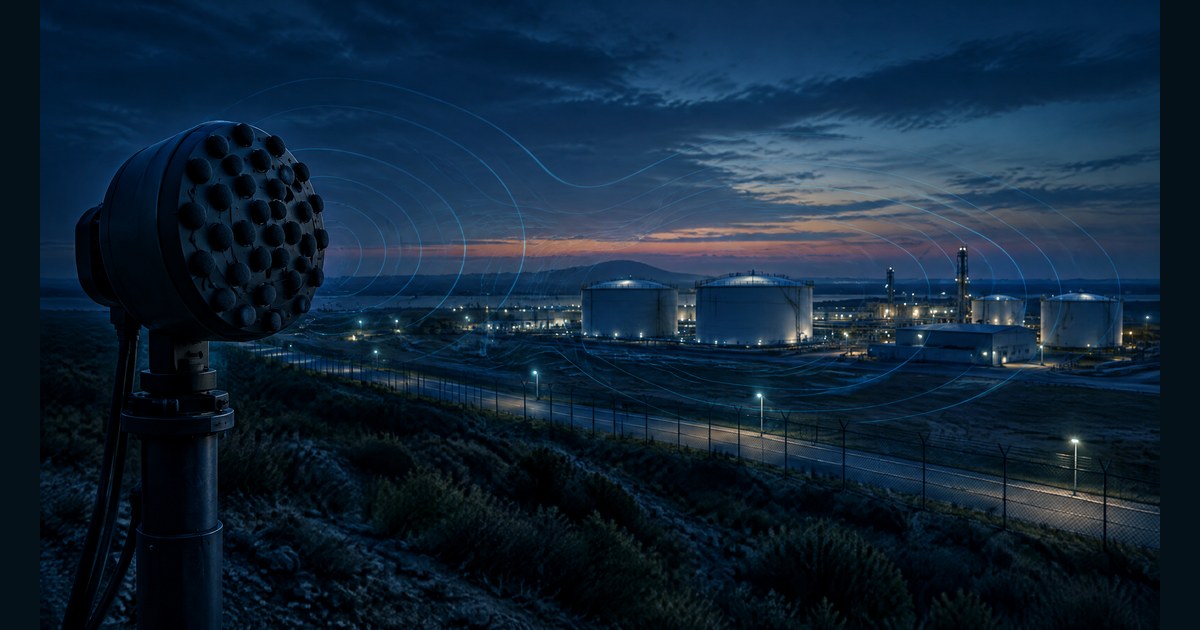
A civil perimeter programme becomes more defensible when every acoustic indication can be placed in a defined zone, reviewed against authorised activity and environmental context, and linked to maintenance evidence.
Start with a defined civil perimeter question
Before procurement, describe the area and decision that the sensing layer is expected to support. NPSA guidance for data halls treats the limit of the area under an organisation's control as its perimeter and describes it as the first line at which an intruder could be detected. That principle is transferable as a planning discipline, not as a universal acoustic specification: the owner must define the boundary, the monitored zones, the responsible reviewer and the escalation path.
Name the zones and the evidence owner
A civil site may have a public-facing boundary, a controlled vehicle entrance, a service corridor, a roof or yard, and an inner asset boundary. Give each zone an identifier that appears on the site plan, sensor register and event record. Assign an owner for first review and a separate contact for facilities or maintenance questions. This prevents a vague perimeter alert from becoming an unowned notification. It also makes later comparisons possible when fencing, plant, access rules or nearby construction changes.
Define the observation without overclaiming
Write the requirement in observable terms: for example, a candidate airborne acoustic event in a named zone during a stated operating period. Do not turn that requirement into a promise that every aircraft will be heard, that a sound alone proves a unique model or operator, or that a sensor output grants authority to intervene. Bearing, location estimate, classification support and identification are different outputs and should be specified separately if they are needed.
Use a review workflow that separates indication from finding
A useful perimeter record has more than a timestamp and an alarm label. It should preserve the sequence from observation to disposition. NPSA describes CCTV as a means to verify and further investigate a perimeter intrusion alarm, which illustrates the civil principle that one detection layer can prompt a controlled review rather than serve as the complete conclusion. The same approach can be used with acoustic observations and other approved site evidence.
Record the first indication
Capture the event identifier, zone, time basis, sensor or node identity, alert type, system health state and relevant configuration version. If the platform provides an audio feature, direction estimate or confidence field, preserve it as an observation with its units and meaning documented. Do not silently convert a model score into a confirmed aircraft identity.
Check authorised activity and independent context
The reviewer should check the site's authorised-flight register, planned maintenance, vehicle movements, work permits and known environmental events. Where policy allows, compare the indication with camera, radar, radio or access-control evidence. The result can be confirmed, unconfirmed, explained by a known source, or escalated for a second review. A quiet RF observation does not prove that an aircraft is absent, and an acoustic indication does not by itself establish permission, identity or intent.
Close the event with a reasoned disposition
The record should state who reviewed the event, what evidence was considered, what action was taken within the site's approved procedures, and whether follow-up maintenance was opened. Preserve the original indication even when it is later explained. This creates a learning record for threshold review, nuisance-source analysis and future acceptance testing without presenting every alert as a security incident.
Make maintenance evidence part of the detection record
Maintenance is not a separate back-office activity when sensor health affects the meaning of an event. CISA describes creation and maintenance of security documentation as supporting continuously monitored systems and security-control assessment. For a civil acoustic programme, the same evidence-led habit means linking equipment condition, work performed and post-maintenance verification to the event history.
Maintain an asset and configuration register
For each node or processing component, record the asset identifier, physical zone, firmware or software version, interface dependencies, power and communications state, installation date, approved configuration and last service date. Track moves, replacements, disabled periods and configuration changes. A node that has been relocated near a new fan, road or construction area should not retain an unquestioned assumption that its previous acoustic baseline still applies.
Define service evidence that can be checked
A service entry should identify the symptom or scheduled reason, technician or service organisation, date and time, affected asset, inspection or test performed, parts or settings changed, and the result. If a microphone, enclosure, connector, network path or time source was touched, say so. Attach before-and-after health readings or test observations where the system supports them, and record any open limitation rather than marking the asset fully healthy by habit.
Verify after work and preserve downtime context
After maintenance, confirm that the node reports correctly, timestamps align, expected data reaches the review platform and the approved test stimulus or controlled check produces the documented response. Record the start and end of any degraded or offline period. Planned work should be visible to reviewers so an apparent gap in perimeter evidence is not misread as a quiet site. NPSA also advises organisations to understand whether fault and maintenance records are kept by a facility provider; that is a useful question when infrastructure is shared.
Treat the acoustic environment as a changing maintenance input
An acoustic baseline is not a permanent certificate for a site. UK environment agencies' noise and vibration guidance emphasises that background levels vary by time and location, that operating loads and propagation conditions affect measurements, and that uncertainty should be identified and minimised. Those statements concern environmental noise assessment rather than drone detection performance, but they support a directly relevant civil control: document the conditions under which a perimeter sensing workflow was reviewed and re-check it after material site changes.
Log recurring and temporary sound sources
Record sources that can alter the review context, such as ventilation, pumps, generators, loading activity, road works, construction, weather exposure and seasonal wildlife. The point is not to declare these sources as universal false alarms. It is to let a reviewer distinguish a stable local condition from a new or unusual acoustic event and to decide whether a threshold, placement or review rule needs controlled reassessment.
Trigger reassessment after physical change
Define a change trigger for fence work, landscaping, new plant, building extensions, road layout changes, sensor relocation, software updates and nearby construction. Reassessment may include a new background survey, a controlled test, comparison with another approved layer or a short observation period. The acceptance of the change should be recorded with the affected zones and any residual limitation.
Keep airborne acoustic sensing distinct from fence sensing
An airborne acoustic observation listens to sound propagating through the environment. Fence vibration sensing measures a different physical phenomenon in a boundary structure. A procurement document should state which question each layer answers. A fibre link used to carry data or radio-control information is not evidence that the system measures vibration in the fence, and neither layer should inherit the other's maintenance assumptions.
Turn the evidence chain into procurement questions
A civil buyer can test the maturity of an acoustic perimeter proposal without demanding unsupported performance promises. Ask how the supplier defines an event, what health states are exposed, what is retained in the audit record, and how the project will handle environmental change. Written answers should distinguish standard product behaviour from project configuration and from items requiring site validation.
Questions for the sensing and software scope
Ask: Which event fields are available through the user interface or API? Can the system show node health and communication loss separately from an acoustic indication? Are timestamps synchronised, and how are configuration revisions recorded? What data can be exported for an incident or maintenance review? Which outputs are detection, direction, track or classification support rather than identity?
Questions for acceptance and routine review
Ask for a proposed site acceptance method that names zones, test conditions, expected records and pass or follow-up criteria. Ask how authorised activity is represented, how unexplained events are escalated, and how operators are trained to avoid treating a single acoustic cue as a final finding. Request a maintenance schedule and sample service record, but require the final interval and tasks to be confirmed for the actual hardware, enclosure, climate and operating environment.
Questions for lifecycle and change control
Ask who owns the asset register, who approves configuration changes, how replacement nodes inherit or reset settings, and how a degraded zone is shown to reviewers. Confirm the support boundary for firmware, software, interfaces, spare parts and documentation in writing. Compatibility with an existing platform, SDK or API should be treated as a project confirmation item unless the relevant interface has been verified.
Request a perimeter evidence pack before comparing vendors
Ask each shortlisted supplier to map the proposed acoustic layer to a zone plan, event-review workflow, asset register, maintenance record and change-control process. Then identify which statements require a site survey or written project confirmation. This keeps the procurement discussion focused on usable civil evidence rather than an unqualified range or accuracy claim.
Discuss your projectAcoustic observations are affected by site conditions and do not guarantee detection, identification or continuous coverage. This article is a civil procurement and review framework, not a substitute for a site survey, local regulation, safety assessment or written supplier acceptance plan.