
ACOUSTIC SENSING / ENGINEERING AND PROCUREMENT
Acoustic Perimeter Detection System: Define the Sensing Question Before You Define Coverage
An acoustic perimeter detection system should begin with a sensing question, not a promise that one technology will cover every edge of a property. A civil site may want to know whether an airborne sound source is observable near an operational boundary, whether someone is attempting to breach a fence, or whether an alarm can be verified and logged. Those are related security questions, but they are not the same output. Defining the question first prevents a microphone array from being treated as a fence sensor or a perimeter alarm from being presented as blanket airborne coverage.
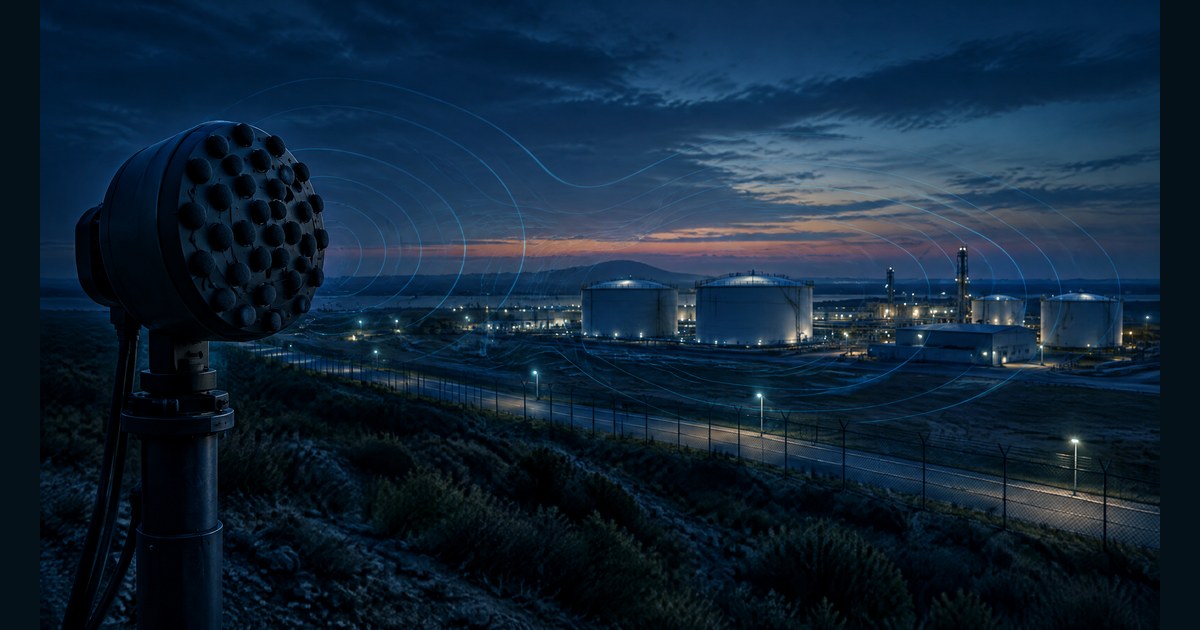
A practical civil-procurement guide to separating airborne acoustic observation from fence intrusion sensing, writing a site-specific perimeter question, and requesting evidence that can be maintained.
What does “perimeter” mean in the requirement?
In procurement language, perimeter can describe a legal property line, a physical fence, a sterile zone, a monitored approach, or an operational boundary around an asset. Each boundary changes what must be observed and what evidence counts. NPSA describes perimeter intruder detection systems as systems for detecting intruders attempting illegal entry onto or into a site, usually at a fence or other barrier. That is different from a wide-area observation question about activity in the air around the site. [1]
Name the event before naming the sensor
Write the event in plain language: an attempted fence breach, movement in a protected approach, an airborne acoustic observation, or an alarm that needs human verification. Then define the desired output. It may be an event timestamp, a sector or bearing, a confidence score, a camera cue, or a record for later review. Detection, localization, classification and authorization are separate outputs. A sound observation cannot by itself establish who operates an aircraft, whether its flight is permitted, or what response is lawful.
Separate physical, acoustic and operational boundaries
A fence line is a physical object with posts, mesh, gates, vegetation and adjacent public activity. An airborne acoustic observation is affected by wind, machinery, traffic, reflections and the position of the sound source. An operational boundary may also include a runway protection area, a process zone or a restricted work area that does not align with the fence. A useful requirement states which boundary is being discussed instead of using “perimeter coverage” as a single undifferentiated promise.
Fence vibration sensing is not airborne acoustic observation
A barrier-mounted perimeter intrusion detection system is coupled to the barrier. NPSA describes microphonic cable systems as piezoelectric cable attached to a fence fabric to detect vibrations caused by an intruder breaching it; geophones and point sensors can also be attached to the fence structure. A published NPSA catalogue example uses a linear sensor cable along a particular fence line and an analyser. These are fence-condition and intrusion-sensing arrangements, not microphones listening for an aircraft in the air. [1] [2]
Why the distinction changes the acceptance test
For fence sensing, the test should represent the host barrier, its mounting, gates, corners, supports and normal sources of vibration. For airborne acoustic sensing, the test should represent the local soundscape and the intended observation area. A successful fence-vibration test does not prove that airborne sound is observable. Conversely, an acoustic indication near a boundary does not prove that a fence has been touched or breached. The two systems may contribute to one review workflow, but their test objects are different.
Avoid the false equivalence of a sensor at the edge
Putting a microphone beside a fence does not turn it into a fence intrusion sensor. Mounting a vibration cable on a fence does not make it an airborne acoustic array. Ask suppliers to identify the measured physical phenomenon, the installation interface, the alarm unit, and the evidence produced at each stage. This simple vocabulary check often exposes an over-broad coverage statement before it enters a tender or design review.
Build a site-specific perimeter sensing question
NPSA guidance on protective-security requirements recommends considering the intended use, threat, vulnerability, consequence, environment, interoperability, false alarms and operating needs. CISA likewise says a security plan for each substation should be tailored to its unique operating environment and discourages a boilerplate assessment. The procurement lesson is direct: define the local question and operating consequence before comparing sensor counts or advertised range. [3] [4]
Describe the soundscape and the boundary conditions
Record fixed and changing sound sources such as fans, transformers, compressors, roads, rail, construction, birds and nearby public activity. Note reflective walls, open ground, trees, slopes and structures that may affect propagation. The record need not predict performance in advance. Its purpose is to give bidders a common site context and make later validation reproducible.
Define what operators must be able to review
A civil team may need a timestamped indication, approximate direction, a mapped sensor location, an audio feature record, a camera handoff, or a case file that can be audited. DSIAC describes acoustic systems as receiving sensor identity, coordinates and timestamps and processing sound to estimate a candidate location, while also identifying background-noise differentiation as a central challenge. Treat those as evidence fields to confirm in the proposed workflow, not as an automatic identification or authorization decision. [5]
Replace blanket coverage language with bounded evidence
“Covers the entire perimeter” is incomplete unless the perimeter, conditions, output and test method are defined. A stronger requirement states the boundary segments under review, the observation conditions, the alarm or event definition, the expected record, and the conditions that invalidate or qualify the result. This makes a proposal comparable without turning a site trial into a universal performance claim.
Ask for a coverage map with assumptions
Request a map showing the intended observation areas and exclusions, together with assumptions about background noise, weather, structures, power, communications and maintenance access. If a supplier uses terms such as range, sector or coverage, ask whether the term refers to detection, bearing, localization, classification or a combined workflow. Published acoustic research reports that wind, reverberation, ambient interference, longer distances and overhead geometry can affect results in the tested setup; such findings demonstrate why conditions belong beside any claimed measurement. [6]
Make the evidence reviewable by someone else
A useful evidence pack can include the site drawing, sensor locations, configuration and software version, test dates, environmental notes, event logs, false-alarm observations, missing-data records and corrective actions. It should distinguish a demonstration from an acceptance result. If the system is changed, relocated or exposed to a materially different soundscape, the record should show whether a partial or full revalidation was required.
Treat maintenance as part of perimeter sensing
A perimeter question is not answered once at commissioning. Fence condition, vegetation, gates, construction, machinery and weather can alter the observed environment. CISA recommends written maintenance and testing procedures so security equipment remains functional and deficiencies are addressed promptly. The same discipline is useful for an acoustic observation layer, even when the sensing hardware is passive. [4]
Keep the physical and acoustic baselines together
For fence-mounted sensing, record barrier repairs, cable or sensor changes, tension or mounting changes where relevant, and alarm-zone tests. For airborne acoustic sensing, record microphone health, synchronization or communications status where applicable, obstructions, major new noise sources and representative background samples. The purpose is not to create paperwork for its own sake. It is to explain whether a changed result reflects a real event, a changed site, or a degraded sensing path.
Connect alarms to a controlled review path
NPSA notes that PIDS alarms need verification because weather, animals and technical failures can produce false alarms. A civil workflow should therefore define who reviews an indication, what corroborating evidence may be consulted, how an uncertain event is recorded, and when maintenance is opened. Acoustic observations should enter the same accountable review logic rather than triggering an unqualified conclusion. [1]
Turn the next site walk into a procurement record
Before requesting an acoustic perimeter detection system proposal, document the boundary segments, the event to be observed, the desired output, the local soundscape, the complementary fence or camera layers, the acceptance evidence and the maintenance owner. Ask SonicVast to review the sensing and integration assumptions for the actual civil project rather than treating a general coverage statement as a specification.
Discuss your projectAcoustic sensing observes sound and cannot detect a literally silent target. Any range, coverage, classification or localization result depends on the tested configuration and environment. This article does not establish a SonicVast performance guarantee, certification, availability or universal perimeter coverage.