
ACOUSTIC SENSING / ENGINEERING AND PROCUREMENT
Acoustic Security System for Drones: Build a Civil Security Use Case Around Verified Observations
An acoustic security system for drones becomes useful in civil security when it helps people turn an uncertain sound into a documented observation. The practical question is not whether a microphone can declare that an aircraft is hostile. It is whether the system can record a candidate event, add useful directional or classification context, show its uncertainty, and pass that information into a review process that the site can defend later.
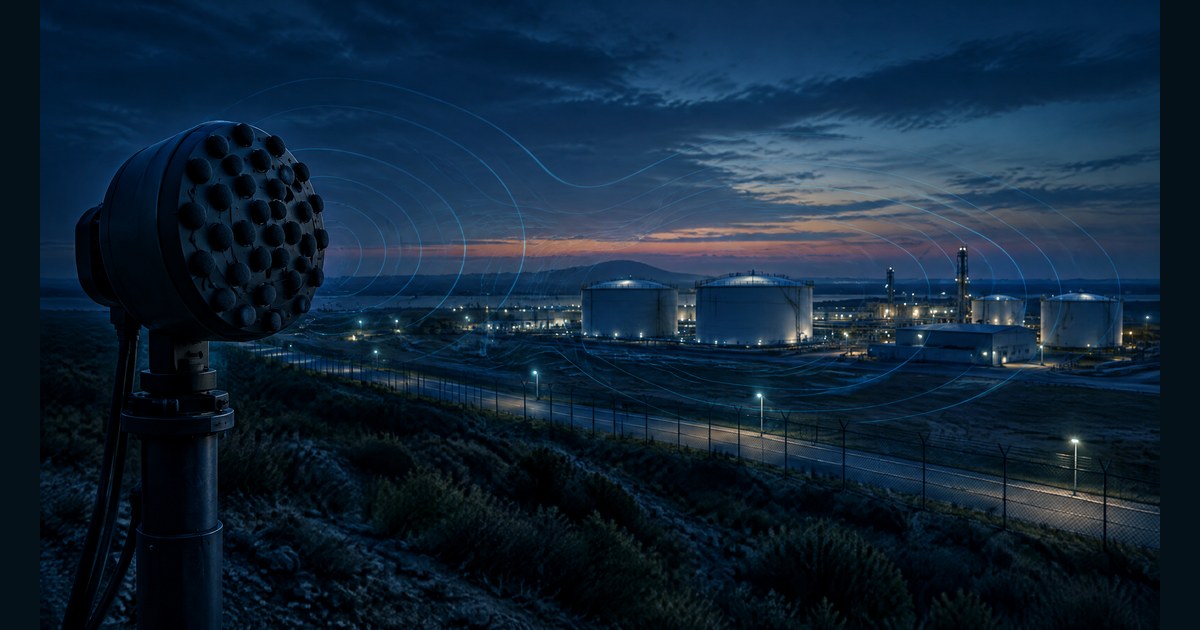
A civil buyer should treat acoustic sensing as an evidence source for reviewing a possible drone event—not as proof of identity, authorization, or a reason for automatic enforcement.
Start with an observation question, not a threat label
A procurement team should first define the decision that the observation is meant to support. CISA recommends setting detection requirements around the threat, the facility’s location and layout, the surrounding airspace, existing security protocols, and available resources. That approach prevents a broad promise such as “detect every drone” from becoming the acceptance criterion.
Define what a useful event record contains
A useful record may include the event time, sensor or node that produced it, a confidence or quality indicator, an estimated bearing when available, the relevant sound features, and links to approved corroborating evidence. It should also show whether the event was reviewed, what alternative explanations were considered, and who made the disposition. These fields turn a signal into an auditable observation without claiming more than the sensor measured.
Separate detection, direction, classification, and identity
A microphone array may detect a sound pattern and, when several sensors are used, provide rough directional context. The UK Department for Transport and Maritime and Coastguard Agency describe these as distinct strengths and limitations of acoustic detection. A candidate drone-like sound is not automatically a precise track, a model identification, an operator location, or proof that a flight is unauthorized. Remote ID, visual evidence, airspace records, and responsible authorities address different questions.
Build verification around independent evidence
The civil use case is strongest when acoustic sensing is one input in a reviewable workflow. CISA describes site-appropriate detection and integration into existing security plans as part of a layered approach. The aim is not to make every alert more dramatic. It is to make the next decision better supported.
Use corroboration to test a candidate event
For an illustrative example, a facility might receive a short acoustic alert near a perimeter. The operator could compare its time and bearing with camera footage, approved airspace or flight records, access logs, and another available sensor. If the sources agree, the record can be escalated for the site’s defined review. If they disagree, the correct outcome may be “unresolved” rather than “confirmed drone.” This example is a workflow illustration, not a SonicVast performance or customer result.
Record uncertainty instead of hiding it
Wind, machinery, traffic, marine engines, rain, buildings, and other sources can change the acoustic background. The UK guidance specifically notes that range depends on microphone sensitivity, how noisy the drone is, and whether motor sound rises above other noise. A 2024 study in Electronics likewise found that distance, attenuation, training data, wind, and rain can affect detection performance. A buyer should therefore request evidence from representative site conditions and preserve the uncertainty attached to each event.
Turn verified observations into a civil decision path
Verification has value only if people know what to do with the result. CISA’s suspicious-UAS guidance directs infrastructure stakeholders to understand routine activity, recognize suspicious indicators, determine an appropriate response, and engage law enforcement when necessary. The system should support those responsibilities rather than silently convert an alert into an enforcement instruction.
Maintain a routine-activity baseline
A site should document expected drone work, maintenance flights, nearby operations, recurring machinery noise, and normal environmental conditions through its approved procedures. That baseline helps operators distinguish a new observation from a familiar one. It also protects legitimate users from being treated as suspicious simply because a sensor detected sound in the area.
Use human review and proportionate escalation
A sensible workflow can move from alert, to operator review, to corroboration, to notification of the accountable site or public authority. The escalation rule should state what evidence is sufficient for each step and what remains unknown. Any response that affects people, aircraft, communications, or operations requires separate legal, safety, and authority checks; acoustic sensing itself does not grant response authority.
Write procurement requirements around evidence quality
A buyer should evaluate the complete observation chain rather than a sensor label or a headline range. CISA and UK government guidance both emphasize matching the technology to the site and the anticipated threat, while the UK guidance recommends checking integration, performance evidence, and operational consequences before purchase.
Ask for site-relevant validation
Request test conditions that resemble the intended site: typical background noise, weather, structures, expected drone classes, and the distances that matter to the decision timeline. Ask how the system records false alerts, missed observations, library coverage, model updates, and changes in the acoustic environment. Do not convert results from a different site into a guaranteed local range or accuracy.
Check integration and accountability requirements
Confirm how timestamps, event identifiers, sensor health, confidence information, and review outcomes move into the existing security or command system. Check power, networking, storage, access control, retention, privacy, and cybersecurity requirements with the responsible teams. The UK guidance also warns that new solutions can affect existing critical systems and recommends in-situ integration testing. These questions belong in the statement of work and acceptance evidence.
Define the evidence package before selecting the sensor
Before requesting a quotation or pilot, write one sample event record and one escalation flow for your site. Then ask suppliers to demonstrate how their acoustic system produces the record, handles uncertain or conflicting evidence, integrates with approved systems, and supports review. A project that cannot explain those steps is not ready to evaluate a detection number.
Discuss your projectAcoustic performance depends on site conditions, sensor configuration, target sound, environmental noise, training data, and system integration. This article does not establish a universal detection range, accuracy, certification, availability, or response authority for any product.